Wrong Again!

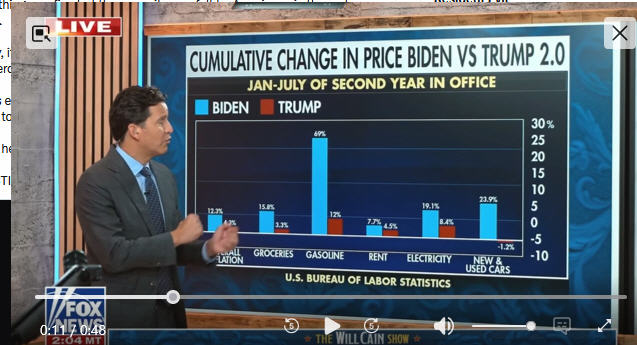
How many times do the experts have to be wrong before we ignore them? Remember the predictions that the Trump tariffs would add to inflation? Well, the numbers tell a different story.

On Wednesday, The Conservative Treehouse reported:

The Bureau of Labor and Statistics (BLS) released the December price information on Tuesday 1/13/26 [DATA HERE].  Overall, the topline inflation number is moderate at 2.7% much lower than economists projected.

However, that’s not the only important element.  To get an understanding of the impact from tariffs to imported consumer goods, you can look at TABLE-2 [DATA HERE].  As you skim the categories we import the most, electronics, television, sporting goods, apparel, shoes, tools, furniture, etc. what you will note is that the prices are stable with negligible inflation impact noted.

What this means is that tariffs are not creating any upward price pressure on the imported good.  The December ’25 imported good prices are stable despite massive tariffs applied in the second and third quarter of 2025.  As expected, based on history from 2018/2019, the exporting nation (and company) are absorbing most of the wholesale price increased due to tariffs.

The imported goods are reaching the consumer with no substantively changed price.  Some domestically generated goods (food and housing) are still driving the overall inflation number, particularly in the year-over-year calculation, but no substantive price pressure is coming from the import sector.

Export dependent nations are squeezing their own productivity, their governments are subsidizing the critical industries, and the tariffs are being absorbed before the products leave the docks.   This is the USA “rust belt” in reverse.  The same scenario played out in the USA for decades as domestic manufacturers tried to retain U.S. industry.  Now the foreign countries are experiencing their own economic squeeze.

This is part of the inflation table:

The article concludes:

Having gaslit the American electorate over the issues of Joe Biden’s economic/energy policy which created record inflation, the same media who ran cover for Joe Biden then switched during the Trump administration to calling the subsequent high costs an “affordability” crisis.

In essence, Biden’s economic, energy and monetary policies drove 2021/2022 inflation to record levels, this made all prices rise massively. Those high prices are now the “affordability problem” all U.S. consumers are dealing with.

When will we learn not to pay attention to the ‘experts’?

Positive Changes In Healthcare Costs

On Friday, The Daily Signal posted an article about solving the rapidly rising cost of healthcare in America.

The article reports:

Americans grappling with affordability just got a helpful boost from the Trump administration, which on Friday announced a new push to reduce health care costs. 

The move helps patients get health care prices upfront rather than astronomically high surprise bills later.

The new Transparency in Coverage (TiC) proposed rule will improve data structure, reduce unnecessary file size and increase usability. This will make transparency easier to analyze and more accessible to employers, researchers and innovators working to lower health care costs. 

By receiving prices upfront in a clear, easy-to-use format, Americans can shop around for the best provider at the lowest cost—driving more competition and empowering patients. Friday’s move was announced jointly by the Department of Health and Human Services, Centers for Medicare & Medicaid Services, Department of Labor, and Treasury Department.

President Donald Trump already fought hard in his first term to improve health care price transparency, and Friday’s announcement continues that momentum which continued in Trump’s February executive order.

In December 2020, Trump also signed the No Surprises Act, meant to provide patients detailed upfront price information about their care. But the Biden administration delayed implementing these policies, and the American people never saw the full benefit of price transparency.

Additionally, the Consolidated Appropriations Act of 2021 requires insurance companies and brokers to reveal all historical claims data and broker fees while also removing gag clauses. Hospitals must not surprise patients with bills after insurance companies refuse to pay more.

The article includes the following graph:

The article notes:

There’s a simple reason health care prices skyrocket above overall inflation: no free and fair competition. Costs for hospital services in particular have seen the highest rates of inflation among major U.S. consumer goods and services, per economist Mark J. Perry.  

Notice that college tuition has also gone up faster than inflation. I think that if we could get the government out of healthcare and out of student loans, the price of healthcare and of college would go down.

The Cost Of Thanksgiving

On Saturday, Breitbart posted an article about the cost of celebrating Thanksgiving this year.

The article reports:

The cost of a traditional Thanksgiving meal is down sharply this year, falling to the lowest price since 2021, according to the American Farm Bureau.

The farm bureau’s 40th annual survey found that a classic Thanksgiving dinner for 10 people will cost $55.18, down five percent from last year.

Since 1986, volunteers across all 50 states and Puerto Rico have been organized by the American Farm Bureau (AFB) to record local prices for turkey, cubed stuffing, sweet potatoes, dinner rolls, frozen peas, fresh cranberries, celery, carrots, pumpkin pie mix and crusts, whipping cream and whole milk.

Prices soared during the presidency of Joe Biden, with inflation rising to the worst pace in forty years. The price of a classic Thankgiving meal surged 14 percent in 2021, Biden’s first year in office, hitting a then-record high of $53.31.

Despite the administration’s insistence that the price increases were “transitory” or the result of a temporary supply shock, the following year what came to be called Bidenflation was even worse. The price of a Thanksgiving meal jumped another 20 percent, skyrocketing to $64.05.

By Biden’s final Thanksigiving, the price of a traditional family holiday meal was 24 percent higher than it was when he took office.

The article concludes:

The decline in price vindicates President Trump’s recent claims about the Thanksgiving meal becoming more affordable for American families. The decline is all the more notable because it defies predictions that President Trump’s trade and immigration policies would drive prices up.

I can guarantee that if the Democrats gain control of either Congress of the White House in the coming years, inflation will rear its ugly head again. Although President Trump and Congress have not yet been able to cut spending as much as I would like, I believe that they will continue to move in that direction in the coming months. Cutting government spending is the sensible way to deal with inflation.

The Trump Economy

Periodically, I watch television news shows with economic ‘experts’ that have Trump Derangement Syndrome. I watched one on Saturday. They were complaining about inflation and affordability under the Trump administration. Really? A dozen basic Grade A large eggs at Harris Teeter is $2.59. The average retail price of a dozen eggs in the U.S. was $4.953 in January 2025. Inflation? In January 2025, the average price for a gallon of milk was approximately $4.87. The current price at Harris Teeter is $2.49 a gallon. In January 2025, the average price for regular gasoline was $3.08 per gallon. In eastern North Carolina, the current price is $2.59. If that is inflation, can we please have more of it!

On Monday, Victor David Hanson posted an article at American Greatness about the impact of the Trump economy. He noted that President Trump is not getting credit for the improvement in the economy that his policies have created.

The article notes:

The current economic indicators, at least those attributable to the 10-month Trump administration, are strong.

Fourth-quarter GDP is estimated to grow between 2.7 and 4 percent, the robust latter figure according to the Atlanta Federal Reserve Bank.

Inflation from June to August ranged from 2.7 to 2.9 percent, significantly lower than the 5 percent annual average during Biden’s 2021-2025 term.

Gas prices now average $2.98 per gallon, compared to $3.46, the average cost during Biden’s four years.

In less than a year, Trump has increased oil production by one million barrels per day.

Unemployment in the second quarter of 2025 stayed steady at 4.2 percent, roughly the same as the 4.1 percent during the final month of Biden’s tenure.

The stock market has reached an all-time high. Foreign investment is pegged at record levels. Tariff revenue could reach $400 billion by the end of the year—vastly outpacing the $77 billion in all of last year, 2024.

In other words, the economy is rolling along.

To the extent the Trump administration has a problem with the economy, however, it is threefold.

One is public perceptions.

…Second, the administration and Republicans have rarely compared their own economic record with that of Biden’s dismal four years to explain how there is improvement in almost every area.

…Third, most of Trump’s key economic initiatives are long-term and will not be fully realized by the end of 2025 or in early to mid-2026.

The article concludes:

If the shutdown were quickly ended and the Fed steadily lowered interest rates by at least 2 percent, and if the media would just report the news rather than seek to create realities by falsification, then a strong, and soon to be even more robust, economy would likely determine the 2026 midterms, and with it the Trump presidency.

So the current Trump economy is in a race of sorts. The challenge is not nature, not war, not the unpredictable, and certainly not wrong economic policies and agendas.

The rub is a failure to highlight the radical improvement from the Biden years in just a few months, to explain that novel policies are already in motion that may revolutionize the American economy within a year, and to recognize the destructive efforts of partisan shutdowns, partisan high interest rates, and partisan hysterical doom and gloom fake news.

If Trump meets these challenges, voters could see the economy take off as never before in 2026—just in time for the midterms.

I think that is what the Democrats are trying to avoid!

Why I Don’t Trust The ‘Experts’

On Thursday, Breitbart posted an article about the impact of President Trump’s tariffs. Generally speaking, the results of the tariffs is the exact opposite of what the experts predicted. We really don’t know if the predictions were so dire because President Trump was involved or if the experts really believed what they were writing.

The article reports:

In yesterday’s Breitbart Business Digest, we examined a new working paper from Jared Bernstein and Daniel Posthumus that documented the decline of U.S. manufacturing employment, particularly the devastating 2000-2010 “China Shock” period when 5.7 million factory jobs disappeared.

While the authors called this period “destructive” and urged preventing future shocks, they insisted that “sweeping” tariffs were not the right policy. Their reasoning was undermined by a significant contradiction: they claim tariffs would disrupt American manufacturing because we’re too dependent on foreign inputs, yet they simultaneously advocate for subsidies for sectors vulnerable to foreign export controls. They’ve essentially documented that our industrial base is dangerously hollowed out while arguing we’re too dependent to fix it.

As we explained, the real-world evidence further undermines their anti-tariff position. Despite President Donald Trump’s sweeping tariffs imposed in April 2025, the predicted “tarifflation” never materialized. Prices on tariffed imports haven’t risen as economists predicted. In fact, prices on non-tariffed domestic goods rose more than tariffed imports, while domestic goods competing with tariffed imports are actually down since Liberation Day. There certainly has not been any widespread inflation created by tariffs. The central economic case against tariffs—that they raise consumer prices—has collapsed in the face of actual data.

What we’re actually seeing is something economists have long theorized as “optimal tariff theory.“ A country with a globally dominant consumer market can employ tariffs to force foreign manufacturers to lower prices to maintain their exports. It can also successfully pressure other countries to reduce their own import barriers by threatening even higher tariffs. Finally, the household sector can force a redistribution from the corporate sector by refusing to accept the pass-through of tariff costs.

The article concludes:

Meanwhile, Biden’s subsidy approach—implicitly endorsed by the paper—produced billions in spending, out-of-control inflation, a brief construction boom, and then declining factory employment.

The paper warns that tariffs raise input costs, but we’re currently so dependent on imported inputs that we’re vulnerable to devastating supply cutoffs. The paper warns about retaliation, but sweeping tariffs have proven less provocative than thought, and there’s every reason to believe that targeting other countries’ strategic sectors would ignite backlash. The paper warns about price increases, but the data shows prices on tariffed goods rising less than non-tariffed ones.

At every turn, the real-world evidence contradicts the theoretical objections. An open-minded reader of the paper will come away grateful American’s voted for Trump’s trade policies rather than the industrial policy favored by Bernstein, Postuhumus, and the Biden administration.

I guess the businessman in the White House had a better understanding of economics than the experts.

Wages And Inflation

The problem with inflation is that even after the rate of inflation is finally brought under control, the prices never seem to go back down. This is what many Americans are experiencing in the early months of the Trump administration. Gasoline prices at the pump and eggs are the only noticeable reduced prices we have actually seen.

On Tuesday, Zero Hedge posted the following chart:

So if you are wondering why your grocery bill looks more like what used to be a car payment, now you know why.

The article concludes:

The -0.7% drop in real hourly earnings since January 2021 highlights a fundamental truth: even small mismatches between wage growth and inflation, when sustained over years, can erode financial stability for everyday Americans.

There is reason for optimism, though. If the current trend continues, with inflation stable and wage growth healthy, real wages could soon surpass pre-crisis levels. But that path remains vulnerable to shifts in inflation or labor market conditions.

For a longer-term look at how wages and inflation have tracked historically, check out the data from 2007 in this USAFacts visualization on Voronoi.


Rewriting History For Political Purposes

The problem with inflation is that once the prices go up, they don’t always come back down to where they were. Although gas at the pump is comfortably low, a lot of other things that became more expensive under the Biden administration’s runaway inflation have not yet come down to their previous level. Americans are still feeling the impact of the Biden administration’s economic policies. It is wise to keep in mind that President Trump has only been in office since the end of January, and Rome wasn’t built in a day.

On Thursday, The Daily Caller posted an article giving us a preview of the rhetoric we will encounter in the run up to the mid-term elections.

The article reports:

CNN senior political commentator Scott Jennings reminded former Democratic New York mayoral candidate Michael Blake on Thursday that the affordability crisis began under former President Joe Biden.

Blake claimed that Democratic Iowa state Sen.-elect Catelin Drey defeated the Republican incumbent in the state’s special election because Republicans “cannot articulate a policy agenda” to make Americans’ lives more affordable. Jennings mocked Democrats for sounding the alarm on the affordability crisis when inflation soared to record levels under Biden.

“Well it doesn’t make me very nervous to hear Democrats, with a straight face, looking into a television camera and saying ‘boy, how did we get to this affordability crisis’ given that we all know how we got there over the last four years,” Jennings said.

When Blake blamed President Donald Trump for the inflation under Biden, Jennings said, “So you’re saying we had no affordability crisis during the Biden years? Where did the inflation come from?”

The article notes:

Prices rose more than 20% during Biden’s term in office, jumping from 1.4% at the beginning of Biden’s presidency to its peak of 9.1% in June 2022, the highest annual rate since 1981. Inflation fell below 3% for the first time in two years in July 2024.

Many economists blamed the soaring inflation on the Biden administration spending $1.9 trillion and $750 billion on the American Rescue Plan and the Inflation Reduction Act, which Biden signed into law early in his term.

The article concludes:

Jennings said that Democrats tend to perform better in special elections, which contributed to Drey’s victory.

“It’s absolutely true. Democrats now have more voters who are regular voters in non-traditional elections. Specials, off-year, what have you. That’s absolutely true, and so you’ve seen a pattern of Democrats doing better in these elections that don’t happen outside of a regular occurrence,” Jennings added.

It will be interesting to see where the economy is by next November, and if voters want to go back to the inflation numbers we had in the Biden administration.

When The Facts Disprove The Narrative

When President Trump took office, he instituted policies to level the playing field in trading between America and other countries. The tariff system that was in Place when President Trump took office was not beneficial to America. The mainstream media immediately began clutching their pearls and claiming that the tariffs were going to send inflation through the roof. Funny, they never said much about inflation going through the roof when President Biden was in office.

On August 17, Zero Hedge reported the following:

Update (1020ET): President Trump rage-posted about the lack of inflation amid all the tariff-fearmongering…

Trillions of Dollars are being taken in on Tariffs, which has been incredible for our Country, its Stock Market, its General Wealth, and just about everything else.

It has been proven, that even at this late stage, Tariffs have not caused Inflation, or any other problems for Country, other than massive amounts of CASH pouring into our Treasury’s coffers.

Also, it has been shown that, for the most part, Consumers aren’t even paying these Tariffs, it is mostly Companies and Governments, many of them Foreign, picking up the tabs. “

Then took direct aim at Goldman Sachs:

“But David Solomon and Goldman Sachs refuse to give credit where credit is due.

They made a bad prediction a long time ago on both the Market repercussion and the Tariffs themselves, and they were wrong, just like they are wrong about so much else.

I think that David should go out and get himself a new Economist or, maybe, he ought to just focus on being a DJ, and not bother running a major Financial Institution.”

Ouch!

The article includes a number of graphs explaining exactly what items have increased in price and by how much. Please follow the link to read the article.

One Unusual Economic Indicator

There were hysterics when President Trump took office and instituted tariffs on countries that had instituted tariffs on America for years. The tariffs would cause inflation (in 2022 inflation peaked at 9 percent in June). Inflation is now at roughly 2.3 percent. The President was blamed for the rapidly rising price of eggs (after the Biden administration found a reason to kill millions of chickens). Many restaurants added a surcharge to egg dishes to compensate for the high price of eggs. Waffle House was one of those restaurants.

On Wednesday, PJ Media reported:

Waffle House is a pillar of American culture. A refuge for the hungover, an arena for the absurd, and a beacon for those on a budget, Waffle House delivers on the American melting pot promise — one that is scattered, smothered, and covered. When the chain slapped a 50-cent surcharge on each egg (which are freshly cracked to order, by the way) in February 2025, it echoed the supply and demand quagmire every American felt at the grocery store.

Brooke Rollins, President Trump’s Secretary of Agriculture, told Fox Business:

When President Trump entered office, the cost of eggs was at a record high, seriously denting consumers’ wallets after years of awful inflation. On my first day as Secretary, we got to work to implement a five-pronged strategy to improve biosecurity on the farm and lower egg prices on grocery store shelves. The plan has worked, and families are seeing relief with egg prices driving food deflation in the April Consumer Price Index.

The plan has indeed worked. Yesterday, Waffle House announced the repeal of the surcharge on X.

The article concludes:

To celebrate the Trump administration’s success, I encourage all red-blooded Americans embarking on the Great American Road Trip this Fourth of July weekend to park under the vivid yellow and black waffle sign and order to their heart’s content. After all, this holiday is all about freedom from tyranny, economic opportunity, and the right to peaceably assemble. Unless you order cheese in your grits, because then there will be fireworks.

Thanks to President Trump, consumer costs are starting to come down, and inflation is stabilizing. To the surprise of no one with a functioning brain, our economy does better under a president who knows what he’s doing.

The Waffle House menu is also used as a gauge to the severity of a disaster by Federal Emergency Management Agency (FEMA).

This is the chart used:

The Trump Presidency And Your Wallet

On Friday, Breitbart posted an article about the impact of the Trump economy on personal income.

The article reports:

Americans’ personal income in the first four months of 2025 is “almost triple the expectations,” making for a “great” start of the year, CNBC’s Rick Santelli exclaimed on the air, urging viewers to “give credit” to the Trump administration.

The longtime CNBC editor revealed the “powerful” numbers on Friday morning, sharing that personal income increased 0.8 percent in April. 

“This is a great four-month start to any year,” he said.

“When you look at income, for the first four months of the year, they’re powerful numbers — up 0.6 in January, up 0.7 in February, up 0.5 last month, up 0.8 this month. This is a great four-month start to any year.”

Santelli also lauded the fact that 0.8 percent is the “strongest” income month-over-month jump since May 2021, when it was 1.9 percent.

He went on to lament how the Trump administration is “criticized for just about anything under the sun,” despite the president’s “transparency” and positive accomplishments.

The article concludes:

“This administration is criticized for just about anything under the sun. I’ve never ever in my lifetime had glimpses into the politics of an administration in the form of transparency like this one. Why don’t we… give credit where credit is due?”

Part of the reason for the increase in consumer spending power is the lowering of the rate of inflation.

On Friday, The Daily Caller reported:

President Donald Trump achieved an economic victory after a prominent inflation reading dropped to its lowest reading in four years.

The personal consumption expenditures (PCE) index, one of The Federal Reserve’s primary inflation measurement models, showed a decrease in inflation in April 2025 to a level not seen since March 2021, according to a Commerce Department report.

The index, which measures goods and services spending, showed an increase of $47.8 billion, or 0.2%, with major gains in housing and health care the report stated.

In April, the PCE and Core PCE, which measures without noting volatile food and energy prices, both rose by only 0.1% from the previous month, according to the report. The consumer price index also indicated a drop in inflation to a four-year low as well, with a seasonal adjusted 0.2% in April, as reported by the Daily Caller News Foundation earlier this month.

This is the economic relief Americans needed. If Congress would just pass the spending cuts recommended by the Department of Government Efficiency (DOGE), Americans would enjoy more financial freedom.

Views On The Trump Economy Are Slowly Changing

The Democrat rant that ‘the economic sky is falling’ seems to have fallen on deaf ears. The economy is slowly coming back after four years of inflation and slow job growth. The workforce participation rate is steady, but climbing slightly, and inflation is somewhat under control. We can all rejoice in the significant drop in gasoline prices.

On May 27th, CNBC posted the following headline:

Consumer confidence for May was much stronger than expected on optimism for trade deals

I love how when a Republican is in the White House, good news is always unexpected.

The article reports:

Consumer optimism got a much-needed boost in May on hopes for trade pace between the U.S. and China, according to a survey Tuesday.

The Conference Board’s Consumer Confidence Index leaped to 98.0, a 12.3-point increase from April and much better than the Dow Jones consensus estimate for 86.0.

Much of the positive sentiment, according to board officials, came from developments in the U.S.-China trade impasse, most notably President Donald Trump’s halting of the most severe tariffs on May 12.

“The rebound was already visible before the May 12 US-China trade deal but gained momentum afterwards,” said Stephanie Guichard, the Conference Board’s senior economist for global indicators.

May’s rebound followed five straight months of declines. Consumers and investors had grown sour on economic prospects amid the intensifying trade war that Trump has launched against U.S. global trading partners, with China a particular target.

I think all of us consumers feel optimistic when we don’t have to mortgage our house to buy a steak or fill up our gas tank.

The article concludes:

The present situation index increased to 135.9, up 4.8 points, and the expectations index posted a major surge to 72.8, a 17.4 point gain. Investors also showed more optimism, with 44% now expecting stocks to be higher over the next 12 months, up 6.4 percentage points from April.

Views on the labor market also improved, with 19.2% of respondents expecting more jobs to be available in the next six months, compared to 13.9% in April. At the same time, 26.6% expect fewer jobs, down from 32.4%.

Survey officials said sentiment improved across age, income and political affiliation, though noting that the “strongest improvements” came from Republicans.

Let’s hope Congress can pass laws that keep this going.

The Latest Inflation Numbers

On Thursday, The Epoch Times posted an article about the latest inflation numbers.

The article reports:

Falling energy prices helped U.S. inflation cool in March, slowing to its lowest level in six months.

According to the Bureau of Labor Statistics, the annual inflation rate declined to 2.4 percent from 2.8 percent in February, the lowest reading since September.

Economists had penciled in a reading of 2.6 percent.

On a monthly basis, the consumer price index (CPI) fell by a better-than-expected 0.1 percent.

Core inflation, which excludes volatile energy and food prices, also eased to 2.8 percent. This is the first time that annual core inflation has been below 3 percent since early 2021.

The core CPI increased by 0.1 percent month over month, below the consensus forecast of 0.3 percent.

The article concludes:

Minutes from the March Federal Open Market Committee policy meeting revealed that policymakers are worried about tariff-driven inflation risks.

“Participants assessed that uncertainty around the economic outlook had increased, with almost all participants viewing risks to inflation as tilted to the upside and risks to employment as tilted to the downside,” the meeting summary, released on April 9, reads.

However, based on President Donald Trump’s recent decision to impose a 90-day pause on reciprocal tariffs, many doom-and-gloom projections “can be dialed down a bit,” according to Mark Hamrick, senior economic analyst at Bankrate.

“The so-called 90-day pause doesn’t remove all uncertainty or potential negative impacts but is helpful,” Hamrick said in a statement to The Epoch Times.

“Fears about a huge pickup in inflation and near-term recession risks can be dialed down a bit.”

The next major inflation report will be the March producer price index, which measures the prices businesses pay for goods and services. Economists pay attention to this gauge as it can serve as a precursor to future inflation trends.

Energy prices are one of the things that fuel inflation. As American becomes energy independent again, the cost of crude oil will continue to drop, gasoline prices will continue to drop, and inflation will gradually come down. Even if OPEC cuts production in an attempt to keep oil prices high, it is quite possible that America will be able to make up for the cut. At that point, OPEC may not want to continue losing revenue because of their production cuts. We are in a very interesting time economically right now. Stay out of debt and pay your bills on time!

This Has Not Been Widely Reported

On March 7th, NewsMax posted an article about the February Jobs Report. The media is ignoring the shift from foreign-born workers to American workers. That is good news.

The article reports:

President Trump praised the February jobs report for indicating that American-born workers gained 284,000 more jobs, while jobs held by foreign-born workers contracted by 87,000, Brietbart reports.

“Big gains for native-born Americans,” Trump told reporters in the Oval Office Friday. “For the first time in 15 months, the job gains for native-born Americans, people born in America, exceeded job gains for migrant and foreign-born workers.”

The article reminds us:

During the Biden administration, when inflation rose a cumulative 21.3%, Americans lost earning power in the labor in the labor and housing markets, as well as workplace productivity and training.

White-collar jobs and factory jobs were outsourced, while local communities became unstable due to progressive policies such as Defund the Police and Diversity, Equity and Inclusion, says Steve Camarota, a researcher at the Center for Immigration Studies.

Further, as expanding blocs of migrants-turned-ethnic-voters demanded benefits, native-born Americans lost political power, Camaraota says.

There is room for more improvement for native-born Americans in the labor market, as current data shows that the share of Americans with jobs remains at historic lows.

For instance, Camarota notes, the labor force participation of U.S.-born men without a bachelor’s degree between the ages of 18 and 64 is 75.6%, down from 80.6% in 2006 and nearly 90% in the 1960s, according to data from the U.S. Bureau of Labor Statistics.

Unfortunately, the Workforce Participation Rate has continued to drop slightly since September of last year, but hopefully that can be turned around quickly.

The Media Said Nothing!

This was posted at Storm’n Norm’n’s blog. I have not idea who wrote it, but it is fantastic!

YOU SAID NOTHING

To whomever wrote this- Well said!! 

When millions of illegals were ushered in through the southern border, you said nothing! 

When they abandoned millions of dollars worth of military equipment in Afghanistan, you said nothing! 

When they flaunted a two tier justice system, one for them and one for everyone else, you said nothing!

When they covered up the Hunter Biden laptop, you said nothing!

When they passed a trillion dollar infrastructure bill that failed miserably, you said nothing! 

When they forced Americans to take an untested vaccine, you said nothing! 

When inflation crushed the middle class, you said nothing!

When they sent billions to Ukraine, you said nothing! 

When chemicals polluted the water in East Palestine, Ohio and they ignored it, you said nothing! 

When Americans were raped, robbed and murdered by illegals, you said nothing!

When they implanted Kamala as the presidential nominee without getting a single vote, you said nothing! 

When billionaire and anti American George Soros funded dozens of AG elections, you said nothing! 

When they turned our classrooms into liberal indoctrination camps, you said nothing! 

When they spent our tax dollars on inmates transition surgeries, you said nothing! 

When they gave the citizens of Hawaii $700 after losing their entire city, you said nothing! 

When they gave free money, food and 5 star hotel lodging to illegals, you said nothing! 

When they came for our free speech, you said nothing! 

When DEI weakened the military and put our national security at risk, you said nothing! 

When they colluded with the media to push false reports, you said nothing!

When it was open season on law enforcement and criminals reigned, you said nothing! 

When they weaponized the justice system to take down their political opponents, you said nothing!

When the bureaucrats took over the White House and ran the government, you said nothing! 

When they covered up Biden’s rapidly declining mental state, you said nothing! 

When they groomed our kids in school and hid it from the parents, you said nothing! 

When the drug epidemic exploded and 1000s died annually, you said nothing! 

When they accosted the jews on their campuses, you said nothing!

When they weaponized the intelligence agencies against Americans, you said nothing! 

When they spent $45 million dollars on “Diversity and Inclusion” scholarships in Burma, you said nothing!

When they let men play women’s sports, you said nothing! 

When they chanted “Death to America” and burned our flag, you said nothing! 

When they shutdown our energy production, and emboldened Russia, you said nothing! 

When the crime rates in American cities increased, you said nothing!

While thousands of veterans were left to sleep out on the streets, you said nothing!

When 300,000 migrant children went missing and no one had a clue, you said nothing!

When Joe Biden pardoned his friends and family, you said nothing!

When they sent billions to Iran and inadvertently funded Hamas, you said nothing! 

When men were celebrated for pretending to be women, you said nothing! 

When they let a Chinese Spy Ballon sail across America, you said nothing! 

When 50 intelligence agents all lied to bury the Hunter Biden laptop as Russian disinformation, you said nothing! 

When American citizens were taken hostage and held for a year in Gaza, you said nothing! 

When Facebook admitted, they conspired with the Biden administration to censor the truth, you said nothing!

When they cleaned the streets of San Francisco for the communist Chinese President Xi Jinping, you said nothing!

When Fauci and the WHO peddled covid 19 virus lies and covered up the origins, you said nothing! 

When they sealed the January 6th commission files or “lost them”, you said nothing! 

You saw the corruption, the lies, the bad policy, the anti American agenda and said nothing, so please spare us your crocodile tears and all your fake hysteria now. For 4 years you watched this country get run into the ground on all fronts and you said nothing!

Now, it’s our turn!!!! 🇺🇸🙏🏼🏆

American Voters Are Smarter Than Some People Think They Are

Politico just lost a lost of money it was getting from the United States Agency for International Development (USAID). Is it possible that now their reporting will be more balanced? The article below might be an indication of that!

On Tuesday, Politico posted an article about the gap between the numbers the government was posting about the economy and the public’s perception of the economy during the run-up to the 2024 election.

The article reports:

Before the presidential election, many Democrats were puzzled by the seeming disconnect between “economic reality” as reflected in various government statistics and the public’s perceptions of the economy on the ground. Many in Washington bristled at the public’s failure to register how strong the economy really was. They charged that right-wing echo chambers were conning voters into believing entirely preposterous narratives about America’s decline.

What they rarely considered was whether something else might be responsible for the disconnect — whether, for instance, government statistics were fundamentally flawed. What if the numbers supporting the case for broad-based prosperity were themselves misrepresentations? What if, in fact, darker assessments of the economy were more authentically tethered to reality?

The discrepancy between what Americans were dealing with economically and what the government was telling them may not have been intentional, but it was hidden in the way the government statistics were calculated.

The article explains:

I don’t believe those who went into this past election taking pride in the unemployment numbers understood that the near-record low unemployment figures — the figure was a mere 4.2 percent in November — counted homeless people doing occasional work as “employed.” But the implications are powerful. If you filter the statistic to include as unemployed people who can’t find anything but part-time work or who make a poverty wage (roughly $25,000), the percentage is actually 23.7 percent. In other words, nearly one of every four workers is functionally unemployed in America today — hardly something to celebrate.

The article also notes the problem with the way the inflation numbers were calculated:

But the CPI also perceives reality through a very rosy looking glass. Those with modest incomes purchase only a fraction of the 80,000 goods the CPI tracks, spending a much greater share of their earnings on basics like groceries, health care and rent. And that, of course, affects the overall figure: If prices for eggs, insurance premiums and studio apartment leases rise at a faster clip than those of luxury goods and second homes, the CPI underestimates the impact of inflation on the bulk of Americans. That, of course, is exactly what has happened.

My colleagues and I have modeled an alternative indicator, one that excludes many of the items that only the well-off tend to purchase — and tend to have more stable prices over time — and focuses on the measurements of prices charged for basic necessities, the goods and services that lower- and middle-income families typically can’t avoid. Here again, the results reveal how the challenges facing those with more modest incomes are obscured by the numbers. Our alternative indicator reveals that, since 2001, the cost of living for Americans with modest incomes has risen 35 percent faster than the CPI. Put another way: The resources required simply to maintain the same working-class lifestyle over the last two decades have risen much more dramatically than we’ve been led to believe.

A good statistician can get statistics to say anything he wants them to say, but Americans are smart enough to look at how far their paychecks are going rather than believing all of the statistics.

A Review Of The Presidency Of Jimmy Carter

I will admit up front that I am not a fan of President Carter. His work with Habitat for Humanity was commendable, but his policies as President and meddling in foreign affairs after he left office were not.

On Sunday, The American Thinker posted an article about President Carter’s legacy.

The article reports:

I grew up in a Democrat household, and we all wanted to like Carter. Nevertheless, by the end of his term, my parents disliked him intensely. They were right to do so because some of his decisions were dreadful at the time, and some had terrible consequences for America:

He pardoned draft evaders, which my father, a veteran of two wars, found unforgivable.

He gave away the Panama Canal. Now that China has a foothold in Latin America, its very presence threatens our trade and our national security.

He created the Department of Education, which my father, a teacher, instantly realized was going to be a boondoggle and a disaster that wouldn’t raise up teachers but would bring down education. Dad was right.

He presided over inflation, stagflation, and the energy crisis. The latter was partly a result of his policies, but even if it hadn’t been, these economic crises happened on his watch, and he was stuck with them.

He was a dour, unpleasant person whose very presence was a drag on America. Americans disliked his moralizing from the White House. His very personality defined malaise.

The article concludes:

On the plus side, Carter did broker the Camp David Accords between Israel and Egypt, which have held up for a long time. However, my Dad (a really smart guy) recognized Carter’s nascent antisemitism, something that came into full flower after he left the White House. Even Jonathan Greenblatt, the leftist leader of the ADL, couldn’t tolerate Carter’s animus toward Israel, something that could only be driven by Jew hatred.

Also, after he left the White House, Carter never met a corrupt election he wasn’t willing to certify. Why? I have no idea. But I dislike him a great deal for that.

Ultimately, Carter was a guy who lived a life of personal rectitude (he had the same wife for almost 80 years, went to church, etc.), but he left the United States and the world in much worse shape than they were when he found them.

What Happens When You Elect Good Government

On Christmas Eve, The Epoch Times posted an article about Argentinian President Javier Milei’s first year in office. He definitely has moved Argentina in the right direction.

The article reports:

On his first anniversary as president of Argentina, Javier Milei announced the initial results of his relentless campaign to cut government spending, eliminate regulations, and pare back the country’s administrative state.

“Today, with pride and hope, I can tell you that we have passed the test of fire,” Milei told Argentinians last week. “We are leaving the desert, the recession is over, and the country has finally begun to grow.”

When Milei took office in November 2023, Argentina, once one of the world’s 10 richest countries, was in a dysfunctional state. Having defaulted on its sovereign debt three times since 2001, it was on track to do it again.

Its annual inflation rate was approaching 200 percent, its poverty rate was above 40 percent, its growth rate was negative 1.6 percent, its fiscal deficit was 15 percent of GDP, and it was running a chronic trade deficit.

Argentinians wanted change and voted the self-proclaimed libertarian into office with the largest majority a presidential candidate has received since free elections were reinstated in 1983, taking 55.7 percent of the vote over his opponent, incumbent economy minister Sergio Massa, who received 44.3 percent.

Over the past year, Milei eliminated 10 of Argentina’s 18 government ministries, capped the salaries of top bureaucrats, and fired 34,000 public employees, cutting government spending by 30 percent.

America is heading to the place Argentina was before President Milei took office. Hopefully, President Trump will get results similar to those of President Milei.

The article notes:

Upon taking office, Milei’s administration operated as if it were in a race against time, scrambling to deliver some sign of a brighter future before voters’ patience ran out.
During his first month in office, Milei issued a “mega-decree” that included 366 regulatory reforms, according to a report by Cato political analyst Ian Vasquez and Human Freedom Index co-author Guillermina Sutter Schneider.

By the end of his first year, that had climbed to 672 regulatory reforms enacted, along with the elimination of 331 regulations and modification of 341 others.

These included actions such as eliminating import licenses and lifting rent controls. These acts ultimately led to a 35 percent reduction in the price of home appliances and a 20 percent reduction in the cost of clothing, the authors write, as well as a sharp increase in available rental apartments in Buenos Aires that brought a significant drop in rent prices.

I hope the incoming Trump administration is taking notes.

What A Difference Leadership Makes

This is not an article about America–this is an article about Argentina. On Saturday, The Independent Sentinel posted an article about Argentina’s President Milei.

The article includes the following Tweet:

Wow.

Please follow the link to the article. There are some rough times ahead for Argentina as the President puts things in order, but the future looks bright. The poverty rate in Argentina initially went up, but now is moving down quickly. The country’s economy will contract this year, but is expected to grow 5 percent next year. President Milei has done amazing things.

What Are You Willing To Believe?

On Tuesday, The Media Research Center posted an article about a recent statement by Heather Long, a columnist for The Washington Post.

The article reports:

Washington Post columnist Heather Long decided to gaslight voters one more time before they head to the polls to decide who will run the White House for the next four years. “As Election Day arrives, the data is clear: Americans are better off economically than they were four years ago,” read Long’s ridiculous opening paragraph for her Nov. 4 item. She must have realized the insanity of her claim because she then resorted to telling voters they were better off whether they knew it or not: “I understand many people aren’t feeling it because of the inflation hangover that has left prices noticeably higher than they were in 2020. But it’s important to step back and assess the full picture.” It’s as if Long is trying her hardest to channel her inner Paul Krugman. 

The article includes the following screenshot:

The article concludes:

Ah, but how about that sexy stock market, says Long! “The stock market has gained about 75 percent since Oct. 30, 2020. (A record share of Americans — nearly 60 percent of households — have money in the market],” she wrote with glee. Not so fast. As Heritage Foundation Senior Research Associate Alexander Frei noted in an Oct. 31 column, “Inflation is also making stock markets appear stronger than they really are and cutting into returns for everyone, including those with retirement accounts.” In other words, as prices rise, “even significant returns lose their purchasing power.” Frie argued that now “[m]ore money is required to buy the same goods and services, eroding the real value of one’s gains. As everything becomes more expensive, higher earnings or investment returns don’t stretch as far, making it harder to keep up with the true cost of living.”

But Long was adamant that “looking at the full picture shows that most Americans are better off financially than they were four years ago.” But a Sept. 25 analysis by the Financial Health Network determined that “the majority of Americans are not financially healthy, with expenses outpacing income, little wiggle room to protect against financial shocks, and diminished hope for the future.”

Long is clearly trying to attempt a pathetic, last-minute effort to smear as much lipstick on the pig of the Biden-Harris economy as she can before Election Day closes out. She even undercut herself by conceding that most of her points matter “little to voters. And I get it. They are focused on high prices.” Uh, duh? 

The economy is bad. If people vote their pocketbooks, President Trump wins.

Finding Our Way Back

On Friday, USA Today posted an article about inflation and the impact it has had on the lower and middle classes in America.

The article notes:

Putting “fun” back into low- and middle-income Americans’ budgets could be years away with most of their income barely covering the surge in costs for bare necessities, economists said.

Even with annual inflation last month cooling to the lowest level since February 2021 and wages rising faster than inflation, low- and middle-income Americans are just barely covering their essentials, which include groceries, shelter, utilities and gasoline, economists say.

That’s because when inflation slows, it only means prices aren’t rising as quickly, not that prices are declining. So, Americans continue to pay higher prices for everyday needs.

Low- and middle-income Americans were hit disproportionately harder than their higher-income peers because essentials account for a larger share of their budgets, and their discretionary spending, or spending on nonessential items like dining out, vacations and entertainment, is only just recovering, economists say.

…Middle-income Americans’ purchasing power, after being sharply eroded during the 2021-2022 inflation shock, just recently moved above 2019 levels, according to the monthly Primerica Household Budget Index (HBI). HBI assesses whether families can get ahead financially or if they may fall behind based on the affordability of everyday necessities needed to manage their homes and changes in their earned income.

…Air conditioning, watering the garden and visiting family were “luxuries” Amy Aaroen, 63, cut back on last summer.

The article asks the question:

Will upcoming holiday spending be affected?

Low and middle-income consumers will probably still be bargain-hunting this holiday season, analysts said.

“We are continuing to see inflation’s impact on the middle-class consumer,” said Adam Davis, managing director at Wells Fargo Retail Finance. “Discretionary spending on larger ticket items is down, which could indicate holiday budgets may tighten, and certain consumers might even trade down on items, with many actively looking for bargains.”

Aaroen says that through belt-tightening during the year, “we’ve somehow managed to keep a budget that will probably not affect our coming holidays too much. We have 11 grandchildren and usually spend $25 to $30 on each of them. And we will probably this year as well. We may need to use the credit card though.”

And “yes, we will definitely see family for the holidays,” she said. “But not as often in between.”

Elections have consequences. If you want four more years of inflation and increased government spending, vote for Kamala Harris.

How To Get The Job Done

On Friday, Breitbart posted an article about the inflation rate in Argentina since President Javier Milei took office.

The article reports:

The National Institute of Statistics and Census of Argentina (INDEC) announced on Thursday that the country’s inflation rate for September was 3.5 percent.

September’s result marks the lowest inflation rate recorded in Argentina since November 2021 and is the result of President Javier Milei’s “shock therapy” economic measures that have steadily reduced inflation from 25.5 percent at the time he took office in December 2023 to September’s 3.5 percent.

Milei’s policies aim to overturn Argentina’s years-long economic crisis exacerbated under leftist governments, which dramatically worsened during the administration of Milei’s predecessor, socialist former President Alberto Fernández (2019-2023).

The article concludes:

Milei has insisted that his “zero deficit” fiscal goals for Argentina are “non-negotiable,” a pursuit he reiterated last week when he vetoed a university financing bill that the government branded as “irresponsible” and a danger to the nation’s fiscal balance. Milei reaffirmed that he would veto any bill that infringes upon fiscal balance. The veto was upheld by the Argentine Congress on Wednesday.

Milei’s policies, in addition to steadily reducing inflation over the past nine months from 25.5 percent in December 2023 to 3.5 percent in September, also allowed Argentina to experience its first Gross Domestic Product (GDP) surplus since 2008, overturning a 15 percent GDP deficit that the country faced at the time he took office in December.

America could learn a lot from what is happening in Argentina!

Conservative Replies to Debate Questions

Author: R. Alan Harrop, Ph.D.

I watched the Vice President candidate’s debate the other night and thought that J.D. Vance did a good job. The following are my answers to some of the critical issues that were raised in the debate.

Climate Change. The climate constantly changes. Always has; always will. The idea that the recent destructive hurricane, Helene, was caused by man-made climate change is pure ignorance and typical of the environmental extremists. Severe hurricanes have occurred as far back as records have been kept–long before man’s burning of fossil fuels could have caused them. The Left continues to spout the idea that man-made climate change is “settled science” when it is not. This allows them to justify ruining our energy production.

Green Energy. The Democrat agenda is to spend more of our taxpayer money on solar and wind projects purchased from China, and importantly, to mandate electric vehicles. Meanwhile, China is building a new coal fired plant about every month and using coal that we ship to them. As Europe has found out, no modern civilization can exist on wind and solar. We need more access to fossil fuels and to start building nuclear plants which the environmental extremists are blocking.

Open Borders. The Democrats want open borders in order to get more voters who will support their socialist agenda. They give illegals free housing, food, cell phones and healthcare and will, if allowed, grant them citizenship so they can vote. They realize that they are losing support from working class Americans, blacks, and Hispanics because of their harmful policies and need to replace these voters. Biden/Harris have had the ability to close the borders just as Donald Trump was able to do. THEY WANT OPEN BORDERS!

Housing Costs. The cost of new homes is up over 30% since Biden/Harris took office. Their reckless government spending caused the highest inflation in 40 years. Soaring fuel prices have increase the production cost and shipping cost of all building materials. Inflation caused a surge in mortgage rates from 3% under Trump to over 7% under Biden/Harris. Their solution–to start another big government program of taking money from working Americans and give it to first time home buyers.

Abortion. There is nothing in the Constitution that addresses abortion as a right. In fact, the Constitution specifically states that if an issue is not specified as the responsibility of the federal government then it must be left to the states. That is exactly what the Supreme Court’s ruling against Roe vs Wade rightfully concluded. The Democrats do not want to follow the Constitution–they want a federal law on abortion. Kamala Harris has promised to remove the filibuster rule and pack the court in order to accomplish this objective. They also want to avoid the reality that terminating a child that can live on its own with proper medical care, is not murder.

As in any debate, there are important issues that were not addressed. For example, the increasing crime rates and the destruction of our cities by failing to enforce the law. Anyone want to visit San Francisco? I do not. Recent reports show that due to the Biden/Harris open border policy, 425,000 criminals, 13,000 convicted murderers, and 16,000 sexual assault offenders were released into this country. The Democrats abuse of the law to go after their political opponents should alarm all Americans. No president has ever been indicted while in office or out of office other than President Trump. Yet, they continue to say that he is the threat to democracy when they are the real threat!

Let’s face reality. Harris/Walz are the most radical socialists ever to run for president and vice president. Their policies will make America a weak, failing, socialist country. Choice: big government socialism or traditional American free enterprise and individual freedom. Easy decision actually.

The Cost Of Bidenomics

On Monday, The Daily Signal posted an article that provides some insight into the actual state of the American economy.

The article reports:

Small-business bankruptcies are up 61% on the year. It is a cackle-nomics miracle.

The data comes from bankruptcy analyst Epiq, which reports that commercial filings for Chapter 11 bankruptcies soared to 4,553 so far this year.

Meanwhile, total corporate bankruptcies are also rising, hitting the highest since the COVID-19 pandemic, according to S&P Global Market Intelligence, which is hitting especially hard in retail, with a parade of chains going under this year, including Red Lobster and its beloved endless shrimp. Never forget what they have taken from us.

What’s causing it? Simple: Inflation, high interest costs, and COVID-19 loans.

Inflation, of course, drives up business costs to the point they have to hike prices, which chases consumers out.

High interest rates are well-known to strangle business. In fact, that’s why the Fed does them, to strangle household spending enough that federal spending has inflation all to itself.

And then the COVID-19 loans: During the pandemic, the Small Business Administration pumped out 4 million loans—worth about $380 billion—in so-called economic-injury disaster loans. Note these were separate from the Paycheck Protection Program loans, where $800 billion were handed out to bribe voters into lockdowns.

While many of the PPP loans were fraudulent—actually, most of them, according to NPR—96% of those loans were forgiven.

Incidentally, one gang member recently killed in a Baltimore shootout had, it turned out, an outstanding PPP loan for a nanotech company. Not a joke.

Thing is, those $380 billion in injury loans actually do have to be paid back.

And it turns out a lot of companies can’t. Eighty percent are still outstanding—$300 billion—so, we’re probably just seeing the tip of the injury-loan bankruptcies.

As Tim Walz stated at a recent Pennsylvania rally, “We can’t afford four more years of this!”

Please follow the link above for further details.

The New Jobs Report

On Friday, The Epoch Times posted an article about the latest jobs report. The economy is cooling down, which will probably provide the Federal Reserve with an excuse to lower interest rates in the hope of providing a Democrat election victory.

The article reports:

The U.S. economy created fewer jobs than the market projected in August as the overheated labor market of the past few years continues to show signs of cooling off.

Last month, payrolls increased by 142,000, falling short of the consensus estimate of 160,000, according to the Bureau of Labor Statistics (BLS).

The unemployment rate eased to 4.2 percent, down from 4.3 percent in July. This was in line with economists’ expectations.

Average hourly wages surged at a higher-than-expected pace of 0.7 percent, up from a 0.1 percent drop in July—this was revised from the initial report of 0.2 percent growth. Average hourly earnings also climbed to a better-than-expected year-over-year rate of 3.8 percent, up from 3.6 percent.

The labor force participation rate was unchanged at 62.7 percent. Average weekly hours ticked up to 34.3 from 34.2.

Much of the job creation was concentrated in construction (34,000), health care (31,000), government (24,000), and social assistance (13,000).

There were some other interesting numbers in the report:

So far this year, the total number of downward job revisions equals 372,000.

The number of people working two or more jobs increased by 65,000 to 8.538 million.

In August, full-time jobs plummeted by more than 400,000, and part-time employment increased by 527,000.

Inflation is hurting all Americans, and until the government stops its runaway spending, inflation will continue to be a problem.


This Won’t Be A Surprise To Most Americans

On Wednesday, The Daily Caller posted an article about the Biden administrations’ reporting of the jobs reporting during the past year or so.

The article reports:

The federal government overestimated the number of jobs in the U.S. economy by 818,000 between April 2023 and March 2024, according to data from the Bureau of Labor Statistics released Wednesday, stoking fears of a slowdown in the U.S. economy.

Economists at Goldman Sachs (GS) and Wells Fargo anticipated the government had overestimated job growth by at least 600,000 in that span, while economists at JPMorgan Chase had predicted a lesser decline of 360,000, according to Bloomberg. The downward revision follows a trend of the BLS overestimating the number of nonfarm payroll jobs added, with the cumulative number of new jobs reported in 2023 roughly 1.3 million less than previously thought as of February 2024

The article concludes:

Wednesday’s downward revision has also heightened concern that the Federal Reserve has waited too long to begin cutting interest rates, Bloomberg reported. If the FOMC hesitates to cut rates for too long, it could result in recession instead of a soft landing — an economic slowdown in which inflation is brought down without causing recession.

The Federal Open Market Committee (FOMC) decided to hold its target federal funds rate between 5.25% and 5.50% in July, marking the eighth meeting in a row the FOMC has decided to keep rates at their current 23-year high.

“Wall Street is increasingly waking up to the fact that the economy post-covid has never been as good as the government bean counters claimed, and a recession may have already begun,” Antoni told the DCNF. “These revisions are a violent shove in the direction of reality.”

The economic rebound has been slowed by government policies that are not totally related to interest rates. Government regulation and tax policy play a big role in America\s economy. If a Democrat is elected President in November, you will see tax rates skyrocket and the economy stumble.