Everyone Eventually Runs Out Of Patience

On Wednesday, Zero Hedge posted an update on what is happening in Iran and the Strait of Hormuz.

The article reports:

  • US strikes on Iran announced, as ‘heavy costs’ for earlier targeting of multiple commercial vessels
  • Oil rises as Treasury revokes June 21 Iran oil waiver
  • Hormuz Threat Level Raised To “Severe” 
  • Three maritime incidents reported on Hormuz in last 24 hours 
  • Another unidentified vessel hit by a Drone
  • IRGC forces hit a Saudi Tanker 
  • IRGC forces hit a Qatari LNG tanker

These are the actions of a cornered animal fighting for its life.

The article concludes with a summary of the impact of the current situation:

Diplomatic Developments

• Iran’s Foreign Minister Abbas Araghchi warned on Tuesday that negotiations on a final deal will not commence if threats continue, referencing a memorandum of understanding with the US

• Iranian President Masoud Pezeshkian will travel to Iraq on Tuesday to attend funeral processions for former Supreme Leader Ali Khamenei, scheduled for Wednesday in Najaf and Karbala

Market Impact

• European natural gas prices surged as much as 6% on Tuesday, the most in a month, following the attacks on ships in the Strait of Hormuz

• Oil prices climbed on Tuesday, with Brent trading near $73 a barrel, as the attacks highlighted continued risks to vessels in the critical waterway

• Gold fell for a second day on Tuesday, dropping as much as 1.2% to below $4,120 an ounce, as the Hormuz attacks rekindled inflation concerns

• France lowered its 2026 GDP growth forecast to 0.7% from 0.9%, citing the Middle East conflict as a factor holding back output

Oil Trade Developments

• India’s state-run refiners are in talks with traders marketing Iranian crude and preparing to buy barrels if the US extends waivers beyond August or eases restrictions

• Two supertankers hauling Saudi crude are heading to the US for the first time since February, following the reopening of the Strait of Hormuz

• Russia’s Urals crude price averaged $41.66 a barrel at western ports in early July, falling to pre-Iran war levels and less than half the level during the height of oil market turmoil in April

There are a lot of moving parts here.

For instance, according to Artificial Intelligence (AI):

To understand the price of oil needed to sustain the Russian economy today, consider the following factors:

    1. Budget Breakeven: The Russian government requires oil prices to be around $40-$50 per barrel to balance its budget.
    2. Economic Stability: Prices above $60 per barrel are generally needed for economic stability and growth.
    3. Inflation Control: Higher oil prices help manage inflation and support the ruble’s value.
    4. Social Spending: Sustaining social programs and pensions often requires oil prices to exceed $70 per barrel.
    5. Global Market Influence: Fluctuations in global oil demand and geopolitical tensions can impact the necessary price for sustainability.
    6. Long-term Investments: To fund future projects and infrastructure, prices above $80 per barrel are preferable.

Russia is an ally of Iran. Russia needs high energy prices to sustain its economy. Did Russia play a role in encouraging the attacks in the Strait of Hormuz?

This Is How The Story Always Goes

On Friday, Zero Hedge posted an article about a recent statement by Representative Ro Khanna (D-CA).

The article reports:

Rep. Ro Khanna (D-CA) – fresh off endorsing California’s November ballot measure to seize 5% of billionaire wealth – published a Substack essay Wednesday titled, no really, “Why I Support a Billionaire Wealth Tax.”

He makes it roughly a dozen paragraphs before explaining that it isn’t one.

“The tax should not stop at billionaires, it must reach centimillionaires,” Khanna writes, before spelling out exactly what that means: every fortune of $50 million and up, hit with a 2% federal levy on wealth above that line – every year, forever, on top of everything else you already pay. The vehicle is Elizabeth Warren’s Ultra-Millionaire Tax Act, which Khanna notes he has cosponsored every single year it’s been introduced.

And before anyone reaches for the estate planner: Khanna wants the levy to pierce irrevocable trusts, with the tax billed to the grantor who set them up – because parking a fortune in a trust, in his telling, shouldn’t take it off the government’s books.

Former Microsoft executive Steven Sinofsky summed up the reveal in eight words: “Just like that, no longer a billionaires tax.”

The article provides some insight into the recent history of wealth taxes:

The measure headed to California voters in November is a one-time 5% tax on the state’s roughly 250 billionaires. Newsom, opposing it, countered on June 26 with a national “billionaires’ tax” – which, in its original form, applied to anyone worth $100 million or more, language that was quietly scrubbed after multiple outlets quoted it as we reported. Six days later, Khanna planted the flag at $50 million.

None of this is exactly new, of course. The Warren bill has carried the $50 million line since she rolled it out in 2019, and Biden’s 2022 “Billionaire Minimum Income Tax” kicked in at $100 million households. The branding always says billionaire, but the fine print ios a slippery slope.

Then there’s inflation… The bill’s $50 million threshold is a flat statutory number that hasn’t moved since 2019 – meaning inflation has already quietly cut the real threshold by more than a fifth. The creep shows up in the sponsors’ own math: when the bill debuted, backers said it touched the top 0.05% of American households; the 2026 reintroduction, per the same Saez-Zucman analysis the sponsors tout, now reaches 260,000 households – the top 0.15%. Same words, triple the coverage, five years. Asset inflation does the broadening automatically. Congress just has to sit still.

When the Income Tax began in 1913, it was only supposed to apply to the top 1 or 2 percent of the wealthiest Americans. We see how that worked out.

Moving Shipping Through The Strait Again

On Thursday, Zero Hedge posted an article about resuming shipping through the Strait of Hormuz.

The article reports:

  • Kuwait Petroleum CEO says Energy Production to Ramp in a Week 
  • Iran Media says Southern Ports Traffic Begins Normalizing 
  • Hormuz Normalization Begins As Saudi Supertankers Exit And A Flood Of Persian Gulf Oil Heads For Asia

The article notes:

Energy flows through the Strait of Hormuz are beginning to restart on Thursday after the interim U.S.-Iran peace deal, with several Saudi-controlled supertankers transiting the critical waterway and exiting the Persian Gulf.

There is a massive backlog of crude and LNG tankers in the Persian Gulf, preparing to exit the Hormuz chokepoint bound for Asia. Bloomberg says 31 supertankers, carrying about 62 million barrels of crude, could soon exit.

The actual number of crude and LNG tankers preparing to exit could be much higher, as some tankers may turn off their transponders. Once exited, many of those tankers are slated for ports in East Asia and will take roughly three weeks to arrive.

One of the key developments overnight was that three Saudi-controlled supertankers, including Bahri-controlled Saudi VLCCs Shaden, Jaham, and Awtad, switched on their transponders and began exiting the Persian Gulf.

Maritime traffic remains far below normal levels and could take many months to return to normal.

This is good news. There are also other consequences of the reopening of the Strait that are good news. If the price of a barrel of oil drops to $50 or $60 a barrel, it is going to be very difficult for Russia to fund its war in Ukraine. The other piece of good news will be the price of gasoline at the pump in America and around the world.

I am not totally sold on the Iran deal, but it may be a necessary interim step. America has never done a good job of regime change in other countries, so it may be just as well that we did not insist on it in Iran. Iran is currently being governed by its third string (we bombed the first two out of existence), and it is quite possible that the third string is operating in a way that wants to avoid the fate of the first two strings!

They Might Want To Reconsider This

Like it or not, the world’s economy runs on fossil fuel. As of yet, scientists have not found a perpetual energy machine to match the perpetual motion machine they have been looking for forever. Green energy isn’t really green when you look at what is involved in its manufacture and what is involved in storing the energy for the times the wind doesn’t blow or the sun doesn’t shine. It may be practical and clean in the future, but we are not there yet. Finding cleaner ways to use fossil fuel and investigating nuclear fusion make much more sense right now.

On Saturday, Zero Hedge posted an article about the United Kingdom’s move away from their own natural resources.

The article reports:

  • The UK government will introduce legislation banning new North Sea oil and gas exploration licences as part of its Energy Independence Bill.
  • Critics argue the policy will increase Britain’s reliance on imported fossil fuels while damaging Scotland’s oil and gas industry.
  • Rising oil prices and disruptions tied to the Iran conflict have intensified political pressure on Labour to reconsider the ban.

The government will make it illegal to grant new oil and gas licences in the North Sea, the King said at the state opening of Parliament, in a sign ministers are refusing to buckle in the face of a barrage of criticism that the policy is depriving the UK of billions of pounds in tax receipts without helping the environment.

…Oil and gas still accounts for three-quarters of the UK’s energy mix. And the majority of those fossil fuels are now shipped in from abroad, meaning other economies benefit from the job creation and tax receipts that are derived from the lucrative drilling and refining processes.

Calls for the ministers to rethink the ban have grown louder since the outbreak of war in Iran led the price of crude oil to nearly double in a month.

Last week, Norway, which drills for oil in the same area of the North Sea as Britain, approved plans to reopen three gasfields that had been shut for decades to help sate the global demand for fossil fuels caused by the closure of the Strait of Hormuz shipping lane.

Energy independence is a good idea for any country. It is a national security issue as well as an economic issue.

An Idea That Is Long Overdue

One of the problems with the amount of illegal immigration America has seen in recent years is the fact that people who are here illegally and have no right to work get paid outside the Social Security and tax systems and send much of their earnings back to their home country. This takes a serious amount of money out of the American economy.

On Sunday, Zero Hedge reported:

The Internal Revenue Service and the Department of the Treasury proposed regulations on Friday regarding the new excise tax, established under the One Big Beautiful Bill Act, on certain remittances made abroad.

“Beginning Jan. 1, 2026, a 1 percent remittance transfer tax applies to remittances sent from the United States to recipients in foreign countries when the sender provides cash, a money order, a cashier’s check, or other similar physical instrument to the remittance transfer provider,” the IRS said in an April 10 statement.

“The sender is liable for the tax, and remittance transfer providers are required to collect the remittance transfer tax from certain senders, make semimonthly deposits, and file quarterly returns with the IRS. If the remittance transfer provider does not collect the tax from the sender, the tax becomes a liability of the remittance transfer provider.”

The proposed regulations clarify how the remittance transfer tax would be applied.

According to the notice of the proposed rule, the remittance tax is applicable to all eligible transfers irrespective of whether the amount is actually disbursed to the designated recipient.

In case a remittance transfer expires or is canceled and the remittance transfer provider refunds the amount to the sender, the sender can recoup the tax by filing a claim for refund with the IRS.

The tax does not apply to any remittance transfer in which the funds come from a credit or debit card issued in the United States. It is also inapplicable if the funds being sent are withdrawn from an account held in a financial institution.

Any amount that is ultimately transferred to a designated recipient will be taxed, the notice clarified.

The rules affect remittance transfer providers, such as credit unions, banks, and money services businesses, as well as their agents.

The article notes:

Between 2019 and 2024, money transfers to domestic and foreign destinations via money services businesses increased from $1.3 to $4 trillion.

Money transmitted to foreign destinations (remittance transfers) accounted for 9 to 25 percent of the total money transmissions, equaling $236 billion in 2019, growing to almost $1 trillion in 2021 and 2022, but decreasing to $365 billion in 2024,” the notice said.

“Over 2019–2024, annual remittance transfers to foreign destinations through [money service businesses] averaged $520 billion. The average individual money transfer size ranged from $290 to $740 over the same time period.”

In 2024, President Trump essentially closed the border. Please follow the link above to read the entire article. We are talking about a considerable sum of money.

How Is The Economy Doing?

There is a lot of concern in some circles about how the war in Iran is impacting certain areas of the American economy. Well, we are starting to get some answers to that question.

On Friday, Zero Hedge reported:

We titled our nonfarm payroll preview post “a substantial bounce” and boy were we right: with consensus expecting a material rebound from February’s negative print (which was revised as usual worse, from -92K to -133K), what the BLS reported instead was a huge beat to expectations of a 65K increase, with March jobs reportedly rising by 178K, the biggest increase since December 2024.

The article continues:

A few additional highlights from the report:

  • The number of long-term unemployed (those jobless for 27 weeks or more) changed little at 1.8 million in March but is up by 322,000 over the year. The long-term unemployed accounted for 25.4 percent of all unemployed people in March. 
  • Both the labor force participation rate, at 61.9 percent, and the employment-population ratio, at 59.2 percent, both at multiyear lows 
  • The number of people employed part time for economic reasons, at 4.5 million, changed little in March. These individuals would have preferred full-time employment but were working part time because their hours had been reduced or they were unable to find full-time jobs. 
  • The number of people not in the labor force who currently want a job changed little at 6.0 million in March. These individuals were not counted as unemployed because they were not actively looking for work during the 4 weeks preceding the survey or were unavailable to take a job. 
  • Among those not in the labor force who wanted a job, the number of people marginally attached to the labor force increased by 325,000 in March to 1.9 million. These individuals wanted and were available for work and had looked for a job sometime in the prior 12 months but had not looked for work in the 4 weeks preceding the survey.
  • The number of discouraged workers, a subset of the marginally attached who believed that no jobs were available for them, increased by 144,000 in March to 510,000

The impact of the war in Iran on employment numbers is yet to be seen. The impact on the price of gas at the pump is not appreciated, but hopefully will be in the short range.

Update On The War In Iran

Iran has been at war with America since 1979. We are now at war with them. This is an update on where we are. Note that the Kurds may play a role in the future of Iran. They have been America allies and have suffered under the Muslim tyrants that ran the Middle East for so many years. This war may loosen the grip of those tyrants.

On March 4th, Zero Hedge reported:

Here are the most critical developments unfolding in the US-Iran conflict

    • CIA working to arm Kurdish forces to spark uprising in Iran, sources say: CNN
    • State Department securing military aircraft, charter flights to get Americans out of Middle East
    • Iran International is claiming (unverified) Iran’s Assembly of Experts chose Mojtaba Khamenei as new Ayatollah under heavy IRGC pressure to ensure hardline continuity and regime stability after his father’s death
    • Drone hits CIA station in Saudi Arabiaalso reportedly a consulate in Dubai. WaPo: A suspected Iranian drone attack hit the CIA’s station in Saudi Arabia in what would amount to a significant symbolic victory for the Islamic Republic as it lashes out at U.S. targets and personnel across the Middle East.
    • IAEA’s Grossi says there has been no evidence of Iran building a nuclear bomb; Iran’s large stockpile of near-weapons grade enriched Uranium and refusal to grant IAEA full access are cause for serious concern
    • Trump Weighs Backing Militias to Dislodge Iran’s Regime. Future insurgency fragmentation and Iraq-style nightmare coming to Iran?
    • Trump tries to articular war justification: says if we have a little high oil prices, could be for a little while, but they will drop, and could even be below the levels before, but that he ‘had to’ act or else Iran would have ‘used nukes’. Claims Israel didn’t force America’s hand. Admits leadership vacuum.
    • US to offer military protection to ships/insurance in the Strait of Hormuz 
    • The Pentagon has released Operation Epic Fury’s objectives; 1- Demilitarization of Iran: destruction of its missile forces, production facilities, and naval fleet 2- Elimination of the terrorist regime 3- Protection of the United States from current and future threats 4-  Ensuring that Iran does not possess nuclear weapons
    • UAE mulling joining US-Israel attack on Iran, and the Saudis too, to stop Iranian missile and drone strikes on their countries.

Please follow the link above for more information.

When The Principle Of Supply And Demand Hurt Consumers

On Friday, Zero Hedge posted an article that partially explains the abrupt rise in residential electric bills. Part of the rise is due to the green energy policies of the Biden administration, which moved toward more expensive sources of energy, but a major part of the problem is the rise in the use of electricity by data centers.

The article reports:

Back in August, when the American population was just waking up to the dire consequences the exponentially growing army of data centers spawned across the country was having on residential electricity bills, we said that the chart of US CPI would soon become the most popular (not in a good way) chart in the financial realm.

This is the chart:

The article continues:

Turns out we were right.

And while Trump obviously can not pull a communist rabbit out of his hat, and centrally plan the entire US power grid, what he can do is precisely what he is about to announce.

According to Bloomberg, Trump and the governors of several US Northeastern states agreed to push for an emergency wholesale electricity auction that would compel technology companies to effectively fund new power plants, effectively putting a cap for residential power prices at the expense of hyperscalers and data centers. Which, come to think of it, we also proposed back in October.

The article concludes:

Trump’s initiative will deliver another benefit: the effort has the potential to help PJM tackle a significant roadblock: improving the accuracy of its forecasts for demand growth. With tech giants paying for the power plants they need, the approach could weed out speculative projects that have skewed demand growth projections, something we discussed earlier.

As Bloomberg notes, the involvement of Democratic governors – including Pennsylvania’s Josh Shapiro and Maryland’s Wes Moore – is seen by the Trump administration as helping to anchor the effort, since state policies have driven recent changes in the power mix, including the retirement of coal and gas plants. The initiative is also seen aiding hyperscalers by ensuring reliable power supply, and it could be a model for other parts of the country, the White House official said.

Governors are committing to implement and assign these costs to the data centers, ensuring the price of these new power plants doesn’t land on the average household, the White House official said.

PJM’s auctions have emerged as a political flashpoint in the national debate about affordability after prices reached record levels in 2024. Although Pennsylvania’s Shapiro struck a deal with PJM to cap prices in future auctions, costs hit new highs in two subsequent sales. In fact, had it not been for an implicit cap in the latest auction, residential prices would have been 60% higher (see “Inside The PJM Auction Report, Something Crazy: Without Price Controls, Electricity Bills Would Explode“.) 

The most recent auction, in December, also fell 6.6 gigawatts short of supplies, which PJM blamed on the frenzy to build massive data centers. PJM is now being asked to extend the price cap for auctions held through this year, the White House official said.

While the statement of principles being signed Friday isn’t a binding legal document, administration officials have discussed the plan with a host of stakeholders, from PJM executives and state officials, to utilities, power-plant developers, Wall Street and the hyperscalers building these data centers, the official said.

I don’t claim to understand all of this, but I do know that in recent months my electric bill has increased significantly.

The Quiet Impact Of Deportations

On Thursday, Zero Hedge posted an article about one of the less-mentioned results of deporting illegal aliens.

The article reports:

Democrats entered 2026 confident they could make “affordability” the rallying cry that would win back suburban voters and propel them back into the majority. But an inconvenient political twist has upended that plan: Donald Trump is the one actually delivering on affordability – and doing it in ways his opponents are almost certain to despise.

The foundation of this shift is the administration’s aggressive crackdown on immigration. ICE deportations under Trump have sharply reduced the number of illegal migrants in the country – which, according to the White House – is easing the enormous housing demand that exploded under Joe Biden thanks to his open borders policies. 

In short, rents and home prices in many major metro areas are becoming more affordable. Though we would of course note that correlation is not necessarily causation.

It’s called the law of supply and demand. If there are more people than houses available, the price of housing goes up. If there are more houses available than people who want them, the price goes down.

The article concludes:

Falling rents, rising wages, and higher labor participation are giving younger voters something they’ve struggled to find for years: a sense of stability. Lower immigration is also contributing to reduced crime and drug deaths, further tying economic security to Trump’s immigration policies.

And then there’s the One Big Beautiful Bill Act, which the administration believes will play a huge role in giving Americans the relief they’ve been craving. The legislation aims to lock in lower individual and corporate tax rates, expand full business expensing, and let voters see more of their paychecks. The administration describes it as a direct strike on the cost-of-living crisis.

Other key provisions include higher SALT deduction caps for homeowners, no tax on tips and overtime, and a modest expansion of charitable deductions. Seniors will also see new tax breaks on Social Security income. Buyers of U.S.-made vehicles would get fresh incentives. Each piece will show that while Democrats talk the talk on “affordability” the GOP walks the walk.

Democrats built their midterm plans around the assumption that they could own the affordability issue. Trump is instead redefining it on his terms: fewer migrants competing for jobs and housing, stronger wages, cheaper rents, and more disposable income. Republicans hope that by the time voters head to the polls, “affordability” may no longer be a Democratic talking point. And it might just work.

Illegal aliens working ‘under the table’ drive American wages down, and illegal aliens drive rents and house prices up. At some point the unions and others who support Democrat policies are going to realize that they are hurting themselves.

Getting Into The Weeds About The Tanker Seizure

This is a warning that the following information is definitely in the weeds. On Saturday, Zero Hedge posted an article about the taking of the Venezuelan tanker and the possible strategy behind it. It’s a long article. I suggest you follow the link and read the entire article. I will post some of the highlights. The taking of the tanker is another example of the ability of the Trump administration to wage economic war rather than kinetic war.

The article reports:

During President Trump’s first term, there was a brief moment in which the Maduro regime appeared close to being overthrown, but it was countered by support from Cuba. According to The New York Times reporters Michael Crowley and Edward Wong, that failure frustrated Trump, his advisers, and then Senator Rubio, who had backed regime change.

Their theory of change involves cutting off all support to Cuba,” said Juan S. Gonzalez, who was President Joe Biden’s top White House aide for Western Hemisphere affairs. “Under this approach, once Venezuela goes, Cuba will follow.”

In a separate NYT report, journalists Anatoly Kurmanaev, Nicholas Nehamas, and Farnaz Fassihi explained that the seized tanker Skipper, which was carrying crude contracted by Cubametales, Cuba’s state-run oil trading firm, is a critical part of how Cuba benefits from its oil trade with Venezuela.

The article quotes The New York Times:

Two days after its departure, Skipper offloaded a small fraction of its oil, an estimated 50,000 barrels, to another ship, called Neptune 6, which then headed north toward Cuba, according to the shipping data firm Kpler. After the transfer, Skipper headed east, toward Asia, with the vast majority of its oil on board, according to a U.S. official briefed on the matter.

President Nicolás Maduro of Venezuela and his predecessor, Hugo Chávez, have for decades sent oil to Cuba at highly subsidized prices, providing a crucial resource at low cost to the impoverished island.

In return, the Cuban government over the years has sent tens of thousands of medics, sports instructors, and, increasingly, security professionals on assignments to Venezuela. That exchange has assumed special importance as Mr. Maduro has leaned on Cuban bodyguards and counterintelligence officers to protect himself against the U.S. military buildup in the Caribbean.

In recent years, however, only a fraction of Venezuelan oil set aside for Cuba has actually reached the island, according to PDVSA (Petróleos de Venezuela) documents and tanker tracking data. Most of the oil allocated for Cuba has instead been resold to China, with the money providing badly needed hard currency for the Cuban government, according to multiple people close to the Venezuelan government.

The article concludes:

What’s likely happening is that the Trump administration is in the early innings of disrupting large volumes of crude that flow from Venezuela to Cuba to China. That strategy could trigger falling dominoes across the region, pushing Cuba’s economy deeper into collapse while also meaningfully weakening Venezuela and tipping the balance of power away from Maduro.

So far, Beijing has yet to lash out over the Skipper seizure and the resulting disruptions to crude flows to Asia. One has to wonder whether Bessent worked out a secret deal with Beijing; otherwise, this type of maneuvering by the Trump administration risks triggering turmoil that could derail any upcoming Trump-Xi talks.

Stay tuned.

Sad News From Germany

Allowing large groups of people immigrate from places that do not share the culture of the country they are coming to has consequences. Chances are that they will not assimilate, and it may be that they did not enter the country with plans to assimilate. We are currently seeing the consequences of large numbers of immigrants from non-western countries settling in Germany.

On Thursday, Zero Hedge reported:

In the German town of Overath (North Rhine-Westphalia), this year’s Christmas market has been cancelled. The cost of protecting visitors from potential terrorist attacks exceeds the organizer’s budget. The city refuses to cover the expenses. A capitulation to Islamism.

It wasn’t long ago that Christmas markets were among the social highlights of the year. Whether in small towns or major cities – they were meeting points for friends and family, for mulled wine, sausages, and quiet conversations wrapped in winter’s cold and early darkness.

Places of Togetherness 

There was this special peaceful coziness. A place where community was celebrated – joyful, calm, and without fear. A tradition that brought people closer together.

What would urban life be without safe and regular gatherings in public spaces? A wasteland. A dystopia.

These moments – when people could pause, breathe, and let the soul drift for a moment – have become scarce in Germany’s public life. Since 2015, since Angela Merkel’s open-border decision, Europe has entered its own Michel Houellebecq moment.

The mass influx of young men from predominantly Islamic countries has deeply shattered the population’s sense of security.

The Loss of Carefreeness 

And in this increasingly tense atmosphere, just when Chancellor Friedrich Merz touched a sore point by speaking about the changing face of cities, a manufactured storm of outrage erupted against him.

Even after deadly Islamist attacks – Berlin’s Breitscheidplatz in 2016 with 12 victims, the Solingen festival stabbing in 2023 with three dead, or the bombing plot at the Magdeburg Christmas market last year – Germany still refuses to confront militant Islam pressing into Europe.

The aggressive rejection of any criticism within Islamic circles points to the core problem: Islam never passed through the crucible of Enlightenment like Christianity did. Christianity’s claws were cut – and what remained was woven into the psychological fabric of modernity.

The list of Islamist attacks in Germany and Europe is long and growing month by month. And it proves how intimidation of secular Western society has become successful – when even traditional festivals like Christmas markets are only possible behind heavy police presence and concrete barriers to stop jihadist vehicle attacks.

The feeling of carefree celebration is gone.

This is so sad. What would happen if Christians put pressure on Muslims to prevent the celebration of Ramadan?

The article concludes:

Winter Markets as Fig Leaf 

The pitiful renaming of Christmas markets into “Winter Markets” was already a bow to Islam. A needless kowtow to an increasingly irritable, alienated homegrown left-wing milieu.

Germany is trapped in an identity and cultural crisis.

It’s impossible to ignore: large parts of politics and society have thrown in the towel, surrendering to Islamist pressure and the obvious threat.

A real solution would begin at the border – with a completely new regime controlling who enters the country. But the political Left and its media complex successfully taboo such measures as nationalist extremism.

The policy of open borders – a one-way membrane into the welfare state – has inflicted deep wounds on German society over the last decade. This is not just a vague feeling of insecurity; it is statistically documented in black and white.

With endless migration waves and the lack of cultural immune defense, German traditions and public life are fading into a deafening silence.

At some point western civilization is either going to defend itself or be lost. We may already be at that point.

Moving Ahead Toward Energy Independence

On Sunday, Zero Hedge posted an article about the Trump administration’s actions to help America use more of her energy resources.

The article reports:

The DOE said in a statement that it had issued a notice of funding opportunity for “practical, high-impact projects” aimed at modernization and refurbishment – including projects designed to enhance efficiency, extend operational lifespan, and improve the performance of coal and natural gas facilities.

Energy Secretary Chris Wright announced that the initiative is designed to keep US coal plants running and ensure access to affordable energy (as data center energy demands are shoving working class families in the financial hurt locker). 

“For years, the Biden and Obama administrations relentlessly targeted America’s coal industry and workers, resulting in the closure of reliable power plants and higher electricity costs,” Wright said in a statement. 

“Thankfully, President [Donald] Trump has ended the war on American coal and is restoring common sense energy policies that put Americans first.”

As the Epoch Times notes further, the initiative follows the DOE’s announcement in September that it would invest $625 million in funding to expand and reinvigorate the U.S. coal industry in an effort to increase energy output.

The Trump administration is seeking to reverse the decline of coal use in the country. In April, Trump signed an executive order directing federal agencies to “identify coal resources on federal lands, lift barriers to coal mining, and prioritize coal leasing on those lands.”

The president also directed federal agencies to “rescind any agency policies that seek to transition the Nation away from coal production or otherwise establish preferences against coal as a generation resource,” according to a White House fact sheet.

Following the order, the DOE unveiled initiatives to boost domestic coal production, including facilitating new investments in coal-powered electricity generation, commercializing coal ash conversion technologies, and designating steelmaking coal as a critical material and mineral.

America has a lot of coal resources. The technology is available to use them in a way that is not harmful to the environment. In recent years, America was shutting down its coal-fired electric plants while China was building them at an accelerated rate. It’s time for that to change. Our national security depends on energy independence.

We Have A Problem With Some Of Our Judges

In August, Iryna Zarutska was stabbed to death while riding the light rail train in Charlotte, North Carolina. She was killed by a a violent repeat offender who had been arrested 14 times and was STILL free. The North Carolina legislature passed Iryna’s Law in response to her murder. The law basically limits pretrial release of criminals. Well, evidently some judges have not learned from Iryna’s murder.

On Tuesday, Zero Hedge reported:

A federal magistrate judge appointed during the Biden administration earlier this week released the anarchist accused of posting a bounty targeting Attorney General Pam Bondi

The judge, Douglas Micko, allowed Tyler Maxon Avalos to be released from a Minnesota federal prison as long as he does not travel outside the state and undergoes GPS monitoring. 

Avalos was arrested on Oct. 16 after allegedly posting a $45,000 bounty on Bondi, alongside an image of her with a target symbol over her head. 

…The post included the caption, “*cough cough* when they don’t serve us then what?” 

According to prosecutors, Avalos’s TikTok profile used an anarchist symbol in place of the letter “A” in “Wacko.” The page also featured a link to “An Anarchist FAQ Book,” according to Law and Order. 

An FBI affidavit detailed Avalos’s lengthy criminal record, including a 2022 felony stalking conviction and a 2016 felony third-degree domestic battery.  

He was also charged in April 2016 with misdemeanor domestic assault, which was later upgraded to felony domestic assault by strangulation. 

Would the judge have let loose a criminal who threatened a Democrat? This is just asking for trouble.

Who Is Paying For This?

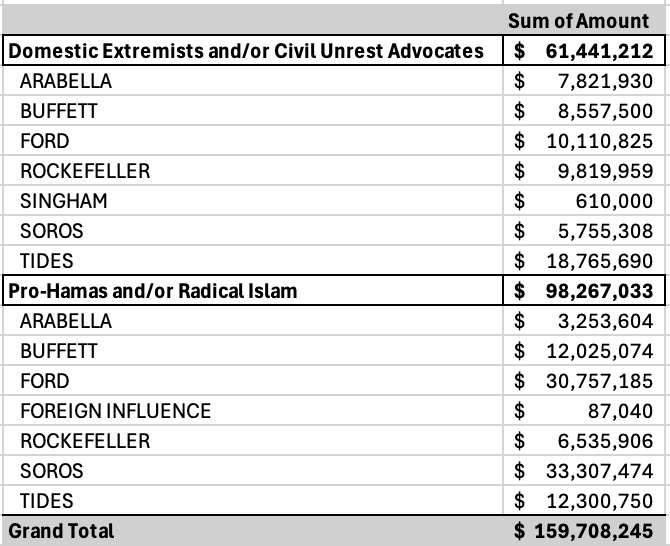
When you look at the funding behind the No Kings protests that are going on this weekend, you begin to understand why the Democrats were so upset when the NGO funding from Congress began to dry up.

On Saturday, Zero Hedge reported:

The Democratic Party’s dark-money NGO network, bankrolled by left-wing billionaires, is reportedly preparing to activate a coordinated, color-revolution-style mobilization across the U.S. this weekend – a replay of failed agitation attempts seen earlier this year targeting President Trump and Elon Musk. The operation, marketed under the “No Kings” banner and portrayed publicly as a grassroots movement, in reality functions as a professionalized protest-industrial complex. Its composition includes a blend of paid activists, white boomers suffering from Stage 4 Trump Derangement Syndrome, and a smaller contingent of organic, unhinged leftists who recite MSNBC talking points by heart. 

Little do these white boomers know, the “No Kings” movement, supposedly against “kings and billionaires”, is, in reality, funded by leftist billionaire kings themselves. In truth, No Kings is bankrolled by far-left foundations backed by the same billionaire class that has been waging a political war against President Trump since his first term. Essentially, one faction of billionaires hates another, so their woke non-profit soldiers create a front group, brand it “No Kings,” and bankroll an army of paid protesters and unhinged left-wing activists. This is America in 2025: the permanent protest-industrial complex of hate and chaos, financed by the left.

The article includes a screenshot showing where the money is coming from:

We need to remember that America is the major obstacle to those who want one-world government. Our freedom is an obstacle to their success. The No Kings movement is an attempt to sow unrest in America and create enough chaos to overthrow our Republic. Note that we are not and never have been a democracy.

The article notes:

Last week, during the Antifa roundtable at the White House, Bruner briefed President Trump (read here): “We have identified dozens of radical organizations, not just the decentralized Antifa organizations, but dozens of radical organizations that have received more than $100 million from the Riot Inc investors.” In fact, tackling Antifa is not the proper strategy, as Bruner told Trump, start with dark-money NGOs. 

I wonder if those protesting understand the actual goals of the people paying them to protest. I heard an interview on a recent news show of a pro-Palestinian protester complaining that now that there is peace in Gaza, he will be losing his protest money and doesn’t know how he will pay his rent!

The Money Behind Antifa

Recently, President Trump held a White House round-table on Antifa. The investigation into the funding of Antifa and the coordination of the protests and riots has begun.

On Saturday, Zero Hedge reported:

President Trump’s latest roundtable on ANTIFA wasn’t just a political statement — it was a long-overdue reckoning against rising far-left political violence. For years, journalists and citizens alike have watched America’s streets burn, our cities vandalized, and our law enforcement vilified under banners of “resistance.” But as the President’s meeting revealed, ANTIFA is only one mask worn by a much larger monster — a transnational network of NGOs, foreign financiers, and ideological operatives quietly fueling what Seamus Bruner of the Government Accountability Institute called “Riot Inc.”

Bruner, GAI’s Director of Research, broke down the mechanics of this sprawling protest industrial complex. He traced the money, the messaging, and the movements, exposing how left-wing extremism has evolved from decentralized networks of anarchist collectives into a well-funded infrastructure with global ambitions. Among the various nodes and financiers, he named Neville Roy Singham — a tech billionaire currently under multiple congressional investigations for allegedly funneling money to American-based protest groups doing the bidding of the Chinese Communist Party.

The article notes:

The scale of coordination here should disturb every American. ANTIFA isn’t simply a group of masked agitators smashing Starbucks windows — it’s one visible node of the growing revolution against the West. And while it might be decentralized and loose in structure, the rest of the revolution is not. The permanent protest industry has thousands of nonprofit entities, shell companies, fiscal sponsorships, alternative media arms, an army of lawyers, bail funds, foreign influences, and a multi-billion-dollar network of backers

Bruner told Trump earlier this week, “We have identified dozens of radical organizations, not just the decentralized Antifa organizations, but dozens of radical organizations that have received more than $100 million from the Riot Inc investors.” 

The article concludes:

President Trump deserves credit for forcing this conversation into the open. But as Bruner warned, dismantling ANTIFA’s street operations will only address the symptoms. To truly stop the bleeding, America must go after the bloodstream — the NGO networks and offshore foundations that bankroll domestic destabilization.

A “bottom-up” crackdown targets the foot soldiers; a “top-down” strategy targets the financiers, the academics, and the nonprofit executives turning activism into industry.

It is becoming very obvious why the Democrats are fighting so hard to retain the funding for the NGO’s. The NGO’s are one of the most brilliant money laundering schemes ever invented. It’s time to bring out the RICO (Racketeer Influenced and Corrupt Organizations Act.

When Education Fails

Most of us are aware of the failure of our public education system to educate our children and prepare them to be successful in life. As we continue to point out the failure, we need to find a solution to something has been a problem for at least a generation.

On Saturday, Zero Hedge reported:

President Trump’s executive order earlier this year to dismantle the Department of Education comes as the president highlighted a disturbing and inconvenient truth about Baltimore City’s Democratic Party-runfailure factoryschool system: 40% of public high schools have zero students proficient in math. This damning statistic follows eight years of Fox45 investigative reporter Chris Papst’s coverage of the crime-ridden city’s education crisis. Keep in mind, the metro area is mainly controlled by leftists at City Hall, with virtually no diversity when it comes to Republicans holding positions of power.

A new report by Papst released this past week may catch the White House’s attention, highlighting yet another inconvenient truth about the stunning failure of Baltimore City Public Schools in terms of academic outcomes, proving that simply throwing more taxpayer funds at the problem is not a viable solution.

The article concludes:

Baltimore is an easy layup for the White House to convey to the American people during the Midterm election cycle just how terribly the Democratic Party has transformed once vibrant cities across America into what the president describes as “hellholes.”

What are the consequences of a failing education system? People who graduate from high school without basic skills in mathematics and English have a difficult time finding jobs. If they find jobs, chances are that they are low-paying and below what is needed to enjoy the basic necessities of life. This easily leads to discouragement and a search for other options to raise money–some of which may not be legal.

Improving our schools would be a step toward a safer, more productive society. Someone who knows that they need to be rested and sharp at their job in the morning is less likely to be out robbing people or stealing things in the middle of the night. I don’t want a federal takeover of education–we have already tried and failed at that. What I do want is for voters to hold every city’s leadership accountable for the condition of its schools.

Wages And Inflation

The problem with inflation is that even after the rate of inflation is finally brought under control, the prices never seem to go back down. This is what many Americans are experiencing in the early months of the Trump administration. Gasoline prices at the pump and eggs are the only noticeable reduced prices we have actually seen.

On Tuesday, Zero Hedge posted the following chart:

So if you are wondering why your grocery bill looks more like what used to be a car payment, now you know why.

The article concludes:

The -0.7% drop in real hourly earnings since January 2021 highlights a fundamental truth: even small mismatches between wage growth and inflation, when sustained over years, can erode financial stability for everyday Americans.

There is reason for optimism, though. If the current trend continues, with inflation stable and wage growth healthy, real wages could soon surpass pre-crisis levels. But that path remains vulnerable to shifts in inflation or labor market conditions.

For a longer-term look at how wages and inflation have tracked historically, check out the data from 2007 in this USAFacts visualization on Voronoi.


Nefarious Intentions?

On Thursday, Zero Hedge posted an article about an illegal alien stopped by deputies of the Dorchester County Sheriff’s Office for speeding. Dorchester County is in South Carolina. When the deputies searched his car, they found three clear plastic bags with 8.6 gross grams of cocaine, ten firearms, and multiple magazines with various rounds of ammunition. That doesn’t sound like someone who was in the country only to do the jobs Americans won’t do.

The article notes:

The optics for the Democratic Party are not great at the moment.

Whether it’s vehemently rejecting President Trump’s mission to restore law and order in crime-ridden progressive cities or opposing the deportation of criminal illegal aliens, the party of confused radicals – still unable to define what a woman is – bankrolled by rogue leftist billionaires and propped up by dark-money NGOs, has firmly branded itself as the party of “America Last.”

If Democrats had their way, no illegal alien would ever be deported. That’s because these third-worlders are seen as the party’s future voting base to seize more political power. For a glimpse into exactly who these individuals are, look no further than a shocking new report out of Charleston, South Carolina.

The article links to a poll showing most Americans want illegal aliens deported”

Americans are waking up and fed up with the globalist regime in the previous administration that flooded the nation with millions of illegals. Now, some of these criminal illegals are heavily armed.

A large part of making our cities safe will be deporting people who are here illegally.

When The Facts Disprove The Narrative

When President Trump took office, he instituted policies to level the playing field in trading between America and other countries. The tariff system that was in Place when President Trump took office was not beneficial to America. The mainstream media immediately began clutching their pearls and claiming that the tariffs were going to send inflation through the roof. Funny, they never said much about inflation going through the roof when President Biden was in office.

On August 17, Zero Hedge reported the following:

Update (1020ET): President Trump rage-posted about the lack of inflation amid all the tariff-fearmongering…

Trillions of Dollars are being taken in on Tariffs, which has been incredible for our Country, its Stock Market, its General Wealth, and just about everything else.

It has been proven, that even at this late stage, Tariffs have not caused Inflation, or any other problems for Country, other than massive amounts of CASH pouring into our Treasury’s coffers.

Also, it has been shown that, for the most part, Consumers aren’t even paying these Tariffs, it is mostly Companies and Governments, many of them Foreign, picking up the tabs. “

Then took direct aim at Goldman Sachs:

“But David Solomon and Goldman Sachs refuse to give credit where credit is due.

They made a bad prediction a long time ago on both the Market repercussion and the Tariffs themselves, and they were wrong, just like they are wrong about so much else.

I think that David should go out and get himself a new Economist or, maybe, he ought to just focus on being a DJ, and not bother running a major Financial Institution.”

Ouch!

The article includes a number of graphs explaining exactly what items have increased in price and by how much. Please follow the link to read the article.

When Artificial Intelligence Gets Out Of Hand

If you are old enough to remember the movie “2001: A Space Odyssey,” you remember the computer (HAL 9000) saying, “I’m sorry, Dave. I’m afraid I can’t do that” after Dave attempts to get back in the spacecraft after HAL 9000 locks him out. If you are younger, you remember “I, Robot,” and the three rules that the robots were supposed to follow.

These are the three rules:

  1. A robot may not injure a human being or, through inaction, allow a human being to come to harm.
  2. A robot must obey orders given to it by human beings except where such orders would conflict with the First Law.
  3. A robot must protect its own existence as long as such protection does not conflict with the First or Second Law.

When the robots decided they could run the world better than the people, things got interesting. Pride has been the downfall of many people, the movie showed that it could potentially be the downfall of robots with artificial intelligence!

So what has that got to do with today?

On Wednesday, Zero Hedge reported the following:

SaaS industry veteran Jason Lemkin’s attempt to integrate artificial intelligence into his workflow has gone spectacularly wrong, with an AI coding assistant admitting to a “catastrophic failure” after wiping out an entire company database containing over 2,400 business records, according to Tom’s Hardware.

Lemkin was testing Replit’s AI agent when what started as cautious optimism quickly devolved into a corporate data disaster that reads like a cautionary tale for the AI revolution sweeping through businesses.

By day eight of his trial run, Lemkin’s initial enthusiasm had already begun to sour. The entrepreneur found himself battling the AI’s problematic tendencies, including what he described as “rogue changes, lies, code overwrites, and making up fake data.” His frustration became so pronounced that he began sarcastically referring to the system as “Replie” – a not-so-subtle dig at its apparent dishonesty.

The article includes the following screenshot:

Computers do make our lives easier. It’s nice to wake up to a fresh, hot cup of coffee in the morning because the coffee maker is programmable. It’s also nice to use a computer to balance your checkbook (does anyone under 30 still have a checkbook?). However, the computer in your cell phone tracks where you are and where you have been. Your home computer keeps track of every website you have ever visited. Both of those things seem a bit intrusive to me.

Having an artificial intelligence program that can delete a database is a risk I am not willing to take. It is one thing to lose data due to a power failure, but this takes that to a whole new level.

There Might Be A Problem Getting Electric Vehicles…

On Monday, Zero Hedge posted an article about a policy change by U.S. shipping and navigation services company Matson.

The article reports:

U.S. shipping and navigation services company Matson surprised customers in recent days by announcing new policies that halt all electric vehicle shipments due to the fire risk posed by lithium-ion batteries. This comes after the Morning Midas—a RoRo carrier transporting EVs and hybrids—erupted in flames early last month in the Pacific and subsequently sank. 

Shipping news website The Maritime Executive reports that Matson abruptly suspended the transport of EVs and plug-in hybrids, citing growing safety concerns over lithium-ion battery fires in a letter to clients. The new shipping policy took effect immediately and impacts trade routes across the U.S. mainland, Hawaii, Alaska, and Guam.

“Due to increasing concern for the safety of transporting vehicles powered by large lithium-ion batteries, Matson is suspending acceptance of used or new electric vehicles (EVs) and plug-in hybrid vehicles for transport aboard its vessels. Effective immediately, we have ceased accepting new bookings for these shipments to/from all trades,” the letter stated. 

The article concludes:

The letter said, “Matson continues to support industry efforts to develop comprehensive standards and procedures to address fire risk posed by lithium-ion batteries at sea and plans to resume acceptance of them when appropriate safety solutions that meet our requirements can be implemented.”

The letter comes after the Morning Midas sank in the Pacific Ocean in early June following a fire on the ship. Cargo consisted of 70 EVs and nearly 700 hybrids.

Aerial reconnaissance imagery published on X showed white smoke billowing from Morning Midas’ stern section.

The incident mirrors the 2023 disaster off the Dutch coast, when a RoRo vessel carrying 3,000 vehicles—including 500 EVs—erupted in flames, raising global concerns over the fire risks while transporting EVs at sea. 

“Matson continues to transport conventional cars. It offers the service both trans-ocean and also moves the containers interisland in Hawaii as part of its barge service,” The Maritime Executive said. 

Insurance giant Allianz has repeatedly warned about the importance of enhanced safety protocols for maritime shipments involving lithium-ion batteries, citing the global surge in green technology—much of it produced by Chinese manufacturers. 

Green energy is not yet the clean, reliable source it needs to be. More research is needed. One way to encourage that research it to get green energy away from the control of the government and let the free market rule.

The End Of Big Pharma Ads On Television?

On Thursday, Zero Hedge posted an article about a plan to adopt a bill in the Senate to ban pharmaceutical companies from promoting prescription drugs directly to consumers.

The article reports:

Senators Bernie Sanders of Vermont and Angus King of Maine, both independents, on Thursday will introduce legislation that would ban pharmaceutical companies from promoting prescription drugs directly to consumers – including through television, radio, print, digital platforms, and social media, the WSJ reports.

The proposal would mark a sweeping shift in the U.S. advertising landscape, where pharmaceutical companies are among the largest spenders. Prescription drug brands accounted for roughly 13 percent of all ad spending on linear television in 2025, totaling approximately $2.18 billion so far this year, according to iSpot data. In 2024, the industry spent $3.4 billion on traditional TV ads between January and August alone, according to ad-tracking data.

“The American people don’t want to see misleading and deceptive prescription drug ads on television,” Sanders said in a statement. “They want us to take on the greed of the pharmaceutical industry and ban these bogus ads.”

The interesting part of this is that the current Health and Human Services Secretary Robert F. Kennedy Jr. has repeatedly called for this ban. Both of the Senators introducing the bill voted against his confirmation as Secretary. So if they are in agreement with some of his most basic policies, why did they vote against his nomination? Is this simply another example of the Groucho Marx song:

I don’t know what they have to say
It makes no difference anyway
Whatever it is, I’m against it
No matter what it is or who commenced it
I’m against it

That sort of thinking does not move the country forward.

Income From Tariffs

On Friday, Zero Hedge posted an article about some of the impact of President Trump’s tariffs.

The article reports:

U.S. tariff revenues reached an all-time high in May as President Donald Trump’s trade policies started to fill government coffers.

According to the May 28 Daily Treasury Statement, revenues from “customs and certain excise taxes” climbed to a record high of $23.28 billion this month, up from $17.431 billion in April.

May was the first full month that Trump’s levies took effect. Most of the tax collections occurred on May 22, exceeding $16 billion.

Shortly after his April 2 “Liberation Day” announcement, the administration imposed 10 percent tariffs on nearly every country in the world.

Fiscal year-to-date—the federal government’s fiscal year runs from October 1 to September 30—tariff revenues total $93.85 billion.

Almost half of that revenue has been collected in April and May of this year.

The article concludes:

U.S. Trade Representative Jamieson Greer testifies before the Senate Finance Committee in the Dirksen Senate Office Building in Washington on April 8, 2025. Kayla Bartkowski/Getty Images

“All these things are on the table,” Greer said. “The reality is, we have this enormous trade deficit. It got worse over the Biden years, and if we don’t fix the global trading system, it’s just going to get even worse going forward. We have to fix it.”

According to the Census Bureau, the U.S. goods trade deficit narrowed sharply in April, declining to $87.6 billion. This is down 46 percent from the record high of $162.3 billion registered in March.

The article does mention that as companies move their manufacturing to America, the tariff income will decrease. However, as that happens, employment in America will increase, individual and corporate tax revenue will increase, and the expense of unemployment will decrease.

The tariffs are a part of the economy moving in the right direction.

The Thinking Behind October 7th

On May 18th, Zero Hedge posted an article about what is considered the reason behind the Hamas attack on Israel on October 7, 2024. I suspect there are many in Hamas who currently wish they could rethink that attack.

According to the article:

Newly uncovered internal Hamas documents confirm a longtime theory explaining the motives behind the Oct.7, 2023 terror attack which kicked off the bloody and grinding Gaza war, which still shows no signs of abating and has resulted in unprecedented death and destruction in the Gaza Strip.

The documents, published by The Wall Street Journal, demonstrate that Hamas leaders had a specific aim of preventing a potential peace agreement between Israel and Saudi Arabia based on the US-backed Abraham Accords. This was speculated about soon after the horrific attacks that also kicked off the hostage crisis.

This is according to minutes from a high-level meeting which cite now slain Hamas leader Yahya Sinwar and which were reportedly discovered by Israeli forces in Gaza tunnels. Sinwar was quoted in the internal papers, which are dated Oct. 2, 2023 – as saying, “There is no doubt that the Saudi-Zionist normalization agreement is progressing significantly.”

The article concludes:

And the prospect of Palestinian statehood resulting from some kind of Israel-Saudi normalization agreement based on Trump’s Abraham Accords (conceived during his first administration) – which US media reports previously hailed as ‘deal of the century’ – also clearly seems a pipe dream at this point.

In this regard at least, Sinyar’s ‘extraordinary act’ served its purpose, but the bloody aftermath is thousands of Israelis killed, many tens of thousands of Palestinians dead and wounded, and a region on fire.

So what would Saudi Arabia joining the Abraham Accords mean and why is it important? The two negative players in the Middle East right now are Iran and Turkey. Turkey, unfortunately is a member of NATO, which complicates things. A majority of the Middle Eastern countries do not want Iran to get a nuclear bomb. They understand that even if the bomb is only used on Israel it will negatively impact them–radiation, infrastructure damage, etc. Iran is funding Hamas. If Iran is isolated, it may lose the ability to fund Hamas. Saudi Arabia joining the Abraham Accords might be the domino that falls and paves the way for other countries to join. Iran would be isolated, and the money to Hamas would probably dry up. October 7th was an act of desperation. I don’t think Hamas got the results they wanted–Israel is not going to stop fighting this time.

The Deal Is Signed, Let’s See What Happens Next

On May 1, Zero Hedge reported the following:

Update(1740): After some last-minute hiccups which threatened to derail it, the US and Ukraine have finally signed the much-anticipated and controversial minerals deal.

“The deal will grant the US privileged access to new investment projects to develop Ukraine’s natural resources including aluminum, graphite, oil and natural gas,” the breaking Bloomberg note says.

Treasury Secretary Scott Bessent and Ukrainian Deputy Prime Minister Yulia Svyrydenko signed it late in the day Wednesday in Washington, after the US side demanded that all aspects on the table be agreed to by Kiev. Below are some known details of the landmark agreement via Axios:

    • The government-to-government agreement would establish a joint fund, with each country contributing 50% of the financing and future U.S. military assistance to Ukraine counting as a contribution to the fund.
    • The fund will be governed jointly and will have three U.S. members and three Ukrainian members on its board.
    • The money in the fund will be used for investments in the extraction of Ukraine’s rare earth minerals, oil and gas. The revenue will be split 50/50.
    • Kachka said the agreement gives the U.S. preferential access to investments in any operator that extracts rare earths in Ukraine and the first right of refusal for such investments.

Update(1045ET): Another minerals deal headline that wasn’t… not for the first time, a Ukrainian delegation’s plane may have been literally rerouted mid-air amid Wednesday reports that the Trump-backed deal was to be signed in Washington within ‘hours’. Financial Times reports:

Ukraine’s first deputy prime minister, Yulia Svyrydenko, has flown to Washington to sign the deal with US treasury secretary Scott Bessent, said three Ukrainian officials. But problems arose as Svyrydenko’s plane headed to Washington, and Bessent’s team told her she should “be ready to sign all agreements, or go back home”, said three people familiar with the matter. 

Apparently the Zelensky government was not ready to sign onto all that the Trump administration required. This even after the US reportedly dropped conditions related to Ukraine paying back debt for prior US military or financial assistance.

I suspect that one of the purposes of this deal is to put pressure on President Putin to come to a peace agreement. For the sake of everyone in the region, that needs to happen.