Stating The Obvious

On Friday, The Daily Signal posted an article about the results of the War on Poverty. The results have not been what the stated goals were, although they may reflect a different agenda than the one stated.

The article reports:

America’s “War on Poverty,” launched by President Lyndon Johnson in 1964, has expanded into a vast array of federal social welfare programs that today exceed $1 trillion per year.

Upon signing the Economic Opportunity Act, Johnson stated: “This is not in any sense a cynical proposal to exploit the poor with a promise of a handout,” but rather a means to “help our people find their footing for a long climb toward a better way of life.”

While poverty has declined significantly over the past half-century, however, recent reports indicate that these programs simultaneously reduced the share of private income for America’s poorest, locking them into long-term dependency and limiting their ability to move up into the middle class.

A recent study by economists Kevin Corinth and Richard Burkhauser, which analyzed poverty rates before and after America embarked on the War on Poverty, concluded that, while poverty decreased substantially since 1964, this was achieved largely by welfare supplanting “market” income such as wages, investments, and profits. In addition, before the 1960s, market income had succeeded in reducing poverty at similar rates to what the War on Poverty achieved.

“Our new research shows that the United States made strong progress in reducing poverty during the quarter century before the War on Poverty began, and that this progress was entirely accounted for by increases in market income, not government transfers,” Corinth told The Daily Signal. “In other words, there was a lot of benefit and not much cost during this earlier period.”

Before the War on Poverty, poverty reduction was achieved across racial groups. Economist Thomas Sowell wrote in 2004 that the poverty rate among black families fell from 87% in 1940 to 47% in 1960, without government assistance.

The article notes:

A January report by the Congressional Budget Office found that, for the poorest 20% of Americans, government payments increased from 26% of total income in 1979 to 42% in 2022. And as welfare programs expanded, market income for America’s poorest declined as a share of total income. Whereas in 1979, welfare payments were only about half the amount of private income sources for the lowest quintile, the two income sources were roughly equal by 2022.

According to a February report in The Daily Economy by analyst Tyler Turman, based on this Congressional Budget Office data, “despite historically unprecedented economic gains for low-income Americans, more of them are dependent on government assistance than at any point in the country’s history.”

The article concludes with a statement that probably describes the actual goal of the War on Poverty:

If the goal of the War on Poverty was to boost Americans’ self-sufficiency, it appears to have fallen short. What it has achieved, rather, is a costly expansion of government, long-term dependency for the poor, and a perennial voting bloc for politicians who feed the addiction.
Policies Have Consequences

On Thursday, The Epoch Times posted an article about America’s trade deficit in September.

The article reports:

President Donald Trump’s tariffs helped shrink the U.S. trade deficit to its lowest monthly level in more than five years, according to new data released by the Bureau of Economic Analysis on Dec. 11.

The U.S. goods and services trade deficit narrowed by 10.9 percent in September to $52.8 billion—the lowest monthly deficit since June 2020—down from $59.3 billion registered in August.

Economists polled by Reuters had forecast a September trade deficit of $63.3 billion.

The article notes:

Trump’s tariffs helped narrow the trade gap with other major U.S. trading partners, including China and India.

The goods deficit with China tumbled by $4 billion to $11.4 billion in September. Exports climbed by 0.2 percent to $8.8 billion, while imports fell by $3.9 billion to $20.1 billion.

The United States’ merchandise deficit with India also narrowed by about $1.8 billion to $3.05 billion.

U.S. and Indian delegations have been engaged in negotiations to iron out a bilateral trade agreement.

The article concludes:

Updated projections from the Congressional Budget Office suggest that enacted tariffs this year will generate $2.5 trillion of revenue, excluding dynamic effects. This is down from the August estimate of $3.3 trillion.

There is still uncertainty, Congressional Budget Office Director Phillip Swagel said.

“The United States has not implemented increases in tariffs of this size in many decades, so there is little empirical evidence to guide our estimates of their long-term effects,” Swagel said in a Nov. 20 report. “Consumers and businesses could be more or less responsive to increases in tariffs of this size, which would cause trade and revenues to diverge from projected amounts.”

The overall average effective tariff rate is 16.8 percent, the highest rate since 1935, according to The Budget Lab at Yale.

When America began, the government was funded by tariffs. At that point the government was following the U.S. Constitution and had not yet become the bloated mess that it is today. The federal government was limited to doing the things the U.S. Constitution allowed it to do. That is not the case today. We can’t just slash and burn the bureaucracy without serious consequences, but we can institute the cuts that the Department of Government Efficiency (DOGE) identified. The tariffs can help with the deficit, and cutting spending could help with the deficit. We need to unelect the people who are fighting the tariffs and the spending cuts.

One Problem With ObamaCare

On Monday, The Federalist posted an article about the problem of fraud in the ObamaCare subsidies.

The article reports:

In recent months, these pages have recounted myriad reports of fraud in Medicaid and on the Obamacare Exchanges. The Congressional Budget Office and others have noted millions of potentially erroneous or fraudulent enrollees, who are receiving tens of billions of dollars in taxpayer-funded subsidies.

On Wednesday, the Government Accountability Office (GAO) added to the reports pouring in. Its preliminary analysis raised additional questions about fraud relating to Exchange subsidies, providing yet another reason for Congress not to extend the enhanced Covid-era subsidy regime that expires at the end of the month. 

…During the last plan year, GAO noted that “we either were not requested to provide the federal Marketplace [i.e., Exchange] with documentation or generally did not provide what was requested, yet our four fictitious applicants received subsidized coverage for November and December 2024.” In one example, the federal Exchange sent a letter that “confirmed the applicant’s income based on documentation we submitted,” even though GAO had not sent any such documentation.

This year, GAO said the Exchange “initially approved coverage for 19 of our 20 fictitious applicants,” with the only exception being “when the broker we were working with stopped responding to us.” In another case, the Exchange cut off coverage after the fictitious enrollee did not provide citizenship documentation. But in total, nine months into the plan year in September, “coverage for 18 [of 20] fictitious enrollees remained active,” totaling over $10,000 per month in taxpayer subsidies paid to insurers on behalf of nonexistent enrollees.

One example of fraud:

In 2023, a total of 58,000 Social Security numbers received subsidies yet also matched Social Security Administration death data. These instances included more than 7,000 numbers “where the reported date of death occurred prior to enrollment” in the Exchange, and more than 19,000 numbers where “matches had different names and dates of birth” between the Exchange database and the Social Security Administration database, a potential sign of “synthetic identity fraud.”

The article concludes:

Regardless, lawmakers should not spend another $350 billion (plus interest) throwing good taxpayer money after bad, even as one government report after another shows Exchange-related fraud remains out of control. After incurring more than $38 trillion in debt, Washington should finally realize it has run out of other people’s money to spend on such profligacy.

It is past time to make the subsidies go away and find a better way to do healthcare.

Where The Money Went

On  Saturday (updated Sunday), Just the News posted an article about where the  government’s money for healthcare has been spent.

The article reports:

More evidence has emerged showing that — despite the claims of Democrats — illegal immigrants have benefited from millions of federal tax dollars. The government watchdog group Open the Books released a new analysis that found almost $197 million in federal healthcare-related grants have benefited illegal immigrants since fiscal year 2021.

That is NOT pocket change and needs to be ended.

The article continues:

According to the report, the grants include both direct services and academic research aimed at expanding access to healthcare for immigrant populations. Open the Books’ researchers said they searched federal databases for grant descriptions that explicitly mentioned terms such as “undocumented” or “unauthorized,” suggesting that the actual total amount of taxpayer funding could be higher.

The article concludes:

Open the Books said the $197 million total does not include “indirect spending on illegal immigrants through Medicaid, which was estimated by the Congressional Budget Office to be around $27 billion from FY 2017-2023, nor does it account for education spending that benefits illegal immigrants and their children, which amounts to an estimated $70 billion annually.”

Open the Books identified about $13 million in new awards since February 2025 after the start of Trump’s second term. Under Trump, border encounters have dropped significantly amid increased federal enforcement. According to U.S. Customs and Border Protection, “26,197 total encounters nationwide” occurred under Trump — a 93% below the peak of the Biden administration’s 370,883. 

The spending on illegal immigrants through Medicaid is what the Democrats want to continue. The fact that the Republicans will not agree to that is one of many reasons the government remains shut down.

One Possible Solution To The Cost Of Health Insurance

On Wednesday, Stephen Moore posted an article at The Patriot Post about the healthcare aspect of the current government shutdown.

The article notes:

The government shutdown has focused debate on the vast sum ($136 billion in 2025, as projected by the Congressional Budget Office) that the federal government spends to annually subsize continually skyrocketing Obamacare health insurance premiums. The Wall Street Journal reports that regardless of how that fiscal tug-of- war turns out, health insurance premiums paid by Americans are expected to rise another 8% or 9% next year.

The mega-health insurers are leading the charge for more subsidies because this money lands right in their pockets. Their profits and stock values have been soaring while the rest of us struggle to pay the rising tab.

One reason health care costs are rising at two to three times the cost of everything else is that the entire insurance market is dysfunctional. Most Americans pay high monthly premiums (or the government pays for them) for coverage they often don’t use.

In 2024, 11.7 million people, more than one-third of those covered by Obamacare, had no medical claims. They, or taxpayers, paid a lot in premiums — for nothing.

But the whole idea of insurance is to protect your family from major expenses — not minor ones. That’s why we have fire insurance on our homes — to protect against the risk of the total loss of your property.

We need a system much more sensible and less costly for patients and taxpayers. We should be encouraging insurance plans with low premiums that cover major “catastrophic” medical expenses but leave smaller expenses — like checkups or minor surgery — to be paid by policyholders directly.

Such policies — known as catastrophic health insurance plans — have been available for several decades. Most of us would be better off financially if we signed up for these plans. With low premiums and coverage for major medical expenses, they are a win-win for families.

Even as regulated by Obamacare, this coverage charges premiums that are only about half the amount of other Obamacare plans. For example, Forbes recently analyzed the premiums of “77 catastrophic health plans nationwide.” The average premium for a 50-year old member is $443 per month, or $5,316 per year, compared to almost $10,000 for the average Obamacare plan, according to Paragon Health Institute calculations.

The article notes that Obamacare makes catastrophic health insurance plans illegal. Many in Congress are quite happy to move Americans to government healthcare and government insurance (as long as they can have their private insurance).

The article concludes:

Sometimes in life the best solution is the simplest one: Stop the hundreds of billions of dollars of wasteful subsidies, the skyrocketing premiums and the “one size fits all” plans that so many of us do not use, want or need — and instead legalize pro-growth catastrophic health insurance plans for all. Stop fattening the checks of the fat and happy health insurance conglomerates like UnitedHealth, who resist paying honest claims but force you to write monthly checks for insurance you don’t use or need.

Please follow the link to read the entire article.

How Much Did The Open Border Really Cost?

On Monday, The Federalist posted an article about the cost of having an open border for the four years of the Biden administration.

The article reports:

The Congressional Budget Office (CBO) estimates that the surge in illegal migration cost governments billions of dollars in 2023, which illustrates the real-world impact of the previous administration’s actions — or inactions. The report also exhorted Congress to provide adequate resources for border security, so that the chaos of the past four years can never happen again.

…CBO believes that, of those 4.3 million, “about a quarter,” or roughly 1.1 million, “were qualified aliens upon arrival.” That term has particular relevance because the 1996 welfare reform law restricted eligibility for federal programs to “qualified aliens” who have served a five-year waiting period. However, CBO also notes that “about half,” or over 500,000, “of those qualified aliens” arriving during the surge “were exempt from the five-year waiting period,” and therefore could immediately receive taxpayer-funded benefits.

…On net, CBO estimated the direct costs to state and local governments from the immigration surge at $9.2 billion in 2023 alone. Including indirect costs raised the total even further, to $9.8 billion in 2023.

America can have either an open border or a welfare state. It can’t have both.

Sorting Through The Lies

On Friday, Breitbart posted an article about some of the current lies being told about the ‘Bid Beautiful Bill.’ The bill is not perfect, but considering the parameters the Republicans had to work with, it is generally a good bill.

The article reports:

Democrats opposing the bill have asserted that it benefits the rich, but they have done so by fudging the numbers, largely relying on the Congressional Budget Office’s (CBO) analysis to fuel their criticisms. But as Breitbart News reported, the CBO — created to act as a nonpartisan advisory body — has its performance as well as personnel’s political history bringing that into question:

But the CBO’s extensive history of overestimating benefits for Americans from public health care, underestimating costs of Democrat policies on taxpayers, and stacking the deck against Republican policies reveals a deeply partisan agency influencing lawmakers in order to further left-wing causes.

In addition to its history of unreliable projections propping up Democrats, according to FEC records, of the nearly $17,000 donated to candidates and committees from CBO employees since 1986, only $250 went to Republican candidates — a single donation to George W. Bush in 2000.

In some ways, Democrats are essentially equivocating taking away tax-funded benefits for illegal immigrants as taking benefits away from the poor. But that in itself is completely disingenuous.

The Ways and Means Committee is correcting the record, warning the American people not to fall for the same lies the Democrat touted to discredit the 2017 Trump tax cut’s benefits for the working class. All in all, the GOP says the numbers are clear, showing that the measure benefits working class Americans.

A fact sheet presented by the Ways and Means Committee shows that not only does the measure halt a $1,700 tax increase, but it provides an additional $1,300 in tax cuts for families of four taking in less than $100,000.

American can have either an economic safety net or open borders. We cannot do both.

The article concludes:

“The facts speak for themselves,” Ways and Means Committee Chairman Jason Smith (R-MO) said in a statement. “After passage of the 2017 Trump tax cuts, we saw a booming economy that raised wages by nearly five percent, with those in the bottom 10 percent seeing 50 percent more wage growth than those in the top ten percent.”

“The top one percent of earners paid more in taxes after its passage. The One, Big, Beautiful Bill builds on that success and delivers even greater tax relief, higher wages, and better economic growth – all of which will primarily benefit working families as will President Trump’s priorities of no tax on tips, overtime, and auto loan interest plus tax relief for seniors,” he said, adding, “The legislation doubles down on pro-growth, pro-family policies that directly benefit low- and middle-income families.”

Ultimately, he said the bill is a “win” for the working class.

Those of us in the working class appreciate the bill.

How Much Did The Inflation Reduction Act Actually Cost?

On Monday, Just the News posted an article about the actual cost of the Inflation Reduction Act. The Inflation Reduction Act was not about inflation–it was about subsidizing green energy.

The article reports:

When former President Joe Biden’s signature Inflation Reduction Act (IRA) passed in 2022, it did so along party lines with not a single Republican voting for it. At the time, a Senate one-pager summarized the law as costing taxpayers $369 billion, based on Congressional Budget Review (CBO) estimates

new study from the Cato Institute finds that the law could cost as much as $4.67 trillion by 2050. That’s roughly 12 times the stated cost. The study also concludes that the subsidies are undermining innovation and driving investments toward subsidy farming rather than satisfying consumer demand. 

“The government should not have a hold on the economy in such a way that it can truly distort entire markets, and that’s what the Inflation Reduction Act is,” Joshua Loucks, research associate with Cato Institute and co-author of the analysis, said in a video explaining the study

…The subsidies for the IRA come in two forms — production tax credits (PTC), which provide tax credits per unit of energy produced, or investment tax credits, which provide tax credits for various investments in carbon-free energy. Which one developers take depends on the project and their business preferences. With the ITC, the subsidies provide an infusion of cash up front, whereas the PTCs provide payouts over time. 

Some of these are not capped, and others are only phased out when certain greenhouse gas emission reductions are met. Using models from the U.S. Energy Information Administration, the study shows there’s little likelihood that these reductions will be met in the next 25 years, meaning the subsidies have no meaningful end date. 

The article concludes:

The study’s authors argue that, in light of the IRA’s actual costs, a full repeal of its energy subsidies is needed. If a full repeal isn’t possible, Congress should limit taxpayer liabilities by placing caps on the dollar value of the subsidies, add expiration dates instead of emission reduction targets — or both. 

“Delaying action only strengthens the political and economic interests tied to its subsidies, making reform even more difficult as the web of government handouts expands,” Loucks and Fisher warn in an article on “The Fishtank,” Fisher’s Substack. 

Repealing the energy subsidies in the IRA is a wonderful idea. This is another budget cut the Department of Government Efficiency (DOGE) needs to look at.

A Necessary Step

There were a lot of reasons for the number of people illegally crossing our southern border during the Biden administration. Among the illegals were people fleeing violence in their home countries, people simply looking for a better, more peaceful life, people looking to take advantage of America’s social safety net, and people simply looking for work to earn money to send home. America’s social safety net was a part of what drew people here, but it was not all of the reason. President Trump decided to do away with at least that reason.

On Wednesday, Chronicles Magazine reported the following:

The Trump White House has successfully flooded the zone in its first 30 days, flummoxing its opponents with a pace and scale even the most ardent anti-Trumper could not have expected. Among all the moves Trump has taken to combat illegal immigration, however, one executive order signed last week stands out and could be the game changer the country so desperately needs.

President Trump’s  order to end federal spending on those here illegally is one of the most meaningful steps taken to end America’s long-running problems with illegal immigration.

“The surge in illegal immigration, enabled by the previous Administration, is siphoning dollars and essential services from American citizens while state and local budgets grow increasingly strained,” the order states. “With this Executive Order, President Trump is ensuring taxpayer resources are used to protect the interests of American citizens, not illegal aliens.”

How many dollars are there in question? A report from the Congressional Budget Office (CBO) last year targeted federal expenditures on illegal aliens during the four years of the Biden administration. The CBO claimed that that the federal government spent $177 billion in benefits for adult illegal aliens and their children who were admitted under Biden. Add that to another $101 billion of other federal spending on illegals, and CBO’s figure comes to $277 billion.

The report further specified where that money goes. Among the biggest categories were Obamacare premium tax credits ($59 billion), Earned Income Tax Credit and Child Tax Credit ($43 billion), Medicaid and Children’s Health Insurance Program, also known as CHIP ($40 billion), and food stamps ($15 billion). This only includes federal spending. A study in 2023 found the annual net cost of illegal immigration to the United States at the federal, state, and local levels, is $150.7 billion.  

Is there any question that this needs to stop now?

What Happened To The Revenue?

On Tuesday, Issues & Insights posted an article about tax revenues under the Biden administration. The Laffer Curve is at work.

The article reports:

Friday afternoon, the Treasury Department reported that, despite a growing economy and low unemployment, the federal deficit shot up by $320 billion in fiscal year 2023. That’s unusual. But what’s really bizarre is why the deficit exploded.

According to the report, overall spending actually dropped by 2% compared with 2022 as the COVID-19 spending splurge abated.

What drove up the deficit this year was a sudden and completely unexpected 9% drop in tax revenues. Not only did revenues come up hundreds of billions lower than last year, but they were well below what everybody expected them to be.

At the start of the year, the Treasury Department and the Office of Management and Budget projected revenues for fiscal 2023 at around $4.7 trillion. The Congressional Budget Office figured it would be $4.8 trillion.

The actual amount: $4.4 trillion.

In other words, there’s between $300 billion and $400 billion worth of missing tax revenues.

…In a normal world, a better-than-expected economy would result in more revenues for the federal government, not less.

Keep in mind, too, that it’s exceedingly rare for tax revenues to drop from one year to the next. In fact, it’s happened only eight times since 1960 – always around an economic downturn – and the average decline was just 4.7%. Even when the COVID lockdowns caused a massive recession, revenues only dipped by 1.2% in 2020. (Revenues plunged nearly 17% during the financial crisis.)

It’s also worth noting that revenues continued to climb after the Kennedy, Reagan and Trump pro-growth tax cuts went into effect.

The article concludes:

But that’s not what happened this year. The federal government is still tremendously bloated – spending in 2023 will be 43% higher than it was the year before COVID-19. The national debt now tops $33 trillion. Social Security and Medicare are racing toward insolvency. Biden is pushing Congress for another $100 billion to finance the never-ending war in Ukraine and provide aid to Israel.

Did the Biden administration overcount revenues in the past two years to paper over the colossal spending increases? Is the White House goosing employment and other economic data today to make the economy look better than it is? Is Biden’s budget team just hopelessly incompetent?

Preston Bashers of the Heritage Foundation speculates that the shortfall could be the result of a sharp drop in capital gains tax revenues, the explosion in “green” tax credits, and other factors.

Somebody in the Biden administration should be made to explain what happened.

In the meantime, we’re now deeper in debt than ever. Way to go Brandon.

I am not sure, but I don’t believe there is anyone in the Biden administration who has actually run a business. We need to go back to the days of putting a businessman in the White House–not a politician.

When Fact Checkers Check President Biden

Recently President Biden made a speech where he claimed that Bidenomics was working for everyone–inflation was down, jobs were up, etc. Well, that sounds wonderful, but the numbers tell a different story.

Issues & Insights reported:

The middle class made huge gains during the “trickle-down” Reagan boom and was making huge gains during the Trump boom until the Biden-backed COVID lockdowns gutted it.

Truth is, the only way Biden can make the case for “Bidenomics” is by lying. Examples:

    • “U.S. has had the highest economic growth rate, leading the world economies since the pandemic.”

Except it didn’t. The U.S. ranks 146th in real GDP growth in the world so far this year, came in 151st place last year, and was 66th in 2021, according to the International Monetary Fund.

    • “We created 13.4 million new jobs.”

Also false. Because almost 10 million of those were simply refilled jobs lost during the pointless COVID lockdown. Under Biden, the number of net new jobs is less than 4 million — which is nothing to brag about, given that the working-age population has grown by 6.8 million since Biden took office.

    • “Americans are back to work who’ve been on the sidelines, and they want to come back.”

Another falsehood. There are almost 10 million people who’ve dropped out of the labor force as of today, which is 2.7 million higher than it was just before all the COVID lockdowns.

    • Just in my first two years in office, my team and I have reduced the deficit by $1.7 trillion.

His biggest lie yet. As we pointed out in this space earlier, a Congressional Budget Office report released at the start of this year showed that “Biden sharply increased the deficit last year, this year, and next year, and he has set the country on course to add a total of $5.45 trillion to the federal deficit over the following decade.”

The only thing that Biden said that was truthful in his speech is that “Bidenomics is working.”

It’s working all right, assuming that Biden’s plan was to destroy America.

Please follow the link to the article. It includes a number of charts that actually illustrate what has happened to the American economy since 2021.

More Fact Checkers

On Thursday, The Washington Examiner posted an article about President Biden’s recent speech on Bidenomics.

The article reports:

President Joe Biden promised a “fundamental break” with “trickle-down economics” in a speech on Wednesday in which he relied on a number of misleading claims to make his point.

Touting “Bidenomics,” the White House’s name for its economic agenda heading into the 2024 race, Biden floated a plan that would involve spending more taxpayer money and boosting union labor.

Here is the fact check on that speech:

“My predecessor enacted the latest iteration of the failed theory. Tax cuts for the wealthy. It wasn’t paid for, and the estimated cost of his tax cut was $2 trillion.”

Former President Donald Trump‘s tax cuts did not benefit only the wealthy, and they didn’t cost the government nearly as much as critics claimed.

Last year, the Congressional Budget Office actually said the government is expected to collect more revenue over the next decade than it had projected before the tax cuts were signed into law.

In fiscal 2018, the first year after Trump signed the tax cuts into law, the federal government actually collected slightly more revenue overall than it had the previous year.

We learned this during the Reagan administration–when you cut taxes, revenue goes up.

The article continues:

“Wind and solar are already significantly cheaper than coal and oil. You’re not going to see anybody building a new coal-fired plant in America — not just because I’d like to pass a law to say that; it’s too expensive.”

One key reason that renewable energy is now cheaper than traditional energy production is because the Biden administration has offered sweeping tax breaks and subsidies to green energy companies.

…“Today, inflation is less than half of what it was a year ago. And that inflation [was] caused by Russia and by the war in Ukraine and by what was going on.”

Inflation still remains significantly higher than before Biden took office, even if it has fallen from the heights of last year.

Before Biden took office, the consumer price index, a measure of inflation, rose 1.4% for 2020.

The CPI climbed 4.9% from April 2022 to April 2023, meaning prices this year are still rising far faster than before Biden’s inauguration.

While inflation was indeed worse last year, with prices jumping by 8.6% between May 2021 and May 2022, it remains a significant problem for many at nearly four times the level it was before Biden’s presidency.

…“When I took office, unemployment was over 6%. With the American Rescue Plan, we provided relief and support directly to working-class families. Our economy came roaring back. Unemployment dipped below 4% by the end of my first year in office.”

Like Biden’s claim about the number of jobs created, this statement is misleading because the unemployment rate was artificially high when he took office.

The unemployment rate had already begun to come down from its high of 14.8% in April 2020 by the time Biden took office.

Ending lockdowns and easing pandemic restrictions were the primary drivers of the unemployment rate’s fall, but Biden opposed both as a presidential candidate.

…“Just in my first two years in office, my team and I reduced the deficit by $1.7 trillion.” 

Biden has previously touted the deficit reduction that occurred on his watch, and it’s been misleading every time.

The national debt grew by $7.8 trillion during Trump’s four years in office.

But much of that occurred in 2020 as a result of emergency pandemic spending.

The deficit at the end of fiscal 2020 was more than triple what it was at the end of fiscal 2019, a result of the massive rescue packages Congress passed to blunt the effects of lockdowns.

…In fact, Biden has pushed for record levels of spending, and he asked Congress for relief funds in 2021 well in excess of what was needed at the time.

Please follow the link to the article for further details.

Let’s Not Celebrate Too Soon

On Friday, CNS News posted an article about the jobs report that was recently released. The mainstream media is thrilled that non-farm payrolls added a whopping 528,000 in July, more than double the estimate of 250,000; and the unemployment rate edged down to 3.5 percent in July from 3.6 percent in June. Unfortunately, that does not really represent the whole picture.

The article notes:

But on the downside, the number of Americans not in the labor force — no job and not looking for one — climbed above the 100,000,000 mark again, settling at 100,051,000 in July. That’s a 239,000 increase from June; and it follows an increase of 510,000 from May to June, when the number rose to 99,812,000.

The “not in the labor force” category includes retired persons, students, those taking care of children or other family members, and others who are neither working nor seeking work.

People who don’t have a job and aren’t looking for one put downward pressure on the important labor force participation rate, which dropped a tenth of a point to 62.1 percent in July.

According to the Congressional Budget Office, a lower labor force participation rate is associated with lower gross domestic product (GDP) and lower tax revenues. It is also associated with larger federal outlays, because people who are not in the labor force are more likely to enroll in certain federal benefit programs.

The article concludes:

In contrast to the aging of the population, CBO said it expects two long-term trends to boost participation in the labor force:

The population is becoming more educated, and people with more education tend to participate in the labor force at higher rates than do people with less education. And increasing longevity is expected to lead people to continue working until increasingly older ages.

But CBO said it expects those two trends to be mostly offset by other trends that will put downward pressure on the labor force participation rate.

The unemployment rate is projected to gradually rise over the next few years. By 2028, it is projected to reach 4.5 percent, CBO said.

We saw what policies actually increase the workforce participation rate and gross domestic product (GDP) during the Trump administration. A return to those policies would increase government revenue, slow down inflation, and improve the overall economy. However, the Biden administration is so intent on undoing everything President Trump did, they don’t care if they destroy the American economy in the process.

This Really Isn’t A Surprise

Yesterday The Daily Caller posted an article about President Biden’s spending plans.

The article reports:

President Joe Biden’s administration is facing a daunting reality check after claiming for months that their spending agenda will “cost zero dollars,” with the head of the Congressional Budget Office (CBO) saying the White House drastically overestimated the revenue the IRS could gain by cracking down on tax loopholes.

Biden and numerous other senior Democrats in the White House and on Capitol Hill have repeatedly insisted that their $1.85 trillion social spending package will add nothing to the national debt. They argued the package included enough pay-fors to offset the spending programs. CBO chief Phillip Swagel brought that claim down on Monday, however, saying that the tax loophole crackdown in the bill would only garner $120 billion, a far cry from the White House’s projected $400 billion, according to The New York Times.

Why didn’t these numbers come out before they voted on the Infrastructure Bill?

The article notes:

The CBO, which is a non-partisan organization, is set to release its official report Friday. The White House is shoring up support and urging lawmakers to disregard the report ahead of its release.

“In this one case, I think we’ve made a very strong empirical case for CBO not having an accurate score,” Ben Harris, assistant secretary for economic policy at the Treasury Department, told the NYT. “The question is would they rather go with CBO knowing CBO is wrong, or would they want to target the best information they could possibly have?”

Why do we have the CBO if lawmakers are going to disregard their research? Again, why didn’t the lawmakers wait for the report before they voted on the spending?

Sad News For America

The Epoch Times is reporting that yesterday the House of Representatives voted to pass a bipartisan $1.2 trillion infrastructure bill. Unfortunately, thirteen Republicans joined with Democrats to pass the bill. Oddly enough, six progressive Democrats—members of the “Squad”—voted against the measure. Evidently the squad has grown–there used to be only four members. Now Cori Bush, a Democrat from Missouri, and Jamaal Bowman, a Democrat from New York, have joined the group.

The article reports:

The final vote was 228-206, with 13 Republicans joining Democrats in support of the bill. The Republicans were Reps. John Katko (R-N.Y.), Andrew Garbarino (R-N.Y.), Nicole Malliotakis (R-N.Y.), Tom Reed (R-N.Y.), Jeff Van Drew (R-N.J.), Chris Smith (R-N.J.), Don Young (R-Alaska), Adam Kinzinger (R-Ill.), Fred Upon (R-Mich.), Don Bacon (R-Nebr.), Anthony Gonzalez (R-Ohio), Brian Fitzpatrick (R-Penn.), and David McKinley (R-W.Va.)

…House Speaker Nancy Pelosi (D-Calif.) had sought to hold votes on both bills on Friday but was forced to postpone the vote on the Build Back Better bill, after some moderate Democrats said they wanted a least 72 hours to review the text of the bill, and to review the Congressional Budget Office (CBO) and Joint Committee on Taxation (JCT) scores on the spending bill to understand the “true cost of the legislation.” They also wanted the Senate to confirm it would not make changes to the bill in the interim period.

The New York Post reports:

In an effort to get the entire Democratic caucus on board, the legislation was further amended on Thursday to change provisions pertaining to drug pricing and the state and local tax deduction (SALT) — a priority for members that represent high-tax states like New York and New Jersey. 

Under the latest version of the Build Back Better legislation, the SALT cap would increase from $10,000 to $80,00 through 2030 before returning to $10,000 in 2031.

Drug pricing language was also altered to provide an extra year before Medicare is permitted to negotiate prices on biologics once those drugs hit the market.

The bipartisan infrastructure measure — negotiated by a group of 22 bipartisan lawmakers led by Sinema and Rob Portman (R-Ohio) — includes $550 billion in new spending, with $110 billion set to be allocated toward roads, bridges and other projects; $65 billion toward broadband, $66 billion to be spent on passenger and freight rail, $55 billion for water infrastructure, $39.2 billion for public transit, $47.2 billion for resiliency purposes, $7.5 billion for electric vehicle infrastructure and $21 billion to address pollution. 

Note that of the $1.2 trillion spent, only $110 billion goes toward roads, bridges and other projects.

Make no mistake about it, the change in the SALT cap is a tax cut for the rich in Democrat states where taxes are high due to reckless spending. It will cut the amount of revenue coming into the treasury and reward the states that voted for Joe Biden. It causes states with lower taxes to essentially subsidize the higher tax states.

We all remember a reasonable infrastructure bill that was suggested during the Trump administration that Speaker Pelosi refused to pass because she didn’t want President Trump to get credit for it. Now we have a pork-laden bill that includes things that no rational person would call infrastructure. We need to elect people who will be fiscally responsible and put patriotism over party.

Fudging The Numbers (As Usual)

Townhall posted an article today about President Biden’s plan to pay for his massive spending programs. He plans to close the gap between what taxpayers legally owe and what the IRS actually takes in.

The article reports:

Commissioner Rettig’s testimony appeared to provide groundbreaking new information that the tax gap has reached $1 trillion, with major media outlets like the New York Times taking this statement as gospel — even though it’s nearly three times what had been previously estimated by the IRS. Rettig’s statements were soon followed by a plan from Biden to raise $780 billion over the next decade by spending $80 billion on increased enforcement.

But the context of Rettig’s statements show that it was not a new agency estimate. Rettig was asked by Senator Ron Wyden (D-OR) to state his “personal opinion” on the size of the tax gap, and responded by saying that “it would not be outlandish to believe” that the tax gap “could approach or possibly even exceed $1 trillion.” Note also that the IRS Commissioner made this statement while trying to secure increased agency funding.

While this statement may be interesting, to portray it as equivalent to an official IRS estimate is absurd. Less than two years ago, the IRS estimated that, after factoring in enforcement and late payments, the net tax gap was $381 billion. Clearly the gap hasn’t more than doubled in just over 18 months.

The article notes that increased funding of the Internal Revenue Service would bring in some additional revenue, but nowhere near what is needed:

The government’s official budgetary scorekeeper, the Congressional Budget Office (CBO), does believe that some additional revenue could be raised by increasing tax enforcement spending. But the CBO estimates that increasing IRS funding by $40 billion would increase collections by just $103 billion over ten years. Based on that, the Administration’s claim that it could raise $700 billion on net is ludicrous.

The article concludes:

All of this means that closing the tax gap is not as simple as grabbing revenue the IRS thus far simply has not bothered to collect. It would cost money and would end up targeting a broad swath of taxpayers, not just the wealthiest. That means auditors combing through the lives of thousands of Americans, many of whom would be lower income. And it would probably yield far less than Americans are being led to believe.

Biden’s promises of easy revenue from tax cheats are overblown at best. While enforcing owed tax payments isn’t inherently bad, throwing more money at the problem than the IRS would know what to do with is impulsive and wasteful.

Has anyone considered that the way to cut the deficit might be to examine the budget for wasteful spending (and end earmarks again)?

The Cost Of A $15 An Hour Minimum Wage

What would be the cost of waging the minimum wage nationally to $15 an hour? Townhall posted an article today about the consequences.

The article notes five negative consequences of a $15 an hour minimum wage:

It will destroy jobs

According to the Congressional Budge Office upwards of 1.4 million jobs will be lost if the minimum wage goes to $15 an hour. The cost of doing business will increase and the number of jobs will decrease.

It will hurt low-skilled workers

Low-skilled jobs will be the ones being lost, denying low-skilled workers entrance to the work force.

It will cause inflation

When the cost of doing business goes up, the price of the item produced goes up.

The rich will get richer

Bid companies can absorb the additional cost; small businesses probably cannot. This helps big corporations get rid of their competition.

It will hurt red states the most

Generally speaking, red states are well run and have a lower cost of living than blue states. A sudden increase in the minimum wage would skew their economic profile, causing a sharp increase in their cost of living.

The article concludes:

Yes, people are struggling. I’m not denying that. But an oft-hidden fact is that employers are struggling too … to find workers willing to work … and they are adjusting their rates accordingly. Indeed, the average hourly wage has risen from just under $14 per hour in 2000 to over $25 today. If employers could get workers for less, they would. Instead, the MARKET has forced them to gradually raise wages in order to compete with other employers for labor. Working against this, ironically, is Democrat-encouraged immigration, which serves to dampen wage prospects for lower-skilled employees forced to compete with counterparts used to making less than 50 cents on the hour.

If we’re suddenly jumping from $7.25 to $15, it’s hard not to ask why they wouldn’t just go all out and say $20? Hell, why not $30, or even $50? Everyone in America should have the ‘right’ to a six-figure income, right? No? The same problems anyone with an IQ above 60 could see with such a proposal apply just as much at $15. Of course, none of this has ever been about logic, just politics.

We need the people in Congress to study economics.

Policies Have Consequences

So far the Biden administration has not been kind to American workers. If you work in the energy sector of the economy, you are in danger of losing your job–if you haven’t lost it already. Now there is another policy idea that will increase unemployment in America.

CNBC reported the following yesterday:

Raising the federal minimum wage to $15 an hour, as President Joe Biden has proposed, would cost 1.4 million jobs over the next four years while lifting 900,000 people out of poverty, according to a Congressional Budget Office report Monday.

The impact on the employment rolls is slightly higher than the 1.3 million employment estimate from a 2019 report from the CBO, a nonpartisan agency that provides budgetary analysis to Congress.

The number has been disputed by employment advocates who cite the benefits from the raise and say businesses will be able to handle the costs.

Biden has acknowledged that the plan to phase in the new federal wage floor likely won’t make it through the $1.9 trillion spending plan he is pushing through Congress, though he remains committed to the increase.

The CBO report estimates that the employment reduction would happen by 2025 and come as employers cut payroll to compensate for the increased costs.

Along with the reduction in employment, the federal budget deficit would increase by $54 billion over the next 10 years, a fairly negligible level considering the fiscal 2020 shortfall totaled more than $3 trillion.

There are a few facts being left out in this discussion. The minimum wage exists to allow new unskilled workers to enter the workplace. It exists for high school students looking for part-time jobs. It allows new unskilled workers to learn some basic skills that are applicable in any job–showing up on time, dressing appropriately, being reliable, taking responsibility, etc. Jobs that pay the minimum wage are not supposed to be career jobs–the people in those jobs are expected to increase their marketable skills and move up the employment ladder. Raising the minimum wage will result in a lot of high school students not being able to get jobs and learn the skills they need to succeed in the business world. Although raising the minimum wage sounds like a wonderful idea, the consequences will not be wonderful.

Pro-growth Or No-growth

Guy Benson posted an article at Townhall today about the impact of the Trump Tax Cuts on the American economy. As has been pointed out by anyone with a brain, any deficits in Washington are caused by a spending problem–not by a lack of tax revenue.

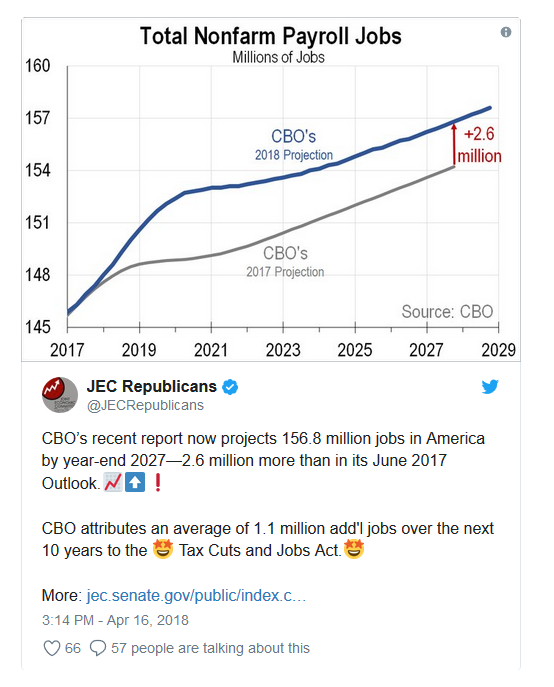
The article includes a chart showing revised economic growth estimates based on the growth that has already occurred because of the tax cuts:

The Congressional Budget Office (CBO) now projects 156.8 million jobs in America by year-end 2027—2.6 million more jobs than in its June 2017 Budget and Economic Outlook. CBO attributes an average of 1.1 million additional jobs over the next 10 years to the recently enacted Tax Cuts and Jobs Act.

On April 10, I posted an article detailing the Democrats plan to roll back the tax cuts and increase both personal and corporate taxes. That will bring us back to the slow economic growth we experienced under President Obama. The Republicans need to make sure that the American voters understand that–a vote for a Democratic Congressman is a vote for economic slowdown.

Economic policies do have consequences. That has become very obvious in the past year or so.

The Cost Of The Wall

One of the recent talking points used against those people who actually want to control our borders is the cost of building a wall. Obviously, Mexico will not directly pay for a wall–they enjoy having people come here illegally and send money back to Mexico. There is no incentive for them to put a stop to that behavior. So how do we pay for the wall?

Paul Sperry posted an article at The New York Post on Saturday that offers one possible solution.

The article reports:

Mexico won’t have to pay for the wall, after all. US taxpayers won’t have to pick up the tab, either. The controversial barrier, rather, will cover its own cost just by closing the border to illegal immigrants who tend to go on the federal dole.

That’s the finding of recent immigration studies showing the $18 billion wall President Trump plans to build along the southern border will pay for itself by curbing the importation of not only crime and drugs, but poverty.

“The wall could pay for itself even if it only modestly reduced illegal crossings and drug smuggling,” Steven A. Camarota, director of research at the Center for Immigration Studies, told The Post.

Federal data shows that a wall would work. A two-story corrugated metal fence in El Paso, Texas, first erected under the Bush administration has already curtailed illegal border crossings there by more than 89 percent over the five-year period during which it was built.

The problem is not only illegal immigrants–it’s drug smuggling. How much money and how many lives do the illegal drugs coming into America cost?

The article concludes:

While Democrats complain the $18 billion price tag for the Trump wall is too high, the “Dreamers” amnesty bill they want Trump and Republicans to pass in exchange for funding the wall (or ideally in spite of the wall) would cost US taxpayers even more than the construction of the border partition over 10 years.

“The cost of the DREAM Act has been estimated as very large — a $26 billion net cost in the first 10 years,” Camarota noted.

Indeed, the Congressional Budget Office recently estimated that 3 million DREAM Act recipients would receive an estimated $12 billion-plus in ObamaCare subsidies, more than $5.5 billion in Medicaid benefits, $5.5 billion in earned-income and child-tax credits and more than $2 billion in food stamps.

A bipartisan bill incorporating the deal was defeated in the Senate last month by a vote of 54-45. Trump rejected the proposal in favor of a tougher border bill introduced by Sen. Chuck Grassley (R-Iowa), which limits the number of DACA beneficiaries to 1.8 million, curbs family visas, or so-called chain migration, and phases out the diversity visa lottery, while earmarking $25 billion in funding for the wall and other border security.

The problem is not the money–the problem is the spending priorities.

This Is Not A New Idea

On Friday, The Daily Signal posted an article about a proposal before Congress asking taxpayers to make loans to private, union-run pension plans. This is a really bad idea. We have seen what has happened to the college loan program since the government took it over. Just in case you think the idea of the government bailing out union pension plans is far-fetched, I posted an article about this idea in October of 2010.

The article reports:

The Butch Lewis Act—a proposal to bail out private-sector pensions through loans as well as direct cash assistance—acknowledges the high probability of default by stipulating that pension plans that have trouble repaying their loans after 30 years of interest-only payments will be eligible for forgiveness or alternative repayment plans.

A loan with a zero-consequence default option for the borrower is not a loan—it’s a bailout.

But it’s not just defaults that taxpayers need to be concerned about. There’s also the cost of providing highly subsidized, low- or no-interest loans for 15 to 30 years, as well as the risk that plans will increase—rather than decrease—their unfunded liabilities over the course of their loans.

These features could lead to loans to insolvent pension plans costing taxpayers more than direct cash bailouts.

But those costs won’t be apparent in the official government score because the Congressional Budget Office is required to score loans under the assumption that insolvent pension plans are essentially riskless borrowers.

In reality, loans to insolvent pension plans could cost taxpayers hundreds of billions of dollars. The most liberal proposals—which supplement loans with direct cash assistance—could cost more than the entirety of multiemployer pensions’ half-trillion-dollar shortfall.

Does anyone really believe that these loans will be paid back? Union membership is down, and various courts are hearing cases that will make the mandatory payment of union dues by non-union members who work in a union shop illegal. Both of these factors will make the union retirement plans (actually a true Ponzi scheme) unsustainable.

The article concludes:

Coping with roughly $500 billion in private union pensions’ unfunded promises will not be easy. There are ways to minimize losses to workers who have earned pension benefits and protect taxpayers from paying for private pensions’ broken promises.

Policymakers should look to improve the solvency of the Pension Benefit Guaranty Corp.’s multiemployer program through premium increases and other reforms; end union pensions’ preferential treatment; enact and enforce sound funding rules; hold pension trustees liable for financial decisions; act sooner rather than later to enact needed reforms, including benefit reductions; and explicitly prohibit federal pension bailouts.

None of these actions provide a costless cure-all, but they offer more fair and rational solutions that don’t treat taxpayers as guarantors of private-sector promises or set the stage for even more mismanagement and reckless behavior.

There is no reason every American should pay for the fact that the unions have not sufficiently funded their retirement plans!

Losing Health Insurance Because You Want To

Yesterday National Review posted an article about the claims the Congressional Budget Office (CBO) is making regarding the number of people who would lose their health insurance if ObamaCare were repealed.

The article states:

Do you want to repeal every word of Obamacare and replace it with nothing? CBO says 22 million fewer people would have health insurance. Do you prefer replacing Obamacare with a system of flat tax credits, in which you get the same amount of assistance regardless of your financial need? CBO says 23 million fewer people would have health insurance. Do you prefer replacing Obamacare with means-tested tax credits, like the Senate bill does, in which the majority of the assistance is directed to those near or below the poverty line? CBO says 22 million fewer people would have health insurance.

22 million, 23 million, 22 million—these numbers are remarkably similar even though the three policies I describe above are significantly different. Why is that?

Thanks to information that was leaked to me by a congressional staffer, we now have the answer.

Nearly three-fourths of the difference in coverage between Obamacare and the various GOP plans derives from a single feature of the Republican bills: their repeal of Obamacare’s individual mandate. But the CBO has never published a year-by-year breakout of the impact of the individual mandate on its coverage estimates.

So actually, a large percentage of the people who would lose insurance coverage if ObamaCare is repealed would choose to lose coverage because they would no longer be penalized for not having insurance. Basically, the CBO report is spin! There is also the matter of ObamaCare requiring people to pay for coverage they don’t need. Generally speaking senior citizens do not need maternity coverage or pediatric dental coverage. They should not be asked to pay for it!