Food Stamps And Luxury Cars

The concept of helping Americans with grocery bills was introduced in the 1930’s. It was made possible by the introduction of the Federal Income Tax in 1913. It should be noted that Americans were told in 1913 that the Income Tax would only affect the top 1 to 3 percent of Americans. The program that began in the 1930’s ended in 1943 as the American economy recovered from the Depression because of World War II. Then in 1964 President Johnson supported a permanent Food Stamp program as part of the War on Poverty. So what has been the result of the Supplemental Nutrition Assistance Program (S.N.A.P.) ?

On April 22nd, The New York Post reported:

What do a university professor, a celebrity barber and a professional football player have in common?

All three bought new, six-figure luxury sports cars and lived lavish lifestyles — while collecting food stamps.

How on earth can these “welfare recipients” purchase high-end vehicles while remaining on the dole?

Thanks to a federal loophole known as Broad-Based Categorical Eligibility.

The Clinton administration manufactured this loophole, and the Obama administration supercharged it.

Currently, 43 states and Washington, DC, use BBCE to bypass federal Supplemental Nutrition Assistance Program eligibility limits on income, assets or both.

The mechanism, based on a federal law that was meant to minimize states’ administrative costs, is simple.

State welfare agencies print up a brochure about welfare programs, or set up an informational hotline, and deem it a “benefit” under the Temporary Assistance for Needy Families program.

Anyone who touches that pamphlet or receives the phone number is then treated as being “categorically eligible” for food stamps — even millionaires.

It’s fraud by design that distributes benefits intended for the truly needy to otherwise ineligible individuals, under the insidious goal of maximizing enrollment and dependency — and it works in almost every state.

Researchers from the Foundation for Government Accountability examined de-identified data on food-stamp enrollment in a single representative state.

The article lists some of the fraud that has been found so far. They have found IP addresses traced to foreign countries, including China, Mexico and Canada. More than 5,000 applicants in this state used foreign-based email addresses to apply,

The article notes:

Under 2025’s One Big Beautiful Bill Act, states with high food-stamp error rates will for the first time face steep federal penalties for their inaction.

Ending the BBCE loophole will move millions of ineligible enrollees off the program and save taxpayers more than $100 billion over the next decade.

Rebuilding verification infrastructure like data cross-matches, identity checks and residency confirmation will finally give caseworkers the ability to catch EBT fraud before the benefits ever go out the door.

I am beginning to believe that we could balance the federal budge if we simply eliminate the fraud.

This is the list posted on X of the cars owned by people receiving S.N.A.P. benefits in one state:

Stating The Obvious

On Friday, The Daily Signal posted an article about the results of the War on Poverty. The results have not been what the stated goals were, although they may reflect a different agenda than the one stated.

The article reports:

America’s “War on Poverty,” launched by President Lyndon Johnson in 1964, has expanded into a vast array of federal social welfare programs that today exceed $1 trillion per year.

Upon signing the Economic Opportunity Act, Johnson stated: “This is not in any sense a cynical proposal to exploit the poor with a promise of a handout,” but rather a means to “help our people find their footing for a long climb toward a better way of life.”

While poverty has declined significantly over the past half-century, however, recent reports indicate that these programs simultaneously reduced the share of private income for America’s poorest, locking them into long-term dependency and limiting their ability to move up into the middle class.

A recent study by economists Kevin Corinth and Richard Burkhauser, which analyzed poverty rates before and after America embarked on the War on Poverty, concluded that, while poverty decreased substantially since 1964, this was achieved largely by welfare supplanting “market” income such as wages, investments, and profits. In addition, before the 1960s, market income had succeeded in reducing poverty at similar rates to what the War on Poverty achieved.

“Our new research shows that the United States made strong progress in reducing poverty during the quarter century before the War on Poverty began, and that this progress was entirely accounted for by increases in market income, not government transfers,” Corinth told The Daily Signal. “In other words, there was a lot of benefit and not much cost during this earlier period.”

Before the War on Poverty, poverty reduction was achieved across racial groups. Economist Thomas Sowell wrote in 2004 that the poverty rate among black families fell from 87% in 1940 to 47% in 1960, without government assistance.

The article notes:

A January report by the Congressional Budget Office found that, for the poorest 20% of Americans, government payments increased from 26% of total income in 1979 to 42% in 2022. And as welfare programs expanded, market income for America’s poorest declined as a share of total income. Whereas in 1979, welfare payments were only about half the amount of private income sources for the lowest quintile, the two income sources were roughly equal by 2022.

According to a February report in The Daily Economy by analyst Tyler Turman, based on this Congressional Budget Office data, “despite historically unprecedented economic gains for low-income Americans, more of them are dependent on government assistance than at any point in the country’s history.”

The article concludes with a statement that probably describes the actual goal of the War on Poverty:

If the goal of the War on Poverty was to boost Americans’ self-sufficiency, it appears to have fallen short. What it has achieved, rather, is a costly expansion of government, long-term dependency for the poor, and a perennial voting bloc for politicians who feed the addiction.

Destroying America’s Foundation

The basic foundation of any western society is the family. Unfortunately many in the political left have been on a mission to destroy the American family since the 1960’s. On Wednesday The Daily Wire posted an article about the status of the two-parent family in America.

The article reports:

Children need a mother and a father — a context that more American youth than ever are lacking.

Among the 130 million households in the United States, only 17.8% feature married parents with children — down from over 40% in 1970, according to the Census Bureau.

The article quotes the Daily Mail:

There are currently just 23.1 million American homes with those ‘nuclear families,’ which is the fewest since 1959. The reasons given for the drop include the pandemic delaying marriage and a continued decline in birth rate.

The average age of a woman at her first marriage is now 28.6 years. In the 1950s and 60s, women typically married at 20.4 years old. The average age for men to marry for the first time in 2021 was 30.4 years old. America’s fertility rate dropped to 55.4 births per 1,000 in the second quarter of 2021, down from 58.5 in the same period of 2019.

Americans are also living alone at a higher rate than they used to. The percentage of adults in the US living with a spouse was 50 percent, down from 52 percent 10 years ago. Over 37 million adults lived alone in early 2021, up from 33 million in 2011. As far back as 1960, 87 percent of adults lived with a spouse.

Oddly enough, there is a government program that is related to this decline:

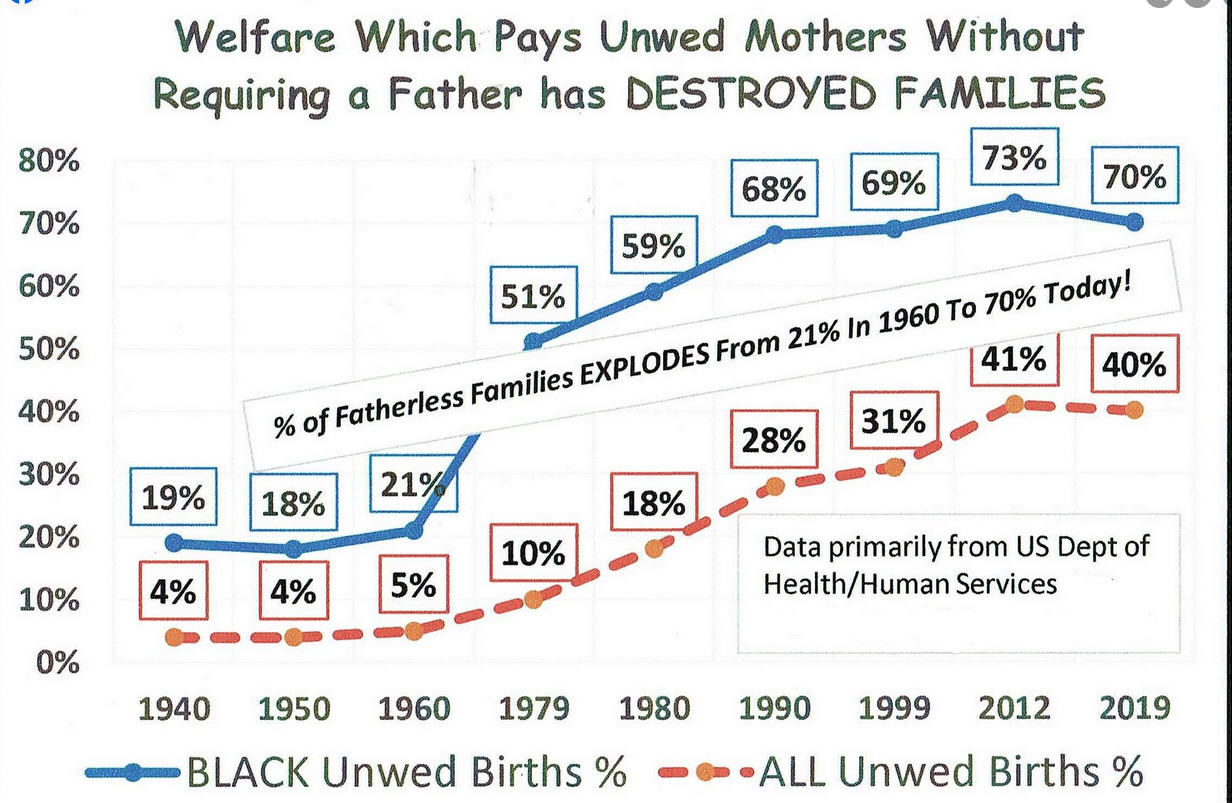
When the War on Poverty began paying single mothers, the number of single mothers increased. When the government subsidizes something, that something increases. Television also played a role in glamorizing single-parent families. Murphy Brown was a prime example.

The article at The Daily Wire also notes:

Analysts and commentators have pointed toward declining rates of religiosity, higher living expenses, the permutation of LGBTQ ideology, and even climate alarmism to explain the erosion of the American family. Indeed, the United States economy is already feeling pressure from the nation’s demographic crisis — for example, through the looming insolvency of Social Security and other programs.

I would suggest that a decline in acceptance of the basic values that America embraced before the 1970’s also plays a major role. Again, the culture has downplayed the importance of fathers and the role of mothers in raising their children. Children who grow up in stable two-parent homes have a much better chance of being successful and well-adjusted than children who grow up fatherless.

A Common Sense Approach To Saving Taxpayer Money

Welfare was meant to be a safety net–not a career choice. Unfortunately we have lost the war on poverty started by President Lyndon Johnson in the 1960’s. According to the social work degree center website, in the 1960’s, 22 percent of Americans lived below the poverty line. In 2014, 14.8 percent of Americans lived below the poverty line. In January 2016, The Daily Signal reported:

First, the War on Poverty has failed to achieve Johnson’s goal: to “strike at the causes, not just the consequences of poverty.” Since he declared “unconditional war,” poverty has thumbed its nose at its would-be conquerors.

The official poverty rate has hovered between ten and fifteen percent for 50 years. But that is only a part of the story. Since the 1960s, the institutions that contribute to self-sufficiency—namely, marriage and work—have declined. Today, more than 40 percent of children are born outside marriage; in 1964, only 7 percent were.

…Robert Rector, senior research fellow in domestic policy studies at the Heritage Foundation, writes that “taxpayers have spent $22 trillion on Johnson’s war. Adjusted for inflation, that’s three times the cost of all military wars since the American Revolution.” It’s time to change course. We need a new strategy against poverty.

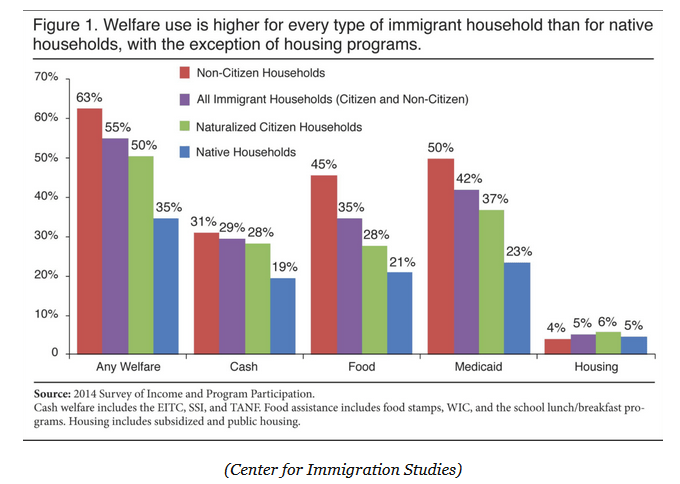
The changes in our culture are part of the problem, but there is another increasing problem–people who come to this country to take advantage of our generous welfare system.

Breitbart posted an article today stating:

President Trump is set to save American taxpayers billions of dollars as his administration announces a new rule on Monday that will essentially ban welfare-dependent legal immigrants from permanently resettling in the United States.

A new regulation set to be published by the Trump administration will ensure that legal immigrants would be less likely to secure a permanent residency in the U.S. if they have used any forms of welfare in the past, including using subsidized healthcare services, food stamps, and public housing.

Below is a chart of current welfare expenditures:

I have no problem with having a safety net, but it seems that our priorities are out of order. The first group of people that we should be helping are our veterans. Too many of them come home and need help to get on their feet when they separate from the military. I would like to see that as our first priority in welfare spending.

The article at Breitbart concludes:

Currently, there is an estimated record high of 44.5 million foreign-born residents living in the U.S. This is nearly quadruple the immigrant population in 2000. The vast majority of those arriving in the country every year are low-skilled legal immigrants who compete against working and middle-class Americans for jobs.

If we don’t get a handle on immigration, we are going to bankrupt America.

Poverty In America

Below are the U.S. Health and Human Services Poverty Guidelines:

This is a chart from The Heritage Foundation showing changes in the poverty rate since 1959:

As you can see, the War on Poverty actually slowed down the decrease in the poverty rate that had begun in 1950.

This is a chart from Pew Research showing how the American family has changed:

First of all, living in poverty in America is not the same as living in poverty in any other part of the world.

The Heritage Foundation reports:

Because the official Census poverty report undercounts welfare income, it fails to provide meaningful information about the actual living conditions of less affluent Americans. The government’s own data show that the actual living conditions of the more than 45 million people deemed “poor” by the Census Bureau differ greatly from popular conceptions of poverty.[7] Consider these facts taken from various government reports:[8]

  • Eighty percent of poor households have air conditioning. By contrast, at the beginning of the War on Poverty, only about 12 percent of the entire U.S. population enjoyed air conditioning.
  • Nearly three-quarters have a car or truck; 31 percent have two or more cars or trucks.[9]
  • Nearly two-thirds have cable or satellite television.
  • Two-thirds have at least one DVD player, and a quarter have two or more.
  • Half have a personal computer; one in seven has two or more computers.
  • More than half of poor families with children have a video game system such as an Xbox or PlayStation.
  • Forty-three percent have Internet access.
  • Forty percent have a wide-screen plasma or LCD TV.
  • A quarter have a digital video recorder system such as a TIVO.
  • Ninety-two percent of poor households have a microwave.

I think it’s time to examine closely the impact of the War on Poverty. One of the differences between business and government is that in business when something doesn’t work, you fix it. In government when something doesn’t work, you simply add more money to it. It is obvious which solution is more effective.

The goal of any poverty program should be to help people develop self-reliance and get out of the poverty program. Obviously that is not happening–we have generations of welfare recipients. Another goal of any poverty program should be to support the family unit. Obviously our current welfare programs do not do that. It’s time to reevaluate and redo our poverty programs–they are breaking the budget and not accomplishing their goals.

In March 2013, The Brookings Institute posted the following three rules to avoid poverty:

First, many poor children come from families that do not give them the kind of support that middle-class children get from their families. Second, as a result, these children enter kindergarten far behind their more advantaged peers and, on average, never catch up and even fall further behind. Third, in addition to the education deficit, poor children are more likely to make bad decisions that lead them to drop out of school, become teen parents, join gangs and break the law.

In addition to the thousands of local and national programs that aim to help young people avoid these life-altering problems, we should figure out more ways to convince young people that their decisions will greatly influence whether they avoid poverty and enter the middle class. Let politicians, schoolteachers and administrators, community leaders, ministers and parents drill into children the message that in a free society, they enter adulthood with three major responsibilities: at least finish high school, get a full-time job and wait until age 21 to get married and have children.

Our research shows that of American adults who followed these three simple rules, only about 2 percent are in poverty and nearly 75 percent have joined the middle class (defined as earning around $55,000 or more per year). There are surely influences other than these principles at play, but following them guides a young adult away from poverty and toward the middle class.

Those three rules should be the foundation of any poverty program.

Changing The Welfare Paradigm

On Tuesday The New York Post posted an article about President Trump’s Executive Order on welfare reform. The article notes that America currently has a very low unemployment rate and a very high number of people on welfare. That really does not seem to compute.

Investor’s Business Daily posted an editorial today on the subject.

The editorial reminds us of some of the history of welfare reform:

Although it was President Clinton who signed that sweeping welfare reform bill into law, plenty of Democrats were furious. Marion Wright Edelman, then head of the Children’s Defense Fund, called it a “moment of shame.” Illinois Sen. Paul Simon declared that “this isn’t welfare reform, it’s welfare denial.” Even now, many Democrats want to get rid of it.

And that’s despite its proven track record of success.

“In the past decade, welfare rolls have dropped substantially, from 12.2 million in 1996 to 4.5 million today. At the same time, caseloads declined by 45%. Sixty percent of mothers who left welfare found work, far surpassing predictions of experts.”

That was how Bill Clinton himself described the reform’s success a decade after he signed it into law.

The reforms that President Clinton put into effect were greatly loosened under President Obama, and welfare rolls soared. Part of that was due to the sluggish economy under President Obama, and part of that was due to the changes in the reforms.

The editorial concludes:

In Trump’s executive order, he makes the compelling case for expanding work requirements:

“Many of the programs designed to help families have instead delayed economic independence, perpetuated poverty, and weakened family bonds.

“While bipartisan welfare reform enacted in 1996 was a step toward eliminating the economic stagnation and social harm that can result from long-term government dependence, the welfare system still traps many recipients, especially children, in poverty and is in need of further reform and modernization in order to increase self-sufficiency, well-being, and economic mobility.”

Well said. But to make that happen, Republicans need to keep hammering away at this theme until it sinks into the public consciousness. And they need to turn around the metric used to define success to one that counts declining enrollment as a victory.

That’s the only way we will ever be able to turn the tide on what seems like a relentless and unstoppable expansion of the welfare state.

Senator Daniel Patrick “Pat” Moynihan wrote a report in 1965 predicting that the War on Poverty would destroy the African-American family. He was right. The welfare programs under the War on Poverty have also destroyed the white family. It is time that generational welfare becomes a bad memory of the past–not a present problem. Hopefully, President Trump has just taken the first step in that direction.,

Lying With False Statistics

When I heard the mainstream media claim that there had been eighteen school shootings this year, I wondered where I had been. It’s only February, and I just don’t remember anywhere near eighteen incidents of school shootings in the last month or so. Well, maybe my memory isn’t as bad as I thought–there haven’t been eighteen school shootings this year.

Investor’s Business Daily is one of many alternative news sources that debunked the claim.

The article explains what the real facts are:

One of the “school shootings” on the list, for example, involved a Greyson College, Tex., student who accidentally discharged a weapon at the school’s Criminal Justice Center during a class supervised by a police officer on how to use handguns.

Another on the list involved a third grader who accidentally pulled the trigger of a police officer’s holstered weapon.

Two were suicides that happened to take place on school grounds. One of them was a 31-year-old man who shot himself while parked in his car, which happened to be on a school lot— at a school that had been closed for seven months. Another was a student who shot himself in the head in the school’s bathroom.

Three “school shootings” involved fights that broke out between either adults or students in school parking lots — one of them at a college in North Carolina — in which one of the people arguing pulled a gun on the other.

Another student was shot by a robber, during a robbery that happened to take place in a school parking lot.

One involved a gun that a 12-year-old brought to school, which accidentally went off inside her backpack.

In fact, of the 18 “school shootings,” only five occurred during school hours, and only four — including the latest — are what most people would consider a school shooting; in which someone brings a gun to school with the intent of shooting students.

Of those three previous shootings, only one resulted in deaths, when a 15-year-old boy armed with a handgun opened fire inside a Kentucky high school and killed two fellow students while injuring 14 others. The two others resulted in two injuries.

Obviously one school shooting is too many, but it would be nice if the mainstream media at least tried to get the facts straight.

I would like to mention at this time some history about guns in school. I have friends from Ohio that tell me that their senior parking lot was filled with pick-up trucks with guns in the gun racks during hunting season. This was during the late 1970’s and early 1980’s. The parking lot was filled with guns and no one used them to shoot at students. My husband tells me that during the early 1950’s when he was in elementary school right outside of New York City, the school provided gun safety classes. The junior high had a shooting range and the high school shop allowed students to work on their guns. Obviously guns were brought into the schools and no one was shot.

So maybe the problem goes deeper than guns. What has happened to our society since the 1950’s? We took prayer out of schools in the 1960’s. At some point we removed the Ten Commandments from our schools. The value of both prayer and the Ten Commandments in the schools was that these two things promoted the idea that there would eventually be a higher authority that students would have to answer to. We have lost that idea–our current children believe that they are a law unto themselves. We taught children (and adults) that it was okay to kill a baby if it was inconvenient. We devalued the family and particularly the role of husbands through media and through government policies (See Senator Daniel Patrick Moynihan‘s comments on the War on Poverty programs). Our media has mocked Christianity, one of the things that historically provided unity in our nation and provided moral clarity. Maybe we need to look at restoring some of the things we have lost since the 1950’s.

We can’t change our culture overnight. It is also obvious that there are many people who do not want to bring back the Christian culture of the 1950’s. Because of that, it may be necessary to harden the security in our schools. There needs to be absolute control as to who enters our schools–the shooter in Florida had no reason to be inside the building. There also should be random (unidentified) teachers with concealed carry permits scattered throughout our schools. That way if an unfortunate incident unfolds, it can be dealt with quickly. Making schools ‘gun-free zones’ simply means that the targets of a shooter will be unarmed. That policy needs to end quickly.


Work Works

Yesterday The Daily Signal posted an article about the House Ways and Means Committee hearing on welfare reform. The Committee is seeking a way to help poor Americans get out of poverty.

The article reports:

The hearing, titled “Moving America’s Families Forward: Setting Priorities for Reducing Poverty and Expanding Opportunity” examined the welfare system. One area of reform examined was work requirements for individuals receiving welfare.

…“I have a personal relationship with this situation, where I started out, and my family started out, in public housing,” Rep. Diane Black, R-Tenn., said at  the hearing. “I know what hard work could do to put me to where I am today, from living in the halls of public housing to serving in the halls of Congress.”

In his testimony, Bragdon ( Tarren Bragdon, CEO of the Foundation for Government Accountability) used two states as examples, Kansas and Maine, that have restored work requirements for welfare programs. In Maine, “Thousands of able-bodied adults leaving food stamps found jobs and increased their hours, leading their incomes to rise by 114 percent on average. And in both states, that higher income more than offset the food stamps they lost, leaving them better off than they had been on welfare,” Bragdon said in his written testimony.

“It turns out work works,” Bragdon said. Bragdon testified that work requirements for able-bodied adults would likely deal with much of the fraud happening in the welfare system.

President Lyndon B. Johnson introduced the idea of ‘declaring war on poverty’ in his State of the Union address in 1964. The chart below shows the impact of the legislation that followed:

PovertyRate1959to2014Although we initially made some progress, it seems as if we have lost the war on poverty. It’s time to rethink our strategy.

The article concludes:

On Tuesday, the Ways and Means Committee passed two bills related to the Temporary Assistance for Needy Families (TANF) program that provides assistance to families in need.

“These bills are part of a commonsense package of proposals to ensure TANF – one of the nation’s most important anti-poverty programs – effectively spends taxpayer dollars to help those most in need,” a blog post from the committee says.

Robert Rector, a senior research fellow at The Heritage Foundation, says the legislation “undermines work requirements” in the TANF program.

“Rhetoric aside, the Ways and Means Committee legislation actually undermines work requirements in TANF,” Rector, who played a key role in writing the original TANF legislation twenty years ago, told The Daily Signal. “A key principle of workfare is that parents who refuse to participate should have their  welfare checks halted. Ironically, the legislation financially penalizes states for doing this. The bill shifts from the successful ‘work first’ strategy embodied in the original law to a social service and training model that has a very long history of failure.”

If Congress cannot figure out something that is so completely obvious, maybe it is time for a new Congress.

Ending Poverty In America

The War on Poverty has been a massive failure. Mostly because it never got near the root of the problem. Yesterday The Daily Signal posted an article that might help us successfully fight poverty and also grow the economy.

The article stated:

States with the highest share of married-parent families are better off than states with the lowest share of such families. They have $1,451 more in per capita GDP, 10.5 percent more upward mobility for low-income children, a 13.2 percent decrease in child poverty, and $3,654 more in median family income. (The researchers controlled for factors such as education, a state’s racial composition, tax policies, and education spending.)

This is the graph included in the article:

WilcoxReport_Chart1_Sheffield

The numbers are convincing. Senator Daniel Patrick Moynihan stated his concerns about the disintegration of the black family in 1965. Since then, welfare programs have a negative impact on families of all races by limiting benefits to two-parent families. The way out of poverty is not giving away more money–it is reasserting the value of the family and creating a culture that encourages intact families.  Television and movies could play a positive role in that if they chose. Until Americans begin to support families and encourage marriage and monogamy, we can expect to spend more money on social programs and get less results.

The Current American Welfare System

Yesterday The Daily Signal posted an article about the current state of American welfare spending. It seems that those leaders who believe that we should become more like Europe and Scandinavia in our welfare spending practices might want to take another look.

The article reports:

The U.S. Census Bureau has released its annual poverty report. Conventional wisdom holds that the U.S. has a small social welfare system and far more poverty compared with other affluent nations. But noted liberal scholars Irwin Garfinkel, Lee Rainwater, and Timothy Smeeding challenge such simplistic ideas in their book “Wealth and Welfare States: Is America a Laggard or Leader?”

Garfinkel and his colleagues examine social welfare spending and poverty in rich nations. They define social welfare as having five components: health care spending, education spending, cash retirement benefits, other government cash transfers such as unemployment insurance and the earned-income tax credit (EITC), and non-cash aid such as food stamps and public housing.

The authors find that in the U.S., social welfare spending differs from that in other affluent countries because it draws heavily on both public and private resources. By contrast, in Europe, government controls most of the resources and benefits. For example, in the U.S., government health care spending is targeted to elderly and low-income persons; the American middle and working classes rely primarily on employer-provided health insurance. The U.S. government health care system is, therefore, more redistributive than the systems of most other developed nations.

Note to Bernie Sanders–we are already redistributing wealth.

The article goes on to explain that ‘poor’ families in America usually have air-conditioning, a car, and cable or satellite television. Poverty in America looks very different than poverty in many other parts of the world.

The article concludes:

It is, of course, a good thing that left-wing claims of widespread deprivation in the U.S. are inaccurate. But government welfare policy should be about more than shoveling out a trillion dollars per year in “free” benefits. When President Lyndon Johnson launched the War on Poverty, he sought to decrease welfare dependence and increase self-sufficiency: the ability of family to support itself above poverty without the need for government handouts. By that score, the War on Poverty has been a $24-trillion flop. While self-sufficiency improved dramatically in the decades before the War on Poverty started, for the last 45 years, it has been at a standstill.

A decent welfare system would return to Johnson’s original goal of reducing poverty by increasing self-sufficiency. It would require able-bodied recipients to work or prepare for work if they are to receive benefits. It would reward, not penalize, marriage. In other words, it would be the exact opposite of the welfare behemoth we currently have.

We have lost the War on Poverty. We are spending billions of dollars to create generational dependency rather than to create economic independence. It is time to refocus and encourage working instead of collecting money from the government. This process was begun under President Clinton (with the assistance of Newt Gingrich), but halted under President Obama. It’s time to bring a work requirement back into the welfare program. Please  follow the link and read the TopRightNews article about what is happening in Maine to bring welfare programs back under control.

When People Are Not Optimistic, They Don’t Have Children

Breitbart.com posted an article today about the declining birthrate in America.

The article reports:

The birth rate among that group dropped 15 percent between 2007 and 2012. The study postulated that the reason for the decline in births was the recession. Nan Marie Astone, one of the report’s authors, said, “It’s hard to think that [the economic decline] wasn’t the reason.”

The period in question saw a “dramatic decline in birth rates among unmarried” black and Latino women and a concomitant drop in the number of white married women. Latino women’s births plummeted 26 percent, black women’s 14 percent, and white women’s 11 percent.

The report stated, “We calculate that in 2012, women in their twenties had births at a pace that would lead to 948 births per 1,000 women, by far the slowest pace of any generation of young women in U.S. history… If these low birth rates to women in their twenties continue, the U.S. might eventually face the type of generational imbalance that currently characterizes Japan and some European countries, but it is too early to predict or worry about that eventuality.”

People who are not optimistic about the future tend to put off having children.

Another aspect of this story:

Of course, the study ignores one salient fact. According to the Guttmacher Institute, over 5.6 million abortions were performed between 2007 and 2011.

There is another aspect of the decline in the birthright that should be mentioned. Since the 1960’s women have told that they need to work outside the home to be ‘fulfilled.’ Motherhood has been devalued. At the same time, the tax burden on the American family has risen sharply due to the War on Poverty (which we seem to have lost) and the Great Society. As a society, we have been dealing with this mindset and these economic forces for fifty years. I believe that the drop in the birthrate is a reflection of this mindset and those forces. Until we begin to see the value of the two parent family in a traditional marriage, we will continue to see the building blocks of our society weakened. The hand that rocks the cradle rules the world, and right now our government is that hand. Parents need to be aware of who is raising their children and begin to take back the responsibility of having and raising their children. We can restore the family by shrinking the role of government and cutting taxes. Look at the percentage of people’s income that went to taxes before we declared war on poverty. Look at the number of intact poor families before we declared war on poverty.  Our values need to change so that women have the option of staying home if they choose to (without it being a financial strain on the family). At that point, we will see the birthrate come back to a level that is healthy for our society.

We Fought The War On Poverty And We Lost

The war on poverty began in the 1960’s. In 1959, the poverty rate was 22.4%. In 1969, shortly after the war on poverty began, the poverty rate was 12.1%. Today the poverty rate is 16.1%. It looks to me as though we are losing ground–not gaining it.

These figures are from an article in Forbes Magazine posted yesterday. The article points out:

Federal and state governments spend a trillion dollars a year just on these means tested welfare programs, which does not include Social and Medicare. That is more than we spend on national defense. It adds up to roughly $17,000 per person in poverty, over $50,000 for a poor family of three. The Census Bureau estimates that our current welfare spending totals four times what would be necessary just to give all of the poor the cash to bring them up to the poverty line, eliminating all poverty in America. A recent book by Charles Murray, In These Hands, further documents that.

The article also points out that from 1965 to 2008 the total amount of money spent on means tested welfare is nearly $16 trillion–in 2008 dollars. That is double the amount America has spent on military conflicts from the Revolution until today.

The article reports:

One major reason that poverty stopped declining after the War on Poverty started is that the poor and lower income population stopped working. In 1960, nearly two-thirds of households in the lowest income one-fifth of the population were headed by persons who worked. But by 1991, this work effort had declined by about 50%, with only one-third of household heads in the bottom 20% in income working, and only 11% working full-time, year round.

The war on poverty has also destroyed low-income families and increased the number of out-of-wedlock births. It has increased the number of one parent homes and children with two unmarried parents.

Please follow the link above and read to entire article. The article explains the negative impact the war on poverty has had on our society. It also explains how to solve some of the problems associated with the way the current welfare state is funded. We need to change the way we help those among us who are less fortunate. What we are currently doing is not working.

Enhanced by Zemanta

One Place We Need To Consider Cutting The Budget

I realize that I am about to sound like Scrooge at Christmas, but I really feel this situation is getting out of hand.

From The Weekly Standard:

The article is not clear on how much of that money goes to the recipient and how much supports the bureaucracy; but either way, I think we need to do some re-evaluating of the success of our poverty programs.

There is no incentive for someone in government to help someone on welfare get off of welfare–if there is no one on welfare, the government worker has no program to administer. There is no incentive for the person on welfare to get off of welfare because not working takes less effort than working. Also, in many cases, welfare pays more than working. Thus our welfare programs have become the government equivalent of a perpetual motion machine.

The article at The Weekly Standard states:

For fiscal year 2011, CRS identified roughly 80 overlapping federal means-tested welfare programs that together represented the single largest budget item in 2011—more than the nation spends on Social Security, Medicare, or national defense.

…The diffuse and overlapping nature of federal welfare spending has led to some confusion regarding the scope and nature of benefits. For instance, Newark Mayor Cory Booker has recently received a great deal of attention for adopting the “food stamp diet” in which he spends only $4 a day on food (the median individual benefit) to apparently illustrate the insufficiency of food stamp spending ($80 billion a year) or the impossibility of reductions. The situation Booker presents, however, is not accurate: a low-income individual on food stamps may qualify for $25,000 in various forms of welfare support from the federal government on top of his or her existing income and resources—including access to 15 different food assistance programs. Further, even if one unrealistically assumes that no other welfare benefits are available, the size of the food stamp benefit increases as one’s income decreases, as the benefit is designed as a supplement to existing resources; it is explicitly not intended to be the sole source of funds for purchasing food.

It’s time for a Mulligan on welfare programs. We fought the war on poverty and we lost.

Enhanced by Zemanta