One Result Of The Big Beautiful Bill

On Saturday, Just the News posted an article about the impact of the One Big Beautiful Bill on Americans’ tax refunds.

The article reports:

The Internal Revenue Service issued $296 billion in refunds during the 2026 filing season, a 17% increase from the previous year, as millions of Americans benefited from President Donald Trump’s signature tax law, according to a new Government Accountability Office report.

The increase represented $43 billion more in refunds than the IRS had issued during the 2025 filing season for tax year 2024. The average refund also increased by $333, or 11%, compared with the previous year, according to the full report.

The GAO attributed the larger refunds, in part, to millions of taxpayers claiming new deductions created by recent tax law changes in Trump’s One Big Beautiful Bill Act (OBBB), including provisions allowing deductions for qualified tips and overtime.

The IRS also issued more refunds overall, sending out more than 8 million additional refunds compared with 2025.

The increase in refunds came as the agency faced delays affecting taxpayers who received their money by paper check.

The article notes the advantage of filing electronically and receiving your return electronically:

Still, taxpayers who had filed paper returns or relied on paper refund checks had faced significant delays.

“Most paper check refunds were delayed by weeks,” the GAO reported, as the IRS had moved toward issuing refunds primarily through direct deposit.

The IRS sent approximately 4.2 million notices to taxpayers by early May asking them to provide bank account information to allow for electronic delivery of their refunds.

Taxpayers who had not responded were told they would receive a paper check after six weeks.

As a result, the number of paper-check refunds issued by early April had plunged more than 80%, from about 2.8 million in 2025 to roughly 493,000 in 2026. Those who had received paper checks waited an average of 36 days, compared with 13 days the previous year.

The GAO found that the IRS had therefore taken about three times longer to issue paper-check refunds than it had in 2025.

Taxpayers using direct deposit generally avoided the worst of the delays.

According to the report, nine out of 10 refunds issued through direct deposit had arrived within 21 days.

According to Artificial Intelligence, this is who pays taxes in America:

In the U.S., the top 1% of earners, who make over $663,164, paid approximately 40.4% of federal income taxes in 2022, while the top 50% of earners contributed about 97% of total federal income taxes.

Federal Tax Contributions by Income Group

Understanding the distribution of federal tax payments reveals significant disparities.

    • Top 1% — They earned 22.2% of total Adjusted Gross Income (AGI) and paid 42.3% of federal income taxes.
    • Top 50% — This group accounted for 97% of all federal individual income taxes.
    • Bottom 50% — They contributed only 3% of federal income taxes.
    • Top 5% — In 2023, they paid over $1.27 trillion in income taxes, about 60% of the total.
    • Progressive Tax System — High-income earners pay higher average tax rates, emphasizing the system’s progressive nature.

Whenever someone tells you that the rich don’t pay their fair share, show them these numbers.
Comparing Apples To Apples

Most of us understand that the media is biased and slants its articles accordingly. The challenge for voters is to look past the obvious to make sure what they are reading is actually true. One recent example of misrepresenting a basic fact is the way the Trump tax cuts are being reported.

On February 13th The Daily Signal posted an article illustrating the fake news regarding the tax cuts.

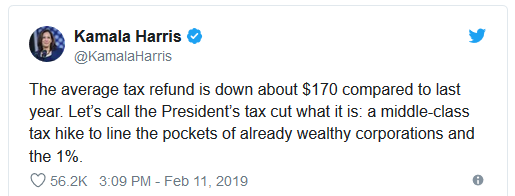
The article includes the following tweet:

The article explains the problem with her statement:

This is simply the latest episode in a long-running campaign to demagogue tax cuts that let the vast majority of Americans keep more of their hard-earned money.

Some of the biggest cuts are actually being enjoyed by the lowest-income Americans. A typical family of four got a $2,917 tax cut this year.

…So what’s the complaint about?

In an early sample of tax returns, the IRS has reported that average refunds are down $170 from last year and that they hadn’t changed much from 2017, the year before.

But this is not relevant, for two reasons.

First, the sample of tax returns cited by the IRS is very small, and some analysts expect refunds will actually go up this year.

But second, and more importantly, tax refunds have nothing to do with the size of anyone’s tax cut. A refund is what you get back if you’ve paid too much in taxes throughout the year. Your tax cut is the drop in total taxes you owed to Uncle Sam last year. The two are not connected.

Employers across the country already gave us our tax cuts by withholding less money from our paychecks every pay period. Americans saw a bump to their paychecks in February 2018.

Of course, withholding is never perfectly accurate, so your refund or tax payment at the end of the year is simply a last-minute adjustment. But that refund does not cancel out the overall bump in take-home pay due to the tax cut.

Do you remember when House Speaker Nancy Pelosi called the tax cuts “monumental, brazen theft,” or when former Treasury Secretary Larry Summers predicted the tax cuts would kill 10,000 people every year? This most recent round of hysteria is just more of the same.

Be prepared for more false stories as the 2020 election grows closer.

Most People Got Bigger Tax Refunds This Year Than Last Year

Yesterday Hot Air posted an article about this year’s tax refunds. The article was in response to a Washington Post article claiming that people were getting lower tax refunds this year than last year.

The article at Hot Air pointed out a number of things that might result in getting a smaller tax refund:

But since we have to play this game, let’s figure out why your refund is smaller. Did you get a raise or a significant bonus last year? Did you perhaps start a new job that pays more? Were there any other major changes in your financial situation? Tax filing company Intuit has a list of possible explanations you could look for. They include things such as your filing status changing, the selling of assets or the possibility that you were hit with a penalty.

There will be a small number of people who lost out on part of their SALT (state and local tax) deductions, but that should really only have a significant impact on people in high-tax states like New York who are earning well into six figures. As for everyone else, if your income went up, did you adjust your withholdings accordingly? If not, perhaps you need to have a chat with an accountant.

The article also reminds us that a tax refund is a refund of the money that you gave to the government during the year. You allowed them to have that money interest free until you filed your tax return and they were obligated to give the money back to you. Ideally, your tax refund should be small–that means that you correctly calculated the amount of money you actually owed the government. The question is not how big your tax refund is–the question is how much money you actually paid in taxes. The size of your tax refund is simply a reflection of how much money the government took from you during the year.

The Need For Fiscal Responsibility In Washington

Yesterday The Washington Times reported that the Internal Revenue Service was extremely generous with taxpayer money–paying millions of dollars in refunds to people who were not legally entitled to them.

The article reports:

The IRS doled out more than $24 billion in potentially bogus refunds claimed under several controversial tax credits in 2016, according to a new audit that said $118 million was even paid to people who weren’t authorized to work in the U.S. in the first place.

Some $16.8 billion in payments were made on improper claims under the Earned Income Tax Credit, signifying a 24 percent error rate. Investigators also estimated $7.2 billion in improper payments for the Additional Child Tax Credit, representing 25 percent of the total, and $1.1 billion in improper payments, or 24 percent, for a higher education tax credit.

The totals and error rates for the earned income and child credits were comparable for 2015, while the education tax credit saw improvement.

The article explains that Congress passed a law in 2015 that was supposed to curb payments to people who were not entitled to them.

The article reports:

Both the inspector general and the tax agency said that steps have already been taken to try to prevent a repeat in the future, saying that a law passed in late 2015 should help.

Treasury Inspector General for Tax Administration J. Russell George said the IRS needs to follow through on the 2015 law, which imposes more restrictions on certain filers and delays refunds for people claiming the credits to give agents more time to flag suspicious returns.

One particular problem the IRS faces is checking people who have Social Security numbers but who aren’t authorized to work in the U.S.

This is one place that the federal budget could be easily cut. Tax refunds should only go to the people entitled to receive them.