We Need A Fair Search Engine!

On Tuesday, Hot Air posted an article about Google and Google searches. Searching for a politically conservative link on Google is like looking for ice cubes in the Sahara Desert.

The article reports:

When we first learned that Google’s autocomplete function in its search engine appeared to be blocking suggestions about Donald Trump’s attempted assassination (or even his name), the company assured us that those results were simply “an anomaly” in the code. But the House Judiciary Committee has been digging into the question more deeply and asked parent company Alphabet’s legal counsel to explain further. The answers the committee received weren’t exactly definitive, but they may provide a bit of additional clarity. First of all, the search engine absolutely was blocking autofill from pointing users to articles about the assassination attempt. But was it out of some bias against Trump? According to them, the system was performing as designed, but the design was overly broad. We’ll look into it a bit further here this evening. (National Review)

The article concludes that the blocking may not have been intentional politics, but a filter to prevent malfeasance.

The article concludes:

As to the far more damning searches for information about the assassination attempt, it was easy enough to note that the shooting created an iconic moment for President Trump and his approval ratings and donations were surging. A liberal outlet could easily be tempted to suppress such search results. But in reality, anyone searching for information related to trying to assassinate a President would no doubt raise red flags across the board. The FBI would (or at least should) be interested in any persons conducting such a search. Would it be that surprising that their default filters would prevent the autocomplete, typeahead function from refusing to fill in questions such as “How could I ass**ate President D*****”?” ( I won’t even type it out here or we will be blocked as well.)

The code underlying the search engines is smart, but it’s not “human smart.” I believe that they had such a filter in place to cover all such eventualities. And after the flaw was discovered, they had to go in and manually revise it to allow for searches dealing with news of the events in Butler, Pennsylvania. I’m generally not shy about criticizing Google and Alphabet, but in this case I believe I’m going to give them a pass.

That’s the word from someone who deals with search engines every day.

How The Internet Impacts Elections

Search engines are a useful tool. However, search engines are biased. As someone who is constantly looking for information on the internet, I can tell you that it is very unusual for me to find an article without a liberal slant on the first three pages of a search engine result. And I am using and have used search engines that are supposed to be unbiased. During the election season, biased search engines are a problem. The voters need to access both sides of a story, and that can be very difficult.

On Wednesday, Newsbusters posted an article about some of their recent experiences with search engines.

The article reports:

MRC researchers searched Google using a “clean environment” (without the influence of prior search history and tracking cookies) and found that the search giant completely eliminated Donald Trump’s website from the top 100 search results, while pushing President Joe Biden’s campaign website up to the number one spot.

Researchers conducted three separate searches for the top three candidate’s names along with the words “presidential race 2024.” While the results for Trump brought up seemingly endless 2024 election updates, including news articles, polls and commentaries, the search engine did not display the candidate’s campaign website.

Google, however, had no issues displaying Joe Biden’s campaign website as the first result in an equivalent search. Independent candidate Robert F. Kennedy Jr.’s website appeared as the fourth result in a similar search.

MRC Free Speech America Vice President Dan Schneider commented on Google’s tone-deaf bias in the aftermath of an assassination attempt on Trump. “Other left-wing media outlets and platforms are taking a pause from their anti-Trump tactics, but not Google,” he said. “The search giant has doubled down on its anti-American, election interference strategies.”

Schneider continued: “People who often do political searches on their computers will likely get different results since Google tracks their search history. But this study reflects a much darker, more sinister behavior at Google. It is through this kind of data manipulation that Google swayed millions of votes in the 2020 election. It must not be allowed to corrupt our democracy.”

The importance of where a search result appears on the first page of a Google search cannot be overstated. Not only is Google the go-to search engine for most people, holding a market share of nearly 92 percent worldwide, but the higher a search result appears, the more likely a user will click on a particular result, according to Brian Dean, a search engine optimization expert.

Never be hesitant to go to page two or three of whatever you need to find information that is not totally biased. It’s unfortunate that Google does this, but the American voters are smart enough to get around it.

Still Playing The Game

The Washington Free Beacon posted an article yesterday that explains why many people are moving away from Google as a search engine. Other than the fact that Google tracks your searches (DuckDuckGo.com does not), Google is not an unbiased search engine. It has a political agenda despite claims to the contrary.

The news of the day Friday was that there would be no further indictments in the Mueller investigation. If you went looking for that news on Google, it would not be immediately obvious.

The article illustrates:

Using Google search on multiple browsers and on private-browsing mode, the Free Beacon found Google search had an aversion to the search term “indictment.”

Using either “Trump” or “Mueller” as the subject, the following word “indictment” was not suggested even after spelling out most of it. For example, putting “Trump indi” into Google’s search bar does not lead to “Trump indictment” but rather to “Trump India,” “Trump India Pakistan,” Trump India tariffs,” and “Trump Indiana.”

Seems like Google might have overlooked the obvious. When “Mueller ind” was entered, the results were similar. The article also includes screenshots of Yahoo and Bing when the letters “Trump ind” and “Mueller ind” were entered. The first entries that came up were “Trump indictment” and “Mueller indictments”.

The article concludes:

Google was previously accused of pushing positive stories about Hillary Clinton during the 2016 election.

Google CEO Sundar Pichai has denied this kind of bias occurs in its search results, saying so repeatedly in a congressional hearing last year. Democrats, however, seemed to undermine Pichai’s message by arguing in that hearing that Google is free to suppress conservatives in its search results if it so desires. Pichai said such suppression of different views would violate the company’s “core principles,” although an executive was caught emailing about making sure Google services helped Hillary Clinton in 2016.

The company’s fidelity to principles of free expression has also come under scrutiny as it has continued to work with Xi Jinping’s autocratic regime in China. Because of severe free speech restrictions in that country, Google had been developing a special search engine “Dragonfly” that would block topics disapproved by the regime, including history about China and the Communist Party. Dragonfly was put on hold after it spawned an outcry against Google, but employees have expressed concern that it’s being developed in secret.

Domestically, the Silicon Valley giant is also dealing with pressure to have its products more strictly regulated. Democratic presidential candidate and Massachusetts senator Elizabeth Warren (D.) has called for breaking up major tech companies on anti-trust grounds.

On a somewhat related personal note, when I began this blog in 2008, Facebook was a good source of articles posted by conservative friends and conservative sources. Blogging was very easy. That has changed in recent years–many friends have spent time in Facebook jail, and many conservative sources have been blocked. Social media in its freest state is a wonderful thing, but gradually those in charge of social media have been removing our freedom. All Americans need to be vigilant about what they read on social media and also about what search engine they use. That is sad, but necessary.


Don’t Look For Me On The First Page Of A Google Search

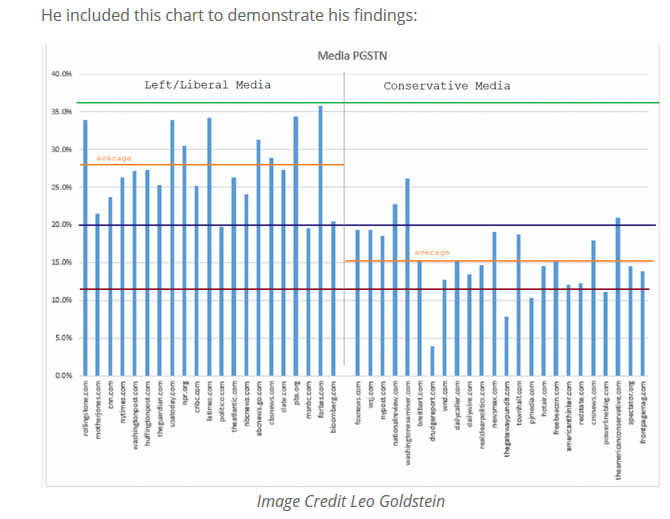
Yesterday PJ Media posted an article about a new research paper from Leo Goldstein.

The article reports the following:

Google Search is found to be biased in favor of left/liberal domains and against conservative domains with a confidence of 95%,” Goldstein found. “Further, certain hard-Left domains have such a high [percentage of domain traffic, referred by Google Search, net of brand searches] that their standing raises suspicions that they have been hand-picked for prominent placement,” he says, adding that “certain respected conservative domains are blacklisted.”

The article includes the following chart:

Conservatives need to realize that they are going to have to get smarter in their research about the news. I strongly recommend DuckDuckGo as a search engine. Not only are their searches unbiased–they don’t keep track of your searches. It’s time for google to lose its users and its advertisers. That is one way conservatives can make their voices heard.