Why We Need To Increase Defense Spending

The Heritage Foundation has posted highlights from the 2017 Index of U.S. Military Strength and the 2016 Index of U.S. Military Strength. I strongly suggest following the links and reading the report summaries, but I can give you the bullet points here:

From 2016:From 2017:

This is the summary of the 2017 Report:

Overall, the 2017 Index concludes that the current U.S. military force is capable of meeting the demands of a single major regional conflict while also attending to various presence and engagement activities—something it is doing now and has done for the past two decades—but that it would be very hard-pressed to do more and certainly would be ill-equipped to handle two nearly simultaneous major regional contingencies. The consistent decline in funding and the consequent shrinking of the force over the past few years have placed it under significant pressure. Essential maintenance continues to be deferred; the availability of fewer units for operational deployments increases the frequency and length of deployments; and old equipment is being extended while programmed replacements are either delayed or beset by developmental difficulties.

The military services have continued to prioritize readiness for current operations by shifting funding to deployed or soon-to-deploy units at the expense of keeping units that are not deployed in “ready” condition; delaying, reducing, extending, or canceling modernization programs; and sustaining the reduction in size and number of military units. These choices and their resulting condition, driven by the lack of funding dedicated to defense, hazard America’s ability to secure its interests now and erode America’s ability to shape conditions to its advantage by assuring allies and deterring competitors.

As currently postured, the U.S. military is only marginally able to meet the demands of defending America’s vital national interests.

If we are to remain free and protect our citizens, I believe that we have to increase our defense spending.

Work Works

Yesterday The Daily Signal posted an article about the House Ways and Means Committee hearing on welfare reform. The Committee is seeking a way to help poor Americans get out of poverty.

The article reports:

The hearing, titled “Moving America’s Families Forward: Setting Priorities for Reducing Poverty and Expanding Opportunity” examined the welfare system. One area of reform examined was work requirements for individuals receiving welfare.

…“I have a personal relationship with this situation, where I started out, and my family started out, in public housing,” Rep. Diane Black, R-Tenn., said at  the hearing. “I know what hard work could do to put me to where I am today, from living in the halls of public housing to serving in the halls of Congress.”

In his testimony, Bragdon ( Tarren Bragdon, CEO of the Foundation for Government Accountability) used two states as examples, Kansas and Maine, that have restored work requirements for welfare programs. In Maine, “Thousands of able-bodied adults leaving food stamps found jobs and increased their hours, leading their incomes to rise by 114 percent on average. And in both states, that higher income more than offset the food stamps they lost, leaving them better off than they had been on welfare,” Bragdon said in his written testimony.

“It turns out work works,” Bragdon said. Bragdon testified that work requirements for able-bodied adults would likely deal with much of the fraud happening in the welfare system.

President Lyndon B. Johnson introduced the idea of ‘declaring war on poverty’ in his State of the Union address in 1964. The chart below shows the impact of the legislation that followed:

PovertyRate1959to2014Although we initially made some progress, it seems as if we have lost the war on poverty. It’s time to rethink our strategy.

The article concludes:

On Tuesday, the Ways and Means Committee passed two bills related to the Temporary Assistance for Needy Families (TANF) program that provides assistance to families in need.

“These bills are part of a commonsense package of proposals to ensure TANF – one of the nation’s most important anti-poverty programs – effectively spends taxpayer dollars to help those most in need,” a blog post from the committee says.

Robert Rector, a senior research fellow at The Heritage Foundation, says the legislation “undermines work requirements” in the TANF program.

“Rhetoric aside, the Ways and Means Committee legislation actually undermines work requirements in TANF,” Rector, who played a key role in writing the original TANF legislation twenty years ago, told The Daily Signal. “A key principle of workfare is that parents who refuse to participate should have their  welfare checks halted. Ironically, the legislation financially penalizes states for doing this. The bill shifts from the successful ‘work first’ strategy embodied in the original law to a social service and training model that has a very long history of failure.”

If Congress cannot figure out something that is so completely obvious, maybe it is time for a new Congress.

Who Is Actually Working?

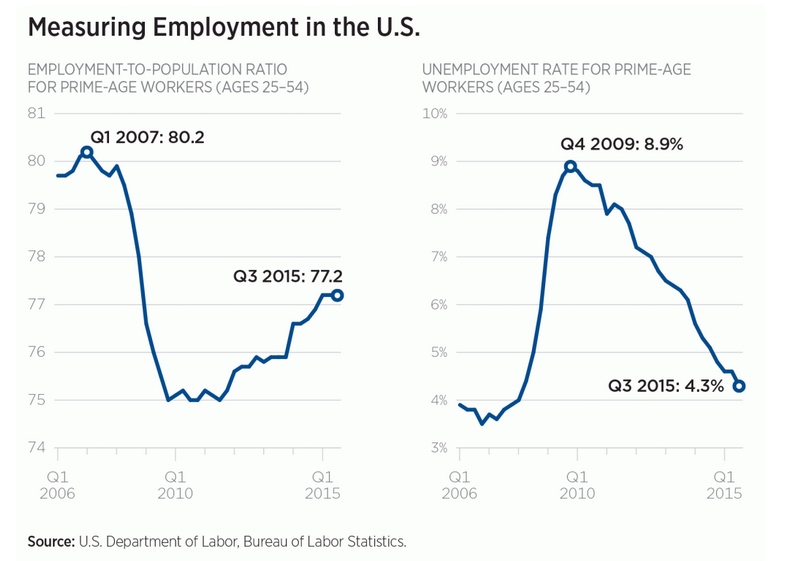
The economic recovery under President Obama has been weak. The Heritage Foundation posted the following graph of our unemployment situation:

EmploymentInTheUSThat tells part of the story, but there is another part that is not being widely told. The Washington Free Beacon posted a story yesterday showing that more foreign workers are employed in America than Americans. That is not encouraging news.

The article reports:

A record-high average of 24,963,000 foreign-born workers were employed in the United States in 2015, according to data released Thursday by the Bureau of Labor Statistics.

According to the bureau, foreign-born individuals include legally admitted immigrants, refugees, temporary residents such as students and temporary workers, and undocumented immigrants.

The bureau began recording this data in 2002. At that time, there were nearly 19 million foreign-born workers employed in the United States. The number has increased by 31.4 percent since then.

While the average number of native-born workers employed also reached a record high in 2015, it did not increase at the same rate as foreign-born workers. In 2015, there were an average of 123,871,000 native-born workers employed, up from 117,487,000 workers employed in 2002, an increase of 5.4 percent.

Additionally, the bureau found that the unemployment rate for foreign-born persons was 4.9 percent for 2015, lower than the 5.4 percent unemployment rate for the native born.

I suppose there are a lot of reasons for hiring foreign-born workers–foreign-born workers are generally willing to work for a lower wage than American workers, foreign-born workers may have a better work ethic than the one we have been teaching Americans, and foreign-born workers may be more inclined to take jobs Americans are not interesting in doing. It may be in a company’s best interest to hire foreign-born workers for the above reasons.

So what is the solution? One thing that might help would be to link the number of visas available to foreign-born workers to the number of jobs available. I have no objection to a legal alien working in America as long as he is not taking a job away from an American. Disney is the poster child for replacing American workers with foreign workers (see article in the Orlando Sentinel).

Meanwhile, until the American people stand up to our government and ask them to limit the number of foreign-worker visas so that it corresponds to the jobs available, Americans will be out of work. Corporations have lobbyists, and those lobbyists strongly encourage Congress to allow more foreign workers in so that corporations can cut their cost of doing business. That is why no one has closed our southern border–corporations make more money by hiring illegal aliens as workers. Until we have someone in Washington in power who is not bought and sold by corporate interests, we will not have a secure southern border and American workers will not be secure in their jobs.


The Negative Impact Of Universal Preschool

As the tax burden on the American Family has increased and the value of our currency has decreased, many families now have two parents who work outside the home. One result of this is a growing daycare industry that takes care of children from the time they are three or four months old. What impact does this have on the children and what impact does this have on our society?

The Heritage Foundation posted the results of research on the impact of universal preschool on its website today. We might want to rethink what we are doing.

Some highlights from the article:

Evidence continues to mount that government-funded preschool fails to fulfill the promises of its proponents. New studies of large-scale preschool programs in Quebec and Tennessee show that vastly expanding access to free or subsidized preschool may worsen behavioral and emotional outcomes. Even proponents of universal preschool admit that it does nothing to improve future academic performance.

As proponents of government preschool programs continue to appeal to findings from 50 years ago that have never been replicated, current, large-scale, rigorous evaluations of major programs at the federal level, in the states, and internationally make a strong case against such initiatives and deserve serious consideration from policymakers wont to further expand government intervention in the care of the youngest Americans.

…The Head Start Impact Study. In late 2012, the Department of Health and Human Services released the Head Start Impact Study, a scientifically rigorous evaluation that tracked 5,000 three-year-old and four-year-old children through the end of third grade. The study found little to no impact on the parenting practices or the cognitive, social-emotional, and health outcomes of participants. Notably, on a few measures, access to Head Start had harmful effects on participating children.[7] For both the three-year-old and four-year-old cohorts, access to Head Start had no statistically measurable effects on any measure of cognitive ability, including reading, language, and math.[8] In other words, by the time they finished third grade, there was no difference between those children who attended Head Start and the control group of their peers who did not.

Vanderbilt Tennessee Voluntary Pre-K Study. In 2015, a team of researchers from Vanderbilt University released an evaluation of Tennessee’s Voluntary Pre-K (VPK) Program, a state-subsidized preschool program open to low-income children in the state. Some 18,000 children participate in the program, which was introduced in 1996. Proponents have long claimed Tennessee’s VPK program is a model state-based preschool program, with standards aligned to the Obama Administration’s Preschool for All initiative.[9] Teachers must be licensed, the child-adult ratio is limited to 10:1, and a structured “age-appropriate” curriculum must be used in classrooms. The program is available first to children from low-income Tennessee families, and then, space permitting, to children with special needs and children with limited English proficiency, among other children deemed “at-risk.” An earlier evaluation found that gains made by participating four-year-olds had faded by kindergarten. In a follow-up evaluation released in September 2015, Mark Lipsey, Dale Farrar, and Kerry Hofer reported that there were no sustained benefits for the same children through the end of third grade.[10]

These studies showed no benefit. Some studies show that preschool can be harmful. The article reports:

The province of Quebec introduced universal low-cost day care for children through age four beginning in 1997. The program has had a large impact: privately funded child care arrangements have almost disappeared, and Quebec has the highest rate of subsidized child care in Canada, at 58 percent in 2011.[13] The program caused a 14.5 percent increase in the share of mothers of young children working outside the home.[14] The Quebec experience offers more guidance for the potential introduction of universal child care than small, targeted programs, because it implicitly includes indirect effects on non-participants and any general equilibrium effects due to the drastic shift in the way child care was funded and conducted.

Regrettably, new research has found that children who became eligible for the program in Quebec were more anxious as children and have committed more crimes as teenagers. The availability of day care clearly worsened children’s non-cognitive “soft” skills.

Michael Baker, Jonathan Gruber, and Kevin Milligan found that children exposed to the program were 4.6 percent more likely to be convicted of a crime and 17 percent more likely to commit a drug crime. Their health and life satisfaction were worse.

I realize that staying at home is not an option for every mother. However, the decision to have someone else with your young child for most of their waking hours does have consequences. Mothers are one of America’s most important assets.

Debunking The Myth Of White Privilege

In recent years there has been talk about ‘white privilege.’ There has also been some talk on college campuses recently about ‘Christian privilege.’ (rightwinggranny.com) I think we are all forgetting some of the basic aspects of ‘privilege.’

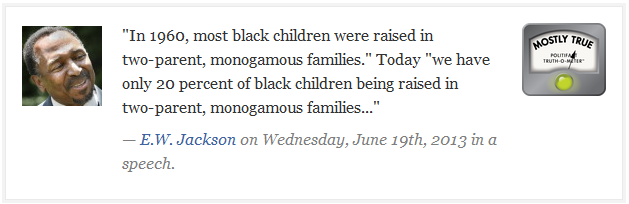
In 2012, the Heritage Foundation posted an article about poverty in America. The article was essentially a study of the causes of poverty in America, stating that one of the main causes was the demise of the two-parent family. The article included the following quote:

Historically, the black out-of-wedlock childbearing rate has always been somewhat higher than the white rate; however, through much of the 20th century, the rates for both groups were comparatively low. For example, as Chart 10 shows, 2 percent of white children and 14 percent of black children born in 1940 were born out of wedlock.

These rates remained relatively low until the onset of Lyndon Johnson’s War on Poverty in the early 1960s. Then the black out-of-wedlock birth rate skyrocketed, doubling in little more than a decade from 24.5 percent in 1964 to 50.3 percent in 1976. It continued to rise rapidly, reaching 70.7 percent in 1994. Over the next decade, it declined slightly but then began to rise again, reaching 72.3 percent in 2008.

The white out-of-wedlock birth rate followed a similar but less dramatic pattern. It remained almost unchanged at around 2 percent between 1930 and 1960 and then began a slow but steady rise in the 1960s that accelerated in the 1980s, reaching 20 percent by 1990. It slowed in the 1990s but then resumed its upward rise. In recent years, it has been increasing at a rate of 1 percent per annum, reaching 28.6 percent in 2008.

This is the impact of a government program that pays women if there is not a man in the house–there are less men in the house! When the government subsidizes a behavior, there is more of it. When a government taxes a behavior, there is less of it.

whiteprivilegeChildren raised in two-parent, monogamous families do better in school and ultimately achieve more than their contemporaries raised in one-parent homes. There are exceptions–notably Dr. Ben Carson and others.

Until the government stops supporting living arrangements other than marriage, we will continue to have a poverty problem. Until the government stops creating generations of people who have grown up with the idea that they do not have to work for a living, we will have ever-growing welfare rolls. Until the success of welfare programs is measured by how many people leave them and go into the work force, rather than how many more employees are needed to administer them, we will still have growing dependency in black and poor white communities.

White privilege does not exist. It is a term invented to divide people and to discourage people from reaching their full potential. How many great scientists and inventors have we lost because the black culture said it wasn’t cool to study and do well in school? How many brilliant minds have been shamed into not doing well in school because education was ‘a white man’s thing.’ Before you talk about white privilege, teach black children that it is cool to do well in school. Teach the black community to encourage academic success, and encourage those who are successful and involved in the black community to provide scholarship money to students who do achieve, so that they can continue their education.

White privilege is a term that will create problems rather than solve them. It is time we all worked together to make sure all races were privileged by encouraging achievement and bringing back the two-parent family.

States Can Take Action When The Federal Government Fails To

Last Friday, The Daily Signal posted an article about states that have defunded Planned Parenthood since the undercover videos showing the sale of aborted baby body parts were released.

The article reports:

Ohio Gov. John Kasich is expected to sign a bill defunding Planned Parenthood, making Ohio the ninth state to do so since undercover videos exposed the abortion provider’s apparent role in harvesting the body parts of aborted babies.

The bill, H.B. 294, ensures that state and certain federal funds are not used to perform or promote nontherapeutic abortions at Planned Parenthood or elsewhere. The Ohio House passed the final version 62-32 on Wednesday and sent the legislation to the Republican governor’s desk.

“Governor Kasich has worked with legislative leaders to ensure that public dollars are used to their best purpose,” Kasich spokesman Joe Andrews said, according to The Columbus Dispatch. “The Ohio Department of Health had already stopped awarding state dollars to Planned Parenthood.”

Eight states—Alabama, Arkansas, Kansas, Louisiana, New Hampshire, North Carolina, Texas, and Utah—have defunded Planned Parenthood after the pro-life Center for Medical Progress released a series of hidden-camera videos that put the nation’s largest abortion provider under the microscope for questionable and perhaps illegal practices.

As was previously reported here:

Two CMP (Center for Medical Progress ) investigators, David Daleiden and Sandra Merritt, were indicted by a grand jury Monday with tampering with governmental records by creating fake driver’s licenses as part of a nearly three-year undercover investigation.

Mr. Daleiden was also indicted on a misdemeanor charge of soliciting human organs. He released a statement Monday defending the investigation and saying that “buying fetal tissue requires a seller as well.”

Judie Brown, president of the American Life League, said it was “not surprising” that the DA’s office would findPlanned Parenthood “blameless while trying to silence those who want to protect every human being’s life.”

“The evidence against Daleiden, as reported by the mainstream media, may or may not be valid, but lest we forget that the prosecution in this case is a district attorney’s office that has a Planned Parenthood board member as a prosecutor,” Ms. Brown said in a Tuesday statement.

Eleven undercover videos released by the CMP beginning in July prompted a dozen states to examine whetherPlanned Parenthood was illegally trafficking in fetal tissue from abortions. Planned Parenthood officials have insisted they were only reimbursed for costs associated with providing fetal tissue to researchers, which is legal.

The indictment of David Daleiden and Sandra Merritt was a travesty of justice. I am sure that the fact that the staff of the district attorney’s office includes a board member of Planned Parenthood had a lot to do with the indictment. I suspect that eventually that indictment will be overturned.

The article at The Daily Signal concludes:

Sarah Torre, a policy analyst in the DeVos Center for Religion and Civil Society at The Heritage Foundation, wrote that Planned Parenthood affiliates receive over half a billion dollars each year from state and federal sources.

“Congress should end federal taxpayer funding to Planned Parenthood affiliates and redirect those funds to health centers that provide health care for women without entanglement in abortion or questionable handling of baby body parts,” Torre wrote.

The prosecution of those trying to expose the horrific practices involving the sale of aborted baby body parts is horrible, but that is understandable when you consider the amount of money involved in making abortion an acceptable practice. However, there is a lesson here. The videos have resulted in a number of states defunding Planned Parenthood. The exposure of the practice of selling aborted baby body parts did bring positive results.

Finally, I would like to state that I do not want to make all abortions illegal. There are times when an abortion is a medical necessity. In those cases (which are very rare), that abortion should be done in a hospital under the supervision of a medical doctor. Abortion should not be a for-profit industry bringing in millions of dollars a year–it should be a medical procedure to be used only when absolutely necessary.

Elections Have Consequences

One of the things to keep in mind as you prepare to vote in your state’s primary election is that elections have consequences. The Daily Signal posted an article today about the decline in economic freedom during the Obama Administration. The Heritage Foundation posted a more complete article.

The Heritage Foundation reports:

According to the 2016 Index of Economic Freedom, an annual publication by The Heritage Foundation, America’s economic freedom has tumbled. With losses of economic freedom in eight of the past nine years, the U.S. has tied its worst score ever, wiping out a decade of progress.

The U.S. has fallen from the 6th freest economy in the world, when President Barack Obama took office, to 11th place in 2016. America’s declining score in the index is closely related to rapidly rising government spending, subsidies, and bailouts.

Economic freedom creates prosperity across the board. Without economic freedom there is no incentive to achieve. When there are no rewards for achievement, there is less achievement.

The Heritage Foundation reports:

Since early 2009:

  • Government spending has exploded, amounting to $29,867 per household in 2015.
  • The national debt has risen to $125,000 for every tax-filing household in America—a total over $18 trillion.
  • The government takeover of health care is raising prices and disrupting markets.
  • Bailouts and new government regulations have increased uncertainty, stifling investment and job creation.

This is not something to take lightly. Economic freedom is the foundation of U.S. economic strength, and economic strength is the foundation of America’s high living standards, military power, and status as a world leader. The perils of losing economic freedom are not fictional.

This is something to consider as you cast your primary ballot, regardless of which political party you belong to. Economic freedom matters–to you, to your children, and to your grandchildren.

The Problems With The Budget Deal

Yesterday John Hinderaker at Power Line posted an article about the budget deal recently reached by Congress. He strongly suggests that Republicans do not approve the deal.

The chart below from the Heritage Foundation is included in the article:

image001

As you can see, there are no immediate spending cuts and no significant cuts until 2025. We all know what happens to budget cuts in the distant future–somehow they never materialize. There is also the matter of this Congress trying to bind a future Congress to a budget it had nothing to do with.

In an article posted yesterday, The New York Times described the deal as follows:

The deal is the policy equivalent of keeping the lights on — hardly the stuff of a bold fiscal legacy. But it achieves the main objective of his 2016 budget: to break free of the spending shackles he agreed to when he signed the Budget Control Act of 2011, an outcome, the president allowed Tuesday, that he could be “pretty happy” about.

I don’t want to see the government shut down, but this is not a compromise–iti’s a cave. This budget deal is an example of why John Boehner is being replaced as Speaker of the House.

An article at Daniel Mitchell’s website states:

Moody’s Investors Service announced Monday that, despite dire warnings from the Treasury Department, the government would find a way to pay money owed on its debt, regardless of whether lawmakers agree to raise the $18.1 trillion borrowing cap. …”Even if the debt limit is not raised, …the government will order its payment priorities to allow the Treasury to continue servicing its debt obligations,” says Moody’s Senior Vice President Steven Hess.

Raising the debt limit is not really required despite what the big spenders are telling you.

I think Senator Jeff Sessions said it best:

“Once again, a massive deal, crafted in secret, unveiled at the 11th hour, is being rushed through Congress under threat of panic.  Once again, we have waited until an artificial deadline to force through that which our voters oppose.

At its core, this deal with President Obama does two things: First, it lifts federal spending caps for the next two years – including a $40 billion increase in spending on the federal bureaucracy.  Second, it waives the federal debt limit through March of 2017, allowing for approximately $1.5 trillion to be added to the debt – ensuring no further conversation about our debt course or any corresponding action to alter it.

It appears this deal is built on the same principles as the Ryan-Murray budget deal from 2013.  It exchanges instant increases in federal spending for distant savings, as much two decades down the road, that are likely to never materialize.  It funds increased spending through increased revenues – violating a core budget principle by collecting more money to expand an already too-large federal bureaucracy.  And it trades the termination of today’s spending limits for the promise of new spending limits ten years from now.

The spending caps in law today were pledged as part of the 2011 Budget Control Act agreement to lift the debt ceiling by $2.1 trillion.  It represented a bipartisan commitment to cap spending at a fixed amount.  This deal shatters that commitment by spending $80 billion more than we promised over the next 2 years.

The deal also uses a common gimmick where alleged savings in an entitlement program are used to boost unrelated spending in the federal bureaucracy.  Any savings found to entitlement programs faced with insolvency must be used to shore up those programs – not to surge spending somewhere else.  Yet this deal claims illusory savings from Disability Insurance and increased pension insurance fees in order to boost bureaucratic budgets.  Perhaps even worse, the deal attempts to stave off the shortfall in fraud-ridden Social Security Disability by plundering from the Social Security Trust Fund for retirees.  One hundred and fifty billion dollars in funds will be siphoned from Americans’ payroll retirement contributions and redirected to the mismanaged disability program….

Republicans in Congress need to vote against this budget deal.


Another Reason To Oppose An Increase In The Gasoline Tax

I have previously stated my objection to raising the tax on gasoline now that the price per gallon has dropped–the gas tax is much more of a burden on lower income people than on the upper middle class. As much as I do think tax burdens should be somewhat equal, I don’t like to see people spend a major portion of their income just getting to work. When the price of gasoline dropped, I think everyone breathed a sigh of relief–it was like getting a tax rebate. Now Congress is ready to mess that up.

The Wall Street Journal posted an article today explaining where the money paid in gasoline taxes has been spent. Because we are hearing cries about our crumbling infrastructure, you would think that the gasoline tax money would be spent on roads. Think again.

The article reports:

But before considering any policy that would raise additional revenue, Congress should first reform where the fund’s money goes. The Highway Trust Fund now pays for a plethora of projects that have little to do with highways. According to a 2013 analysis by the Heritage Foundation, at least 20% of gas-tax revenues in recent years went toward other programs, from light rail to bike lanes to landscaping projects. Some funds even went toward establishing transportation museums.

Hence the financial problems. According to an editorial in this newspaper, spending on non-highway projects has increased by nearly 40% since 2008, while highway-related spending has remained flat. If Congress directed the fund to spend its money only on highways and other road-related infrastructure—what it was initially created to do—it would be 98% solvent for the next decade.

This is the perfect picture of the problem with government spending–the problem is not lack of money–the problem is how the money they have is being spent.

The article concludes:

Higher gas prices, tax-induced or otherwise, also correspond with diminished economic growth. When you and I have more money to spend, we usually do so, benefiting the economy in the process. Financial analysts at Goldman Sachs predict that lower gas prices could add as much as half a percentage point to GDP growth this year. Some of this will be offset by corresponding declines in the oil and gas industry, but the overall effect on America’s economy is still expected to be positive in 2015.

This puts in perspective the first quarter’s lackluster 0.2% economic growth. Without the benefits of lower gas prices, growth could have been even slower, which is the last thing Americans need. When the Highway Trust Fund’s future comes up for congressional debate in the coming weeks, legislators should consider reforming it rather than simply demanding that you and I pay more at the pump.

There are Republicans and Democrats who have authored this bill. Every one of them should be voted out of office at the next opportunity. This is not the time to raise taxes–this is the time to begin to spend responsibly.

Ghouls On Parade

The crash of an Amtrak train on Tuesday night was a tragedy. It was also an accident. Sometimes accidents can be avoided; sometimes they cannot. However, it is truly disgusting to see the death of American citizens innocently riding a train used for political purposes. While authorities were still rescuing the injured from the crash scene, Democrats in Washington went to work blaming the accident on Republican spending cuts. First of all, I would like to point out that President Obama has been in office since January 2009. If Amtrak spending were a priority for him, would the President have asked for more spending while the Democrat party had full control of the House and Senate? Would he have asked while the Democrat party had majorities in both the House and the Senate? To blame anyone before investigators have had a chance to begin their search for a cause is simply ghoulish political opportunism. Also, just for the record, where has spending been cut?

The Heritage Foundation posted the following graph of federal spending:

Federal Government Has a Spending, Not Revenue, Problem

There have been no serious budget cuts.

It also posted the chart below:

Where Does All the Money Go?

I don’t believe our problem is that we are not spending enough–our problem is that the politicians in Washington have used taxpayer money to buy so many votes that they don’t have very much left over. I would also like to know where in the U.S. Constitution it states that the taxpayers should be funding Amtrak.

It is a tragedy that people died in a train accident on Tuesday night. It is also really sad that some politicians sought to gain political points through the death of their fellow citizens.

Do We Really Want To Do This?

Yesterday Breitbart.com posted a story about the cost of President Obama’s executive order on amnesty. This executive order has major consequences.

The article reports:

The lifetime costs of Social Security and Medicare benefits of illegal immigrant beneficiaries of President Obama’s executive amnesty would be well over a trillion dollars, according to Heritage Foundation expert Robert Rector’s prepared testimony for a House panel obtained in advance by Breitbart News.

Rector, a senior research fellow at Heritage, is slated to speak on the costs of Obama’s executive amnesty Tuesday before the House Oversight and Government Reform Committee. He will testify to the high entitlement costs of granting legal status to millions of illegal immigrants.

Based on Rector’s calculations, which assume that at least 3.97 illegal immigrants would apply for and receive legal status under Deferred Action for Parents of U.S. citizens and legal permanent residents (DAPA), and that the average DAPA beneficiary would have a 10th grade education, the costs would be immense.

Specifically, in 2010 dollars, the lifetime costs of Social Security benefits to DAPA beneficiaries would be about $1.3 trillion.

This would be a problem for the federal government.

The article also calculates the cost of welfare benefits to the new immigrants.

The article explains:

“On average, the combined cost of means-tested welfare benefits currently received, the EITC and ACTC cash, and potential Obamacare benefits would come to $17,800 per year per DAPA family,” Rector’s testimony reads. “The aggregate cost would be over $35 billion per year.”

In terms of what DAPA eligible individuals would contribute in tax payments once they are “on the books,” Rector estimates that “Federal Insurance Contribution Act (FICA) and federal income tax revenues would increase by about $7.2 billion per year.”

As you watch the fight for executive amnesty unfold, you might want to add the Cloward Piven Strategy to your list of possible explanations for this fight.

TeaPartyInTheHills defines Cloward Piven as follows:

The strategy was first proposed in 1966 by Columbia University political scientists Richard Andrew Cloward and Frances Fox Piven as a plan to bankrupt the welfare system and produce radical change. Sometimes known as the “crisis strategy” or the the “flood-the-rolls, bankrupt-the-cities strategy,” the Cloward-Piven approach called for swamping the welfare rolls with new applicants – more than the system could bear. It was hoped that the resulting economic collapse would lead to political turmoil and ultimately socialism.

The National Welfare Rights Organization (NWRO), founded by African-American militant George Alvin Wiley, put the Cloward-Piven strategy to work in the streets. Its activities led directly to the welfare crisis that bankrupted New York City in 1975.

Veterans of NWRO went on to found the Living Wage Movement and the Voting Rights Movement, both of which rely on the Cloward-Piven strategy and both of which are spear-headed by the radical cult ACORN.

Both the Living Wage and Voting Rights movements depend heavily on financial support from George Soros‘s Open Society Institute.

 Something to consider.


She Obviously Just Got To Congress And Doesn’t Know How It Works

The Daily Signal posted an article yesterday about legislation introduced by freshman Congresswomen Gwen Graham, D-Florida. The bill is called Travel Perks Elimination Act.

The article reports:

Nine months ago, I pledged I would work to end wasteful Congressional perks. Today, I’m following through on that promise,” Graham said. “It’s a common sense idea that Republicans and Democrats can both agree on: members of Congress shouldn’t be able to charge taxpayers for first-class airfare or long-term personal car leases.”

According to her statement, the legislation would also ban the use of taxpayer funds for personal car leases, some of which are “as high as $825 a month.”

It is very obvious that she is new to Congress. It is also very obvious that she has the right idea.

The article further reports:

Rep. Rod Blum, R-Iowa, is the cosponsor of the bill.

“This is not a partisan issue,” Blum said in a statement. “Members of Congress don’t need taxpayer funded perks like first class travel and long term car leases to do their job. America’s founders never intended for public servants to live a life of luxury paid for by everyday Americans. That’s why I’ve made it a high priority to back legislation which reforms Congress and ensures good stewardship of U.S. taxpayer dollars.”

Romina Boccia, the Grover M. Hermann fellow in federal budgetary affairs at The Heritage Foundation, supports the measure as an appropriate way to reduce government waste.

Note to those people in Congress who say they have no place they can cut the budget–this might be a place to start.