The following is posted on the American Principles In Action website:


I apologize for the small print, but I am not enough of a techie to know how to make it bigger!

The following is posted on the American Principles In Action website:
I apologize for the small print, but I am not enough of a techie to know how to make it bigger!
Common Core has come under fire for many reasons. It is an untested academic standards program the involves data mining activities that make the NSA look like amateurs. The program claims it is not curricula, but a close examinations shows that it controls curricula by controlling a test program that has put undue stress on our schoolchildren. There are also a number of child development specialists who have stated that much of the material included in Common Core is inappropriate for the age groups receiving the instruction.
There is a better way to educate our children than Common Core. The North Carolina Education Plan has been developed in North Carolina as an alternative to Common Core. The developers of the North Carolina Education Plan (NCEP) recently met with Classroom Teachers Association of North Carolina President, Judy Kidd and Steve Oreskovic in Greensboro, North Carolina.
The goal of the meeting was to form an alliance to move the NCEP forward in North Carolina. One of the major items on the agenda in moving NCEP forward is to end the Kindergarten Entry Assessment (KEA). This aspect of Common Core forces schools to collect information on children, including photographs and biometric data. It is the first link in the K through work force chain that is envisioned for this and future generations.
These are some of the problems with the KEA: 1) Teachers must evaluate, profile students and being an electronic portfolio on each five year old entering the system. This profile contains clinical areas such as Emotional & Social Development. These areas are not only clinical in nature, but are very subjective. 2) Data collection cannot be secured. Using a “unique identifier” (UID) does not guarantee the child’s name cannot be hacked. If pictures and videos are used to determine performance level, identification of any child is easily obtainable. The data collection goes outside of the schoolhouse and follows the child for five years into the workforce. 3) Where is the data going to be stored? What data will be part of the Statewide Longitudinal Data System (SLDS) and Common Education Data Analysis & Reporting System (CEDARS)? Where does the data go? Raleigh, Washington? It is national in scope. 4) Do parents know this data is being collected for the child until adulthood?
There are other issues with Common Core, such as unfunded mandates in the form of Microsoft computer update and software licensing requirements [understandable when you consider that Bill Gates (founder of Microsoft) is one of the major financial backers of Common Core]. Common Core is expensive compared to the NCEP. Despite its claims, Common Core does not embrace the concept of Critical Thinking in its curricula. It is also untested.
The North Carolina Education Plan has been presented to the North Carolina Academic Standards Review Commission. They are in the process of studying the NCEP and other options as they prepare to make their recommendations to the state. Hopefully North Carolina will be the first state to adopt its own home-grown program for providing a quality education for the students in the state.
Yesterday the Academic Standards Review Commission (ASRC) met in Raleigh. Jerry Egolf presented the North Carolina Plan (an alternative to Common Core which is less expensive than Common Core and has its origins in the Greensboro Plan). The North Carolina Plan would bring our schools up to some of the highest standards in the nation–it includes parts of the Greensboro Plan, Massachusetts (before Common Core), Minnesota’s math programs, and California (before Common Core). It would be a wonderful alternative to Common Core.
Lady Liberty posted the following on her blog about the meeting:
Yesterday was the June meeting of the Academic Standards Review Commission (ASRC), which is tasked at reviewing the Common Core standards in order to give replacement recommendations to the State Board of Education at the end of this year.
Local media was on hand for yesterday’s event, as it included public comment from parents. Well, it was supposed to be parents. Near the end, the NC PTA President, Donald Dunn, jumped in.
Dunn’s comments were a series of pro-Core talking points; one in particular on Military families “needing the Common Core” has been thoroughly debunked. Time Warner Cable news covered the introduction of the NC Plan, which is a full set of free standards based on the best of the best state and international standards available. Time Warner Cable new also interviewed NC parent, Amy Wilmoth:
“Amy Wilmoth attended with her son Reeves.
She made the decision in February to pull her 9-year-old son from Mangum Elementary School in favor of a home school online curriculum with Liberty University; however, they remain conflicted.
“We wanna send him back to the public school system. My husband and I both are products of the public school system. But it was a very different environment then. We were able to learn and teachers had the ability to teach the children as they saw fit to teach then, and I see that missing in our school system,” said Wilmoth.”
I attended the event and also spoke as a parent of a Wake county student. Around 15 parents spoke; only three spoke in support of the standards. I’ll have more on this testimony from the supporters once I compile my notes and finish some research on some of the attendees.
I live-tweeted the event, which can be read on Storify.
On Thursday the Daily Haymaker posted an article about some recent events in North Carolina that are an affront to the concept of freedom of speech. Recently New Hanover County school board member Tammy Covil posted an opinion on a closed Facebook page.
This is her post and one of the replies after it was screen captured and sent to the Democrat party:

She posted this on a Facebook page that was supposed to be for a closed group. It is her personal opinion. Obviously it does not agree with the person who replied at Equality NC, but are they both not entitled to their opinions?
The article concludes and suggests a course of action:
The left sees Covil as a big problem. She is serving on the state’s Common Core study commission. My New Hanover sources tell me she is a possibility for superintendent of the school district there.
Covil has spoken out against the teaching of nonsense like “gender fluidity.” (I’ve heard about that in some amphibians and reptiles, but not in humans.)
The lynch mob has already set up a Facebook page aimed at shutting Covil down.
If you live in New Hanover County, do what you can to help this woman out. If you don’t live there, talk to any of your friends who do. Donate money to her campaign. Leaders like Tammy Covil — who dare to stand firm on their principles — are our only hope for saving our society, our culture, and our country.
Regardless of where you stand on the issue of gay marriage, there is no reason to shut down free speech on the issue. Ms. Covil is a conscientious person who is doing a good job in her role as a New Hanover County School Committee member and as a member of the Common Core study commission. What she said, essentially, is that she holds a Biblical view of marriage. She is as entitled to her belief as those who oppose her are to theirs. The difference is that she is not trying to shut down their right of free speech.
This article is composed of information taken from a slightly longer article written by the Common Core Diva. Please follow the link to the article to read the Twitter posts. Here are the highlights of the article:
For the anti CCSS warriors out there, this “Riddle Me This” article’s query will be super easy to solve!! What do you get when you take a room full of concerned citizens, add a dash of sassiness, throw in lots of facts, AND create a spark of inspiration??? The answer is: the North Carolina Academic Freedom Alliance’s “Rally in Raleigh”!
I was honored to be among the featured speakers there for the event. In attendance were citizens from all over the state of NC. Thanks to social media, anti CCSS warriors across the globe were able to keep updated, as well. Some pretty big news was shared that can be vital to our movement.
I’m providing a recap of the information shared via Twitter yesterday in the event you haven’t been able to access the social media outlet. It’s also helpful to have all your information in one article.
The Morning was Off to a Great Start:
The Rally opened with a great thinking question for those in attendance that went something like this..“Why bother fighting CCSS? We know those behind it are bigger than us.” Several vocal responses were given, but by far and away the best one was “Because it’s the right thing to do.”
Presentations:
Up first for the day was Andrea Dillon (aka ‘LadyLiberty1885′) as she gave us the NC CCSS Facts NOT from the media, but from her own research and digging through NC’s legislation and hearings. We learned things the big media sources missed! She also shared with us just how and when she got involved in the CCSS fight.
Tireless Teachers:
Also presenting to us during the Rally were 2 retired-from-full -time-teaching-but-active-in- either-substituting-in-classrooms-or-tutoring NC teachers. Their devotion to fighting CCSS is epic, their work invaluable, and their faith in the positive prospect the NC Plan (the completed set of standards that blows the doors off CCSS) is truly exciting.
The Good Doctor:
While there was a tremendous amount of great information, the MOST inspiring bit of news we all received was that Dr. Rosemary Stein officially announced her plans to run for NC State Superintendent of NC Public Schools!! Dr. Stein presented a brilliant presentation on the horrid developmental damage given to our young students, thanks to CCSS. Her expertise (along with her husband’s; he’s also in the medical profession) in not only children, but their learning gave us much insight. Her passion against Common Core was refreshing. When she said she could handle the awesome job of head of DPI, we certainly were thrilled! (During Andrea’s presentation, it was shared that the huge conflict of interest with the current head, Dr. Atkinson {she’s both head of NC DPI AND the President of CCSSO} is certainly investigation worthy.)
The Final Author of the NC Plan:
Jerry Egolf, the last of the 3 NC Plan authors also presented much information during the Rally. Like everyone who presented, his entire portion will be available on You Tube in about 1 week.
Closing:
While there is SO much more I could go on and on about, I am anxious to get this news to you! If you can’t wait for the Rally’s You Tube video debut in about 1 week (has to be edited), you can always email the North Carolina Academic Freedom Alliance main contact person, Don Watson and request them via email. They will be returned to you as files you can download, I believe. To email Don, dwatson83@att.net
One other HUGE bit of anti CCSS Warrior news is that there are currently 3 states which are also wanting to use the NC Plan!! TN, WI, and FL. Wouldn’t that be wonderful: 4 states so embedded with CCSS that they actually face an alternative superior to CCSS?!
Oh, as far as what I shared..I think you can guess some of it! There will be some surprises on the video for you from others, as well as myself.
On Monday, Wicked Local Scituate posted a story about teachers in Massachusetts fighting the adoption of Common Core in their state. Scituate is a beautiful town on the Massachusetts coast about 25 miles from Boston. The median income in the town between 2000 and 2011 was slightly over $100,000. In February 2015, the average price of a house in Scituate was $545,000. I mention this just to give you an idea of the town that publishes the paper involved. I should also mention that in Massachusetts the word ‘wicked’ is frequently used as an adjective. Please follow the link above to read the entire article.
The article states a few facts about the pre-Common Core successes of education in Massachusetts and reminds us of the actions of two courageous members of the validation committee who refused to sign off on Common Core:
According to many of its critics, early childhood experts, teachers, parents, and local school committees were barely consulted during the inception of the Common Core and were inadequately represented on its validation committee. The only two educators on the panel, Dr. Sandra Stotsky, perhaps the nation’s preeminent ELA (English Language Arts) specialist (and a former senior associate commissioner in the Massachusetts Department of Education) and Dr. James Milgram, a mathematics professor from Stanford University, refused to sign off on the Common Core validation statement because they did not support the Common Core’s standards or the program itself, on the basis that the Common Core standards were not research-based, rigorous or internationally benchmarked.
The writer of the article gathered his information about Common Core from a friend who is an early childhood expert of 20 years, a private school teacher, and mother of a third-grader, and who was lobbying against Common Core in Massachusetts.
The article reports:
So why did Massachusetts, which in 2007 was nationally ranked in the 90th percentile for student achievement in standardized testing, adopt a curriculum that had little transparency or accountability and choose to rate teachers not by how well they taught their content area, but instead on students’ scores on a test of dubious value? Why did the Commonwealth replace its top-notch English and math standards with the weaker national standards of the Common Core? As far as my friend is concerned, the answer is “Cha-ching!”
In 2010, the Massachusetts education commissioner relied on reports from Achieve Inc., the Thomas Fordham Institute, and the Massachusetts Business Alliance for Education to support and justify a recommendation to adopt the Common Core. These private organizations had one common thread—the Bill and Melinda Gates Foundation, which invested more than $200 million dollars in promoting the Common Core curriculum.
The article goes on to explain some of the other financial dealings related to Common Core.
The article concludes:
There is no regard for individual and collective aptitudes and motivations within a particular classroom, or for the presentation of developmentally appropriate content. Teachers cannot celebrate or assess the different learning styles of their students, because all students must learn and test the same way. We have gone from educator-created content and teaching methods to a state of test takers and test teachers, who are forced to adhere to a one-size fits all model of standardization.
My friend and her allies in the education community are seeking to convince the state’s political leaders to reinstitute the education standards and testing regime, which prevailed prior to the adoption of the Common Core. Time will tell whether those efforts are successful, but their voice is growing louder, and I can’t see them giving up without a fight.
These are the same objections we are hearing from teachers and parents around the country. It is time to fight the moneyed interests that are promoting Common Core and do what is best for our children.
Yesterday I attended the Academic Standards Review Commission in Raleigh, North Carolina.
The Academic Standards Review Commission was established by General Assembly of North Carolina Session 2013 Session Law 2014-78 Senate Bill 812.
Section 2(c) of the Bill states:
SECTION 2.(c) The Commission shall:
(1) Conduct a comprehensive review of all English Language Arts and Mathematics standards that were adopted by the State Board of Education under G.S. 115C-12(9c) and propose modifications to ensure that those standards meet all of the following criteria:
(2) As soon as practicable upon convening, and at any time prior to termination, recommend changes and modifications to these academic standards to the State Board of Education.
(3) Recommend to the State Board of Education assessments aligned to proposed changes and modifications that would also reduce the number of high-stakes assessments administered to public schools.
(4) Consider the impact on educators, including the need for professional development, when making any of the recommendations required in this section.
The Commission shall assemble content experts to assist it in evaluating the rigor ofacademic standards. The Commission shall also involve interested stakeholders in this processand otherwise ensure that the process is transparent.
The Commission is continuing its work, looking at Math and English standards in states such as Massachusetts (before Common Core), Texas, Minnesota, and others. As the Commission does its research, it is becoming obvious that Common Core is not the best way to improve the education of our students in this state. It was also noted by a member of the Commission that despite its claims to the contrary, Common Core does not make students either college or career ready.
It was interesting to me to hear the discussions relating to helping high school students prepare for both careers and college. It was noted that a student may work for a year or two before deciding to attend college, and that student needs to be prepared for college if he decides to attend. Not every high school student goes to college immediately after graduation, but many students do attend later.
I was impressed by the concern of the Commission for the teachers to have a chance to become familiar with any standards that might be adopted. At one point a Commission member noted that ‘we need to determine what is best for North Carolina–not rush into something as was done with Common Core.’
There will be another meeting next month as they continue their investigation.
The Common Core Diva is a friend. Her blog is informative and detailed. I have attended Common Core meetings, but do not have the knowledge of how the program works that the Diva does. The following is directly taken from her blog (with her permission).

Common Core for the Workforce is present through Career Tech Education. This isn’t new news for those of us fighting the CCSS. However, were you aware that there’s a push to reauthorize the Higher Education Act? By doing so, you can bet CCSS via CTE will be there.
The Higher Ed Act:
Originally written in 1965, under Pres. Johnson domestic agenda for America called “The Great Society”. It was to increase amounts of federal aid universities and colleges received. The Act was to also increase student aid to get into institutions of higher education. It also established a national teacher corps program.
The HEA (as the Higher Education Act can be referred to) has been reauthorized several times. The updates to the law have been many and wide reaching. Much of what your students and mine fill out on their FASFA forms is tied up in this law.
Most notable in what I’ve been able to find in researching is the 1998 versrion known as “Gear Up” If reauthorized, this would be the 3rd time. As always, the CCSS is buried. Where would it be found? Perkins funding, those Titles funding programs, work study programs, apprenticeships, and probably more. We’ll get to the particulars in a bit. But first, what does “Gear Up” stand for? “Gaining Early Awareness and Readiness for Undergraduate Programs”. Remember, this was started in 1998. Before CCSS. But how ironic that we have so much ‘readiness’ rhetoric in modern education.
The 2008 Workforce/Education ‘Marriage’:
According to the Center for Law and Social Policy’s document highlighting the changes to HEA, here’s the one that joined education and businesses (think P3s, or public-private partnerships), “Creates Business Workforce Partnerships for Job Skill Training in High Growth Occupations or Industries. Colleges often lack the “venture capital” to start up new, credit-bearing programs that can respond to business workforce needs because state funding and federal financial aid typically only flow after students are enrolled in programs. This grant program funds partnerships of colleges, employers, and, where applicable, labor representatives to expand or create credit-bearing college programs responsive to business workforce needs, adapt college offerings to workers’ schedules, expand worksite learning opportunities, and purchase equipment related to such academic or job training programs. The grants are targeted toward programs serving nontraditional students, such as working adults, and can be used to create for-credit career pathways (Section 803).”
Other items which supported this ‘marriage’? TRIO and Bridges from Jobs to Careers. If you don’t know much about TRIO, here’s what the U.S. Dept. of Ed. has to say about it, “The history of TRIO is progressive. It began with Upward Bound, which emerged out of the Economic Opportunity Act of 1964 in response to the administration’s War on Poverty. In 1965, Talent Search, the second outreach program, was created as part of the Higher Education Act. In 1968, Student Support Services, which was originally known as Special Services for Disadvantaged Students, was authorized by the Higher Education Amendments and became the third in a series of educational opportunity programs. By the late 1960’s, the term “TRIO” was coined to describe these federal programs. If you don’t know much about Bridges from Jobs to Careers, it basically was a federal program which awarded competing higher education institutions grant money. There were mandatory requirements for use of the funding. In our current educational panaroma, each state appears to have some sort of bridge/work program. I didn’t find all 50 states in my general search, but I did find several states which are proudly open for business, so to speak.
To find out more about TRIO: http://www2.ed.gov/about/offices/list/ope/trio/index.html#references (*Note: at least one of the TRIO programs will begin its overreach as early as middle school)
To read the entire law from Congress back in the day, https://www.congress.gov/bill/110th-congress/house-bill/4067/text
To see CLASP’s information (including the key senators involved), http://www.clasp.org/resources-and-publications/publication-1/0430.pdf
A Jump Ahead to 2014:
While CLASP is still somewhat fresh on our minds, let’s see what more current ed/jobs efforts they’ve been up to.
Here’s a screen shot from their website that plainly has “Career Pathways” displayed. It also states ‘low income’ and ‘disadvantaged’. With some of the sweeping changes embedded in HR5, who is classified as ‘disadvantaged’ and ‘low income’ could drastically change to include almost every student!
You definitely will want to enlarge this screen shot.

There’s no question in my mind how much CLASP is tied into the Gates Foundation and is helping direct the policies of this nation. How utterly disgusting. If you want more information about them, see: http://www.clasp.org/issues/postsecondary Oh, and one more nugget of truth the WIOA (Workforce Investment and Opportunity Act) which has 21 embedded CCSS, CTE, and/or Career Pathways in it will take effect July 2015.
The 2015 Push:
If you’ve not already had to run away from your computer screaming after the bombshells from above, know that Washington is hard at work as we speak plotting even more reform. To this end, refer back to the opening screen shot you saw. It’s at the very top of the page. What I want you to find is the phrase about the 4 pillars of action to be taken in reauthorizing HEA. I’ll include the PDF file, but here’s a quick summary:
Point #1: empowering family decision making; Point #2: Simplifying and improving student aid; Point #3: promoting innovation, access, and completion (of what isn’t clarified upfront); and Point #4: insuring strong accountability and a limited federal role.
Drawbacks to the points include more data tracking/mining via the Integrated PostSecondary Education Data System (IPEDS); the federal agencies streamlining information families can access to cause less confusion; more robust financial literacy; having the U.S. Dept. of Ed create a higher education rating system; strengthening federal financial aid; streamlining student debt repayment plans to better serve taxpayers; making the Pell Grant flexible; possible federal interference in the ‘innovation, access, and completion’ point ( I strongly believe you should read and assimilate the information directly from the source); increasing the push for more digital learning; increasing the competency-based outcomes for students; more federal assistance for those with the lowest incomes; ramping up teaching preparedness via federal programs and/or influence; and, a possible move to make accreditation entities become more rigorous when it comes to post secondary education institutions. For all the details and for your research: hea_whitepaper
To learn more about IPEDS from the U.S. Dept. of Ed: http://nces.ed.gov/ipeds/about/
To learn more about the government entity overseeing all interested parties into post-secondary education and data collection, see: https://nces.ed.gov/npec/ (*Note: be sure to look at the Research/Development Board Members. Note which institutions or organizations they represent)
To learn more about the NCES (National Center for Education Statistics) which oversees all types of assessments (includes post secondary ones), see: http://nces.ed.gov/whatsnew/commissioner/index.asp
*Note: The NCES commissioner oversees all the assessments you see below and then some.

To access the National Post Secondary Education Policy Cooperative’s “Student Success” pdf (which includes public policy, alignment, and more), ewell_report
More You May Want to Know:
The original screen shot showed that an upcoming hearing would be taking place to discuss not only all I’ve shared with you, but even more. Involved in the hearing will be federal budget, plans, and workforce. You’ll want to listen to the entire thing. This hearing actually took place yesterday, March 18th. I can tell you from the opening remarks, at least one U.S. Congress member wasn’t a fan. Here’s a screen shot from Twitter taken from the Ed/Workforce feed:

For Further Related Info:
Articles I’ve previously published on this subject include (not limited to)
11/16/14, CTE, labor unions, federal funding, and more: https://commoncorediva.wordpress.com/2014/11/16/rmt-vp-unions-career-tech-and-common-core/
11/18/14, Gear Up, College and Career Ready Consortium, and more: https://commoncorediva.wordpress.com/2014/11/18/ftf-tuesday-ccrec-college-and-career-readiness-evaluation-consortium/
Yesterday Todd Starnes at Fox News posted an article about a Common Core vocabulary assignment given in English class in Farmville, North Carolina.
The article details the assignment:
“In the following exercises, you will have the opportunity to expand your vocabulary by reading about Muhammad and the Islamic word,” the worksheet read.
The lesson used words like astute, conducive, erratic, mosque, pastoral, and zenith in sentences about the Islamic faith.
“The zenith of any Muslim’s life is a trip to Mecca,” one sentence read. For “erratic,” the lesson included this statement: “The responses to Muhammad’s teachings were at first erratic. Some people responded favorably, while other resisted his claim that ‘there is no God but Allah and Muhammad his Prophet.”
Another section required students to complete a sentence:
“There are such vast numbers of people who are anxious to spread the Muslim faith that it would be impossible to give a(n)___ amount.”
The writer of the article at Fox asked the school district to provide me with a copy of vocabulary worksheets that promoted the Jewish, Hindu and Christian faiths. The school district did not reply.
The article concludes:
The student I spoke with told me they have not had any other assignments dealing with religion – other than the one about Islam.
Why is that not surprising?
Based on its official statement, Pitt County Schools seems confident that the vocabulary lessons are in compliance with three Common Core standards related to literary. If you want to look up those standards, reference CCSSELA-Literary L11-12.4.A, 12.4.D and 12.6.
Since the Common Core folks seem to be infatuated with sentence completion – let me try one out on them.
Use “Islamic” and “proselytizing” in the following sentence: Somebody got their ____ hand caught in the ____ cookie jar.
Where are the protests from the ‘Freedom From Religion’ people?
On November 14th, the Cato Institution posted an article about the waivers given in the “No Child Left Behind” program. The waivers were issued very selectively and were used as a means to get states to approve Common Core educational standards.
The article reports:
If the outcry over unilateral executive moves we’ve seen over the last few years remains consistent, Obamacare and immigration are likely to keep sucking up most of Republicans’ attention and the media’s coverage. But just as sweeping have been executive waivers issued from the hated No Child Left Behind Act – really the most recent reauthorization of the Elementary and Secondary Education Act – that have been instrumental in connecting numerous states to, among other things, the Common Core national curriculum standards. And yesterday, the Education Department issued guidance offering states the chance to obtain waivers – if they do the administration’s bidding, of course – lasting well into the term of the next president: the 2018-19 school year.
These waivers are almost certainly illegal – even a Congressional Research Service report often cited to suggest the opposite says they are unprecedented in scope and, hence, an untested case – and even if they are not deemed technically illegal, the reality is they still amount to the executive department unilaterally making law. NCLB does grant the Secretary of Education the authority to issue waivers from many parts of the Act, but it grants no authority to condition those waivers on states adopting administration-preferred policies. Indeed, as University of South Carolina law professor Derek W. Black writes in a recent analysis of waivers, not only does NCLB not authorize conditional waivers, even if a court were to read any waiver authorization as implicitly authorizing conditions, the actual conditions attached – “college- and career-ready standards,” new teacher evaluations, etc. – fundamentally change the law. In fact the changes, Black notes, are essentially what the administration proposed in its 2010 “blueprint” to reauthorize NCLB. And quite simply, the executive fundamentally changing a law is not constitutional.
The federal government is now taking direct power over what our children learn. That is not only unconstitutional–it is dangerous.
From The Wall Street Journal:

The above chart is included in a Wall Street Journal article about the fight over the testing contracts for Common Core.
This is the beginning of the article:
As states race to implement the Common Core academic standards, companies are fighting for a slice of the accompanying testing market, expected to be worth billions of dollars in coming years.
That jockeying has brought allegations of bid-rigging in one large pricing agreement involving 11 states—the latest hiccup as the math and reading standards are rolled out—while in roughly three dozen others, education companies are battling for contracts state by state.
Mississippi’s education board in September approved an emergency $8 million contract to Pearson PLC for tests aligned with Common Core, sidestepping the state’s contract-review board, which had found the transaction illegal because it failed to meet state rules regarding a single-source bid.
When Maryland officials were considering a roughly $60 million proposal to develop computerized testing for Common Core that month, state Comptroller Peter Franchot also objected that Pearson was the only bidder. “How are we ever going to know if taxpayers are getting a good deal if there is no competition?” the elected Democrat asked, before being outvoted by a state board in approving the contract.
Common Core is sacrificing our children’s education while a few well-placed companies make millions. It is simply not worth it.
The North Carolina Academic Standards Review Commission met today in Raleigh, North Carolina, to discuss the Common Core Mathematics Standards.
The Academic Standards Review Commission was established by General Assembly of North Carolina Session 2013 Session Law 2014-78 Senate Bill 812.
Section 2(c) of the Bill states:
SECTION 2.(c) The Commission shall:
(1) Conduct a comprehensive review of all English Language Arts and Mathematics standards that were adopted by the State Board of Education under G.S. 115C-12(9c) and propose modifications to ensure that those standards meet all of the following criteria:
(2) As soon as practicable upon convening, and at any time prior to termination, recommend changes and modifications to these academic standards to the State Board of Education.
(3) Recommend to the State Board of Education assessments aligned to proposed changes and modifications that would also reduce the number of high-stakes assessments administered to public schools.
(4) Consider the impact on educators, including the need for professional development, when making any of the recommendations required in this section.
The Commission shall assemble content experts to assist it in evaluating the rigor ofacademic standards. The Commission shall also involve interested stakeholders in this processand otherwise ensure that the process is transparent.
Today was the second meeting of the Academic Standards Review Commission I have attended. The last one (last month) dealt with the Common Core Language Arts Standards. Today’s meeting dealt with the Common Core Mathematics Standards. The presentations at both meetings were done by people from the Department of Public Instruction (DPI)(a department that is strongly supporting Common Core). There has been (so far) no discussion of any alternate standards. It was also mentioned in today’s meeting that the Commission does not have any money allocated to it, and thus cannot call any experts who might refute the value of Common Core.
I have never been so disappointed in government. When the North Carolina legislature passed the legislation that created the Commission, they passed it in response to complaints by parents about the Common Core standards (and the curriculum that goes with them). The parents were not looking for a worthless commission that would do nothing but hear from supporters of Common Core, put a rubber stamp on it, and go home. (I do need to say at this point that there were some members of the Commission that were asking genuine questions and were trying to look past the one-sided promotional presentation they were subjected to.)
All in all, the meeting of the Commission was a well-orchestrated and controlled dog and pony show that accomplished nothing except to show the extent to which the North Carolina DPI supports Common Core. I would strongly suggest to the Commission (and to the DPI) that if you truly want to improve the education level of North Carolina students, you study the MCAS (Massachusetts Comprehensive Assessment System) program instituted in Massachusetts during the early 1990’s. Massachusetts has more than ten years of test scores that show that MCAS works. Common Core has no reliable test scores that show that has actually accomplished anything. Normally, I would never suggest North Carolina follow the example of Massachusetts, but this one time Massachusetts got it right, and they should be listened to. I would also like to note that many of the local school boards in Massachusetts have opted out of Common Core in favor of MCAS.
Yesterday The Daily Signal posted an article about the education policies of the winners and losers in Tuesday’s election. As parents become more aware of the problems with a federally controlled education system, they are voting for the candidates who will give them more freedom and more choice in matters involving their children’s education.
The article cites some of the candidates and their positions on education:
Charlie Crist, running as a Democrat, lost his election bid for Florida governor to incumbent Republican Rick Scott. Crist supported the state’s teachers’ union and the Florida School Boards Association’s campaign , to stop Florida’s tuition tax credit scholarship program. The program, which enables nearly 69,000 low-income children to attend a school of choice, is the nation’s largest choice program.
David Figlio of Northwestern University, who has evaluated the scholarship program on an annual basis for the state, found that “scholarship students are by and large the ones who struggled the most at the public schools they left behind, but that they are now, on average, making the same academic gains as students of all income levels nationally.”
Scott’s victory is a victory for supporters of school choice in the Sunshine State.
Similarly, in Wisconsin, Republican Scott Walker won his re-election bid for governor running, in part, on a platform of expanding school choice.
Voters voted for candidates who opposed Common Core and supported state and local control of education.
The changes in the leadership of the Senate Committee dealing with education will make a difference:
Sen. Lamar Alexander, R-Tenn., will take the helm of the Senate Health, Education, Labor, and Pensions Committee and is likely to work to reauthorize No Child Left Behind. Although Congress should pursue policies that would allow states to completely opt out of No Child Left Behind, as the Academic Partnerships Lead Us to Success, or APLUS Act, does, a potential reauthorization of NCLB would provide an opportunity to move the nation’s largest K-12 education law in a more student-centered direction.
Sen. Tim Scott, R-S.C., already has introduced the CHOICE Act, which would allow states to have Individuals with Disabilities Education Act funds follow children to the private schools of their parents’ choice. Rep. Todd Rokita, R-Ind., has introduced a companion measure in the House. A similar approach to Title I funding for low-income school districts also has been advanced in the House by Rep. Luke Messer, R-Ind.
…The Higher Education Reform and Opportunity Act—or HERO Act— introduced by Sen. Mike Lee, R-Utah, and Rep. Ron DeSantis, R-Fla., would empower states to allow any entity to credential courses, which could pave the way for a more flexible college experience for students and make possible a dramatic reduction in college costs.
It’s time for parents and local school boards to take back education. The newly-elected Senate may provide that opportunity. However, the corporate and political interests that are supporting Common Core and the new Advanced Placement U.S. History course will strongly oppose any move in that direction. It won’t be easy to get this done, but it is very doable.
I missed this article when it came out, but the Huffington Post posted an article in early August that makes an important point.
The article reports:
The story about Bill Gates’ swift and silent takeover of American education is startling. His role and the role of the U.S. Department of Education in drafting and imposing the Common Core standards on almost every state should be investigated by Congress.
The idea that the richest man in America can purchase and — working closely with the U.S. Department of Education — impose new and untested academic standards on the nation’s public schools is a national scandal. A Congressional investigation is warranted.
The close involvement of Arne Duncan raises questions about whether the law was broken.
Just the idea that the federal government is taking over local education is frightening.
The writer of the article explains why she opposes Common Core:
The revelation that education policy was shaped by one unelected man, underwriting dozens of groups. and allied with the Secretary of Education, whose staff was laced with Gates’ allies, is ample reason for Congressional hearings.
I have written on various occasions (see here and here) that I could not support the Common Core standards because they were developed and imposed without regard to democratic process. The writers of the standards included no early childhood educators, no educators of children with disabilities, no experienced classroom teachers; indeed, the largest contingent of the drafting committee were representatives of the testing industry. No attempt was made to have pilot testing of the standards in real classrooms with real teachers and students. The standards do not permit any means to challenge, correct, or revise them.
In a democratic society, process matters. The high-handed manner in which these standards were written and imposed in record time makes them unacceptable. These standards not only undermine state and local control of education, but the manner in which they were written and adopted was authoritarian. No one knows how they will work, yet dozens of groups have been paid millions of dollars by the Gates Foundation to claim that they are absolutely vital for our economic future, based on no evidence whatever.
The article points out that at a time when local districts are struggling to fund education adequately, they are now being asked to spend additional money on Common Core materials, testing, software and hardware. This does not make sense.
Diane Ravitch, who wrote the article at the Huffington Post is a
On July 16, 2014, the North Carolina General Assembly ratified SB812 (follow link for full text). The bill charges the State Board of Education with the task of conducting a comprehensive review of all English Language Arts and Mathematics standards adopted under G.S.115C 12(9c) and propose modifications to ensure that those standards will improve the students’ level of academic achievement, meet and reflect North Carolina’s priorities, and other goals. The law sets up the Academic Standards Review Commission composed of eleven people who are charged with reviewing current standards and making recommendations. Unfortunately the way the law is written, the Commission is simply going through the Common Core standards line by line (by hearing a presentation of the Department of Public Instruction [DPI], which supports Common Core). There is no objectivity in the presentation, and there is no factual information at this point that indicates Common Core does anything to raise academic standards.
In May of last year, I wrote an article about the introduction of Common Core in Massachusetts. The article cited a Wall Street Journal article detailing the changes in Massachusetts education during the 1990’s. Education in the state was reformed in 1993, and SAT scores rose for thirteen consecutive years. In 2005 Massachusetts scored best in the nation in all grades and categories on the National Assessment of Educational Progress. They have repeated that performance every time they have taken the test. Massachusetts is doing very well educationally right now.
On October 1 of this year, I wrote another article about Common Core in Massachusetts. The article was about the Lincoln-Sudbury School Board‘s decision to decline a chance to offer the PARCC (Common Core) to students next spring, sharply criticizing the standardized test that could end up replacing the MCAS in the state.
That article quotes a Massachusetts newspaper article that states:
One board member equated the trial run of the exam as making “guinea pigs” out of students, whom he said wouldn’t see any worthwhile benefit from the dozens of hours they would put into practicing for and taking the test.
Lincoln-Sudbury, like all public high schools in Massachusetts, had a choice to administer the PARCC, short for Partnership for Assessment of Readiness for College and Careers, in ninth and 11th grade later this year. The new test, which was introduced in a small pilot roll-out this past spring, was developed by a consortium of states to closely conform to the new Common Core standards adopted by most schools in the nation.
…Several committee members also bemoaned the PARCC’s potential effect of putting increased emphasis on standardized testing, arguing Lincoln-Sudbury on its own is able to come up with much more effective measures of students’ grasp of learning standards.
No matter how hard the Department of Public Instruction tries to sell it, Common Core is untested. If the Commission is truly concerned about the education of North Carolina students, they will look to other states that have successfully improved the academic achievement levels of their students. I am sure there are many communities in Massachusetts who would be willing and able to help with this task.
Meanwhile, today’s meeting was a biased, self-serving presentation by the Department of Public Instruction–a department that was not interested in changing anything (except possibly the name Common Core). That is unfortunate.
If the parents and grandparents of North Carolina students are truly concerned about their students’ education, they need to get involved very quickly. There will be a meeting next month in which the DPI will do a presentation of the mathematics section of Common Core similar to the one they did today on the English Language Arts section. So far there has been no public examination of any set of standards other than the unproven Common Core standards. If that continues, the students of North Carolina will be the victims of an exercise in futility that accomplished nothing.
A parent’s response to Common Core:

MetroWest Daily News (Massachusetts) posted an article today about the Lincoln-Sudbury School Board‘s decision to decline a chance to offer the PARCC to students next spring, sharply criticizing the standardized test that could end up replacing the MCAS in the state. The PARCC (Partnership for Assessment of Readiness for College and Careers) is the testing that is part of the Common Core standards.
The article reports:
One board member equated the trial run of the exam as making “guinea pigs” out of students, whom he said wouldn’t see any worthwhile benefit from the dozens of hours they would put into practicing for and taking the test.
Lincoln-Sudbury, like all public high schools in Massachusetts, had a choice to administer the PARCC, short for Partnership for Assessment of Readiness for College and Careers, in ninth and 11th grade later this year. The new test, which was introduced in a small pilot roll-out this past spring, was developed by a consortium of states to closely conform to the new Common Core standards adopted by most schools in the nation.
…Several committee members also bemoaned the PARCC’s potential effect of putting increased emphasis on standardized testing, arguing Lincoln-Sudbury on its own is able to come up with much more effective measures of students’ grasp of learning standards.
According to greatschools.org, Lincoln-Sudbury schools are rated a 9 out of 10. The School Board in Lincoln-Sudbury is obviously doing a good job. The median income in the town is $142,614, the median home price is $625,000, and the population is 17,673.
The School Board in the town understands that the Common Core standards have not been tested and there is no proof that they will improve the academic performance of our students. MCAS (Massachusetts Comprehensive Assessment System) testing is a proven product that has brought up the level of academic achievement of Massachusetts students. There is no reason to swap something that has proven to be effective for something that is totally untested.
The following was posted on Facebook on the “Stop Common Core In Mississippi” page:
“I just left our pediatrician. He walks in and says, “Common Core.” The look on his face tells me he is concerned. “I have been swamped the past two weeks with concerned parents who think their child needs medication to survive this new program,” he says. “I have a parent who is a teacher who is now homeschooling her children to avoid this mess.” “I know,” I say. “We have been ringing the bell as loudly as we can,” I say. “Many of the standards, especially the math standards are developmentally inappropriate and are biased against left-brained thinkers.” Our legislature had the chance to fix this last year. Next year is an election year. Keep ringing the bell. The Common Core has to go.” Lauren Emswiler Watson
Lauren is MS Senator Michael Watson‘s wife… and also a teacher.
I have heard from other teachers that much of the material in Common Core is not age-appropriate. The only way to get rid of this program is for parents and grandparents to get involved. It’s up to you to go to your local school boards and make yourselves heard. Otherwise you will simply have to live with the results–a generation of frustrated students and a data mining program that a totalitarian state would be proud of.
On Monday, some members of the Coastal Carolina Taxpayers Association (CCTA) attended the NC Academic Standards Review Commission’s First Meeting.
This is the report from the meeting from one of the attendees:
…the meeting room was very crowded. It was also hot, and uncomfortable. CCTA’s Common Core Committee with Kim Fink, our Chairman, was in attendance.
Unfortunately, it appeared to us that the review committee had been stacked with supporters of Common Core, although it was clear that some of the members definitely want the standards adopted to be North Carolina Standards. Senator Jerry Tillman made an impassioned statement that the US Constitution left eduction to the people and the States by not directly allocating authority for education to the federal government. He also said that the “bar must be raised” because NC’s children need to compete in national and world economies and that our top quarter of school graduates were not fairing well in competition with other states and the rest of the world.
Senator Tillman said the General Assembly would not stand for a re-hash of Common Core, but expected the review committee to do its job and develop North Carolina Education Standards which he said would drive curriculum, something proponents of Common Core deny.
It is up to parents and grandparents to get involved in this battle against Common Core. Common Core is not good for our children and needs to be stopped. The curriculum related to the standards is not the only problem–Common Core involves data mining of personal information on our children and grandchildren with no guarantee of the security of the data. It needs to be stopped.
I don’t have children in school anymore, but I have grandchildren in school. Occasionally I help them with their homework. I love math. I was on my high school math team (how nerdy is that?). But what is being done to students today in the name of math is horrible.
From a friend on Facebook:
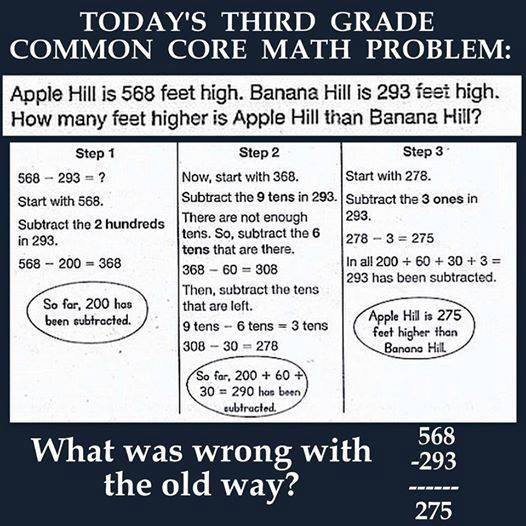
I agree. What was wrong with the old way?
The Fayetteville Observer posted an article on Wednesday written by North Carolina Lt. Governor Dan Forest about the current status of Common Core in North Carolina. Lt. Governor Forest is an opponent of Common Core and has fought the program for the two years he has been in office. Common Core was brought into North Carolina schools before Lt. Governor Forest was elected.
Lt. Governor Forest explains the current situation:
Recently, a bill passed and was signed into law that removed Common Core from the general statutes. There is no longer a legal requirement for Common Core in our state schools. However, those of us against Common Core cannot yet claim victory. Though Common Core has been repealed, it is still the standard in use in our public schools.
But one thing is absolutely sure: The line of authority and responsibility is now clearly delineated with the State Board of Education.
The same bill repealing Common Core also set up an Academic Standards and Review Commission of 11 members, one appointed by the governor, two appointed by the State Board of Education, four appointed by the House, and four appointed by the Senate.
These individuals are tasked with going through the existing Common Core Standards line by line. They will make recommendations on which standards should be kept, which should be fixed, and which should be thrown out.
Is this a good thing? Yes.
Is it as far as it could have gone in repealing Common Core? No.
The bill that repealed Common Core also set up an Academic Standards and Review Commission of 11 members. The Commission will be going through the Common Core Standards line by line to determine which are worth keeping and which need to be thrown out.
The article outlines what parents and grandparents who are opposed to Common Core can do:
Get involved
It is important to know that every North Carolina resident is represented by six members of the State Board of Education (two elected officials, three at-large members and one district representative).
The members of the state school board are William Cobey, chairman and member at large; A.L. Collins, vice chairman, from the 5th Education District; Dan Forest, lieutenant governor; Janet Cowell, state treasurer; Rebecca Taylor, 1st Education District; Reginald Kenan, 2nd Education District; Kevin Howell, 3rd Education District; Dr. Olivia Holmes Oxendine, 4th Education District; John Tate, 6th Education District; Gregory Alcorn, 7th Education District; Wayne McDevitt, 8th Education District; Marcella Savage, member at large; Patricia Willoughby, member at large; and Dr. June Atkinson, state superintendent of public instruction, chief administrative officer and secretary.
All meetings of the Academic Standards and Review Commission are required by law to be public. Likewise, meetings of the State Board of Education are also open to the public.
I encourage those of you opposed to Common Core to communicate with the members of the review commission and the State Board of Education through email, phone calls or mail, or face-to-face. Express to them your desire that they exercise the authority given to them to repeal Common Core with the best standards in the world, made specifically for the children in North Carolina.
The battle is not over. In many ways, it is just beginning.
We all need to be aware of what our children are learning in school and whether or not the things they are being exposed to are age-appropriate.
The Tenth Amendment to the U. S. Constitution states:
The powers not delegated to the United States by the Constitution, nor prohibited by it to the States, are reserved to the States respectively, or to the people.
In today’s language that simply means that if a power is not specifically stated in the Constitution as belonging to the federal government, that power is to be exercised by the states. So how in the world did we ever get a Department of Education? We did, and now we are beginning to see the dangers of the fact that we did.
The State of Oklahoma has chosen to opt out of the Common Core education program. Because of that decision, the U.S. Department of Education has rescinded Oklahoma’s waiver from No Child Left Behind (NCLB). So what does this mean?
On Thursday, Breitbart.com posted an article explaining what is going on:
The loss of the waiver means that 100 percent of Oklahoma students must be performing math and reading at grade level at most schools by this school year. The USED expects the state to use student test results from last school year to determine which schools are meeting the requirement. Those schools that fall short will have to take steps toward improvement, which could include a total reconfiguration of the staff or a private or state takeover of the school.
Oklahoma will also have to set aside about $29 million in federal Title I dollars to pay for tutoring, school choice, and professional development.
I don’t have a problem with setting high standards for students. I do have a problem with the government strong arming a state to allow the federal government to take over the state’s educational system.
The article reminds us:
The fact that Oklahoma’s waiver was denied while Indiana was granted an extension makes it clear that, despite the protests of Common Core supporters that the standards are “voluntary” and “state-led,” the federal government is, in fact, determining which states will receive reprieves from federal restrictions based on their choices of academic standards.
The Oklahoma congressional delegation released the following statement regarding the issue:
“The Obama Administration doesn’t like when Oklahomans buck big government regulations, and today the Administration responded by penalizing our children with failing to grant the one-year extension of the ESEA flexibility,” said Sen. Jim Inhofe (R).
“Oklahomans want education reform that sets standards created and certified by Oklahoma’s institutions, community leaders, and parents,” Inhofe added. “Instead of supporting these values, the Obama Administration has chosen to make it more expensive and difficult to achieve the state’s education goals that, once met, will exceed the requirements set by the U.S. Department of Education.”
“As seen with ObamaCare taxes or the Endangered Species Act rulings, today’s decision continues the trend of this Administration punishing Oklahoma for making decisions that represent the goals and interests of its constituents,” the senator said.
“Our state stood firm against further federal intrusion into the education of our children by rejecting the Common Core curriculum and determining that local educational leaders could best develop the appropriate curriculum for Oklahoma students,” said Rep. Jim Bridenstine (R). “Instead of applauding this constitutional decision and leadership, the Obama Administration decided today to reject the requested one year extension of flexibility previously granted to Oklahoma under ESEA.”
“This politically motivated decision is the perfect example of how the unconstitutional federalization of education has effectively taken away the power reserved for the states and the people by our founders,” Bridenstine continued. “It’s time to abolish the federal Department of Education and return power to the states consistent with the 10th Amendment.”
Pay attention. This is coming to your state in the very near future.
I have posted a few articles on Common Core and on the AP U. S. History course for high school students. There are some real questions as to what the curricula associated with these standards and programs is actually teaching, but now we have strange curriculum showing up in other areas.
Yesterday John Hinderaker at Power Line posted an article quoting Minnesota teachers on how their schools teach literature classes.
The article included the following description of how Edina High School in Edina, Minnesota teaches literature classes:
Acceptance and inter-cultural understanding can be fostered through the use of powerful texts, discussion, analysis, and exploration in the classroom. An English curriculum grounded in social justice rests on a belief based in equity—that each person should have access to resources regardless of race, gender, ability, age, socio-economic status, or sexual orientation.
Why is our educational system trying to divide Americans instead of focusing on the things we have in common that made this country great?
The article includes a comment from Woodbury High School:
At Woodbury High School, the [literature] course is primarily structured chronologically. Social, economic, cultural and political frameworks of the readings are sometimes explored explicitly through eight critical lenses: feminist, deconstruction, new criticism, new historical/biographical, reader response, post-colonial, psychological and Marxist theory. Students apply critical literary elements such as figurative language, symbolism, and motif to find author’s intent.
What about teaching them the uniqueness of the U.S. Constitution instead?
John Hinderaker sums it up:
This is mis-education, worse than not attending school at all. Any child of normal intelligence would gain more from staying up late at night and reading books with a flashlight under the covers than from being subjected to such cant. For many students, such palpable bullshit is likely to ruin literature forever.
After the Constitutional Convention in 1787, people gathered outside Independence Hall in order to learn what had been created. A website called ourrepubliconline.com reports:
A Mrs. Powel of Philadelphia asked Benjamin Franklin, “Well, Doctor, what have we got, a republic or a monarchy?” With no hesitation whatsoever, Franklin responded, “A republic, if you can keep it.”
Unless we do a better job of educating our children, we won’t be able to keep it.
Tonight I attended a Townhall style meeting held in Stanly Hall in New Bern. The two main speakers at the event were state Representative Michael Speciale, who represents North Carolina’s third district, and state Senator Norman Sanderson, who represents North Carolina’s second district. These men are dedicated conservatives who represent eastern North Carolina in Raleigh.
Representative Speciale spoke first. He talked about the need for the conservatives in the state legislature to stand for their principles. He reminded us that he was sent to Raleigh to vote for conservative principles and for what was best for the State of North Carolina. Recently H.B. 1224 was defeated by a 54 to 47 vote. The bill included special interest spending that was not necessary, and needed to be voted down, despite the fact that many Republicans supported it.
Senator Sanderson reminded us that the reports in the press of disunity in Raleigh have been exaggerated. He stated that the Senate and the House agreed on about 95 percent of the budget. About 5 percent of the budget required compromise to work out differences, which the legislature did. Senator Sanderson listed the recent accomplishments of the legislature. These accomplishments included expanded restrictions on sex offenders, rules regarding mo-peds on North Carolina highways, allowing prayer in North Carolina schools, election laws designed to protect the integrity of elections in North Carolina, and energy laws to allow North Carolina to develop its energy resources.
There was an extended period of questions from those who attended the meeting. A variety of subjects were addressed that concern those of us who live in eastern North Carolina–education funding, Common Core, the tourism industry, the fishing industry, and other issues.
The evening was very informative. The meeting was sponsored by the Coastal Carolina Taxpayers Association (CCTA). The CCTA meets at Stanly Hall on the third Tuesday of every month at 7 pm. Attending a CCTA meeting is a good start in becoming an informed voter.
On Wednesday, the Daily Caller posted an article about Louisiana Governor Bobby Jindal‘s battle against Common Core. Governor Jindal is fighting Common Core on the grounds that it is a violation of federal law.
The article reports:
In a brief submitted Wednesday as part of a lawsuit against Louisiana’s Board for Elementary and Secondary Education (BESE), Jindal’s attorneys claim that a consortium used to create multistate standardized tests aligned with Common Core was transformed into a cudgel to force states to obey federal edicts on education.
There is nothing in the U.S. Constitution that gives the federal government control over education–that was left to the state and local governments.
The article explains:
“Simply put, PARCC (Partnership for Assessment of Readiness for College and Careers) is the implementation platform for a carefully orchestrated federal scheme to supervise, direct and control educational curriculum, programs of instruction and instructional materials in direct violation of federal law,” the report argues.
PARCC’s creation, as well as the creation of the Smarter Balanced consortium (which serves the same purpose but has different members), was enabled through grants by the federal government through the Race to the Top program. That federal involvement, Jindal’s team argues, irretrievably taints the organization as well as Common Core more broadly, even though the government was not directly involved with the standards’ creation. The Department of Education Organization Act (DOEA) and other federal laws, they say, explicitly bar the Department of Education from taking actions that increase federal control over education.
“Race to [the] Top…effectively coopted Common Core for the federal government, attempting to accomplish indirectly through economic coercion that which the federal government is prohibited from accomplishing directly,” the brief argues.
Common Core is unconstitutional and does not make a positive contribution to the education of our children. How long will it take state to figure that out? Many of them already have.