
On Sunday, John Hinderaker posted an article at Power Line Blog that illustrates how numbers can be twisted to mislead people. The numbers in question have to do with the declining birth rate in America.
The article reports:
The New York Times has probably put out more significant misinformation than any other news outlet over the last 40 years. Being scrupulously fair, I admit that the National Enquirer may have propounded even more fake stories than the Times, but the Enquirer’s misinformation is generally insignificant–three-headed calves, cabbages that look like Jesus, and the like–while the Times’ lies are important, like the Russia collusion hoax.
Here is a nice example of how the Times misleads its readers–although again, to be entirely fair, it is possible that Times reporters are so bad at math that the error was accidental. The story was Women in Their 20s May Not Be Having Babies, But by 45 Most Probably Will. The point of the story was to reassure readers: concerns about demographic decline are misplaced. This chart was the centerpiece of the story:
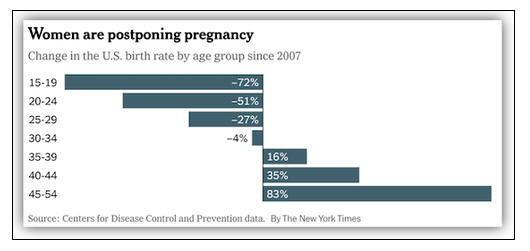
That chart looks good. It implies that women are simply having children later in life.
The article includes the following chart which tells the real story:
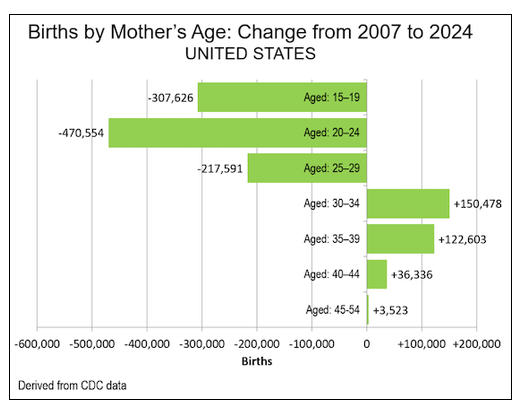
It isn’t really a surprise that a woman who has her first child at 40 is not likely to have as many children as a woman who has her first child at 25. Times have changed. Back in the 1960’s, I had a friend who had her first child at 26. The doctors considered her an ‘older mother.’
The article concludes:
Yes, women over 40 are having more children, and God bless ’em for it. But that increase obviously can’t make up for the decreasing births among women in their childbearing prime. The United States is suffering demographic decline, and it is, or should be, a serious concern.
I think most readers of the New York Times are below average in basic mathematical skills, like most Times reporters and editors. This is unfortunate in an era when data is ubiquitous and statistics are all around us. If you don’t have at least an elementary understanding of statistics, you can’t be an informed voter. And I am afraid that leaves out most of the Times readership.
Having children is a long-term responsibility. Unfortunately, I believe that many of the children raised in the past 30 years or so are not interested in taking on that responsibility.