
On Monday, The American Thinker posted an article about conspiracy theories in America.
The article includes the following meme:
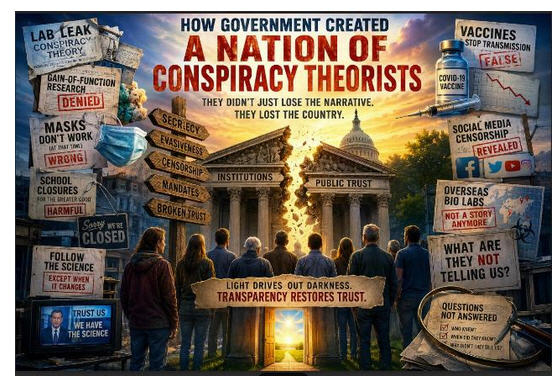
The article reports:
Five years ago, suggesting that COVID-19 may have originated in a laboratory rather than a wet market could earn someone the label “conspiracy theorist.”
Discussing vaccine injuries could result in a post being removed from social media. Questioning prolonged school closures, forced masking, or vaccine mandates often led to accusations of being “anti-science.”
Today, many of those once-forbidden discussions have become part of public debate.
That doesn’t mean every alternative theory is correct.
But it raises an important question.
What happens when institutions repeatedly assure the public that they are unquestionably right, only to revise, retreat, or quietly abandon those assurances months or years later?
The answer may be found in Rasmussen Reports’ latest survey.
Nearly half of Americans — 45 percent — now believe it is at least somewhat likely that COVID-19 was deliberately released as part of an effort to reduce the world’s population.
Pause and consider that.
Not five percent.
Not fifteen percent.
Nearly half of the country.
I am not arguing that this belief is true. I have seen no evidence that COVID was part of a deliberate depopulation plan, and the Rasmussen survey does not make that claim.
But public opinion tells us something equally important.
Americans increasingly assume the worst about the institutions that once enjoyed their confidence.
In my recent Rasmussen Reports column, I argued that the greatest casualty of COVID was trust.
The article concludes:
The real lesson of Rasmussen’s poll isn’t that nearly half of Americans believe a depopulation theory. The real lesson is that nearly half of Americans now consider such a theory plausible.
Those are not the same
Ironically, the officials who warned most loudly about “dangerous conspiracy theories” seldom paused to ask why those theories were gaining traction. People rarely abandon trusted institutions without cause.
That should alarm every physician, scientist, public health official, and elected leader across America.
Distrust doesn’t arise in a vacuum. It is cultivated when certainty supplants humility and questions are treated as threats rather than as opportunities for inquiry.
Trust is the foundation upon which modern medicine rests. Once that foundation is fractured, rebuilding it may take generations—far longer than it took to destroy it.
Please follow the link to read the entire article. Skepticism is healthy within reason, but trust is also important.