Lying With Statistics

Yesterday The Federalist posted an article about the latest unemployment numbers from the Department of Labor. There was rejoicing that the unemployment rate had dropped to 5.5 percent. You might want to hold off on that rejoicing for a bit.

The article includes a chart showing what the unemployment number actually is when you add in the labor force dropouts:

Unemployment Rate With Labor Force Dropouts March 2015

As you can see, the actual unemployment rate is closer to 10 percent. So, if you know anyone who is unemployed and can’t understand why it is so hard to find a job, show them the real numbers. It might make them feel better.

The article explains:

This decline (the decline in the labor force participation rate) has significant effects on the official unemployment rate. People who are unemployed and eventually stop looking for work are no longer counted as being part of the labor force, which means they’re no longer counted by U.S. statistical agencies as being unemployed (you can read in detail about the math underlying this dynamic here). The result? An artificially low official unemployment rate.

It is an unfortunate fact of life that you can make statistics say pretty much anything you want them to say.

Looking Behind The Obvious Numbers

The jobs report came out today. John Hinderaker at Power Line posted an article about the numbers reminding us that what we read in the media may not be the whole story.

Some of the facts he points out:

* The number of people aged 16 years and above who are not in the labor force increased by 111,000 this past month. While a somewhat lower increase than in months past, it still outpaces forecasted retirements.

* The number of people taking part-time jobs because they cannot find full-time work increased by 275,000 this past month.

* In fact, the number of people employed full-time (according to the household survey that also counts self-employed) declined by 523,000 while the number of part-time workers increased by 799,000 (which includes those who wanted part-time and those who wanted full-time but could only find part-time). These estimates are seasonally adjusted to account for the normal increase in June part-time work.

* The U-6 unemployment rate (the broadest measure of unemployment) remains virtually unchanged at 12.1 percent. U-6 includes those people who are discouraged, only occasionally trying to find work, and those employed part-time for economic reasons.

The article also reminds us that both incomes and economic growth remain flat. It seems as if the only thing growing in this economy is the Stock Market (which the government is currently propping up).

The Real Unemployment Story Under President Obama

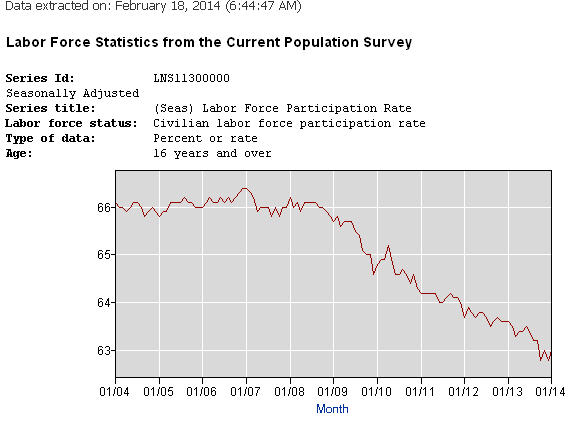
This is a chart of the labor participation rate since 2004:

The chart is from an article posted Friday at Doug Ross @ Journal. As you can see from the chart, the rate was a pretty solid 66 percent for the years 2004 through 2008. It began to drop in 2009 and has continued downward. The current low unemployment rate was obtained by not counting the people who have dropped out of the labor force.  As you can see, there have been a lot of them since 2009. The bottom line here is simple–the economy is not recovering at this time. It is limping along and will be further limited by the President’s war on coal and other environmental decisions.

Enhanced by Zemanta

About Those Unemployment Numbers

John Crudele at the New York Post has done a number of stories about fraud in the reporting of the unemployment numbers. He posted a story yesterday about the Congressional investigations into this fraud, including an investigation by the House Oversight Committee and Congress’ Joint Economic Committee. He adds that he is also investigating. He is currently waiting for the Commerce Department to comply with a Freedom of Information Act request he has filed for e-mails and text messages between people in the Philadelphia Census office.

The article reports:

At the core of all these investigations is solid evidence that at least one surveyor — a guy named Julius Buckmon, working out of the Philadelphia Census office but polling in Washington, DC — submitted fake household surveys that were used in compiling the Labor Department’s unemployment rate.

Because of the scientific nature of the Labor Department survey, Buckmon’s actions alone would have affected the responses of some 500,000 households.

But as I’ve been reporting, the scam was allegedly much larger than that and included other surveyors (or enumerators as they are called) over many years. And supervisors at least two levels up are said to have known about — and covered up — the scandal.

What the investigators are looking for is that the unemployment numbers were falsified so that they would drop just before the 2012 election. In fact, the unemployment rate did drop before the election.

This is a chart from trading economics.com:

United States Unemployment Rate

Before you get too excited over the fact that unemployment may be dropping, you need to take a look at the labor force participation rate. When people stop looking for jobs, they are no longer counted as unemployed. Therefore, as the number of people who are working drops, the unemployment rate drops. That is not the way it should be, but it is the way it is. The chart below from the Bureau of Labor Statistics shows what has happened to our labor force participation rate since 2009:

laborparticipationrate2014Regardless of whether or not there is fraud involved, our current unemployment numbers are very misleading. Please follow the link above to the New York Post to hear the rest of the story. There is a smoking gun. Unfortunately, the person in charge at the time is claiming that he never saw it.

Enhanced by Zemanta

The Numbers Behind The Numbers

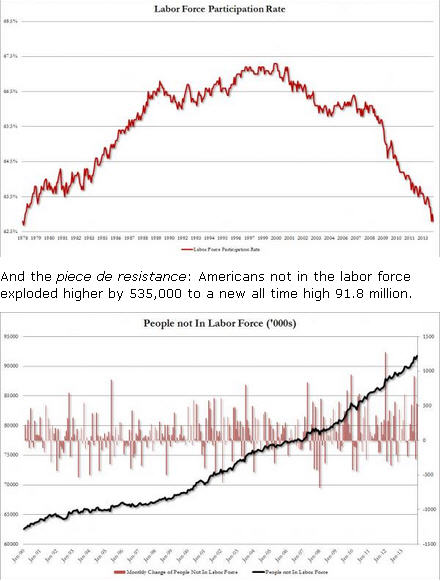
The two charts below are from a website called zerohedge.com. They were posted today. The article posted the charts to explain how the unemployment rate has gone from 7.0% to 6.7%. The unemployment situation for Americans have not improved–more Americans have given up and stopped looking for jobs. We are not in an economic recovery.

LaborForceParticipationRate


Enhanced by Zemanta

If The American Economy Is Recovering Why Do We Need To Extend Unemployment Benefits?

I am not unsympathetic to people who have lost their jobs during the recession. I know that there are a lot of them. I don’t mind paying unemployment benefits to people while they look for jobs. I just don’t understand why unemployment benefits should be paid to people for almost two years. I don’t think that encourages people to look for jobs.

The Wall Street Journal posted an editorial today about the economic impact of extended unemployment benefits. The article reminds us that according to the current unemployment numbers, the unemployment rate is 7 percent–not 10 percent rate as it was when the extension of benefits was originally passed.

The article reports:

This also ignores that states and employers are already paying for this supposed free lunch in the form of higher job-killing payroll taxes under the Federal Unemployment Tax Act, or Futa. At least 24 states have been forced to raise this tax since 2010 and the Labor Department says it will rise again in 13 states to repay $20 billion in loans and interest they owe the feds for helping to finance state-funded benefits. This federal tax is applied to 0.6% of a worker’s first $7,000 of annual wages. The rate rises automatically by 0.3% for every year states fail to repay their unemployment insurance loans from Uncle Sam.

…Economist Martin Feldstein long ago proposed a better plan to create a self-insurance component of unemployment insurance with tax dollars going into an employee trust fund for each worker that could be drawn during a bout of unemployment. Workers could keep whatever money was left over at retirement, which would encourage workers to become re-employed more quickly after losing a job.

Instead the current system provides as much as two years of benefits for not working and raises payroll taxes on employers even as some 20 million Americans are still unemployed, underemployed or discouraged from looking for work. None of this will help the economy create more jobs, which is what the jobless need far more than another government check.

The American taxpayer cannot afford to pay people not to work for extended periods of time. We are in danger of losing our work ethic. There was a time in this country when a person would take any job available rather than take money from the government. Unfortunately, we have come a long way from that time. Unemployment benefits should be paid for a long enough time period to allow a person to find a job. Two years is simply too long to pay a person for not working.

Enhanced by Zemanta

Looking Behind The Unemployment Numbers

Bloomberg.com posted a story today on the unemployment numbers released today. The unemployment rate has dropped to 8.6 percent from 9 percent. That sounds good until you realize that in order to create that unemployment number, the American labor force had to be reduced considerably.

The article reports:

The unemployment rate, derived from a separate survey of households, was forecast to hold at 9 percent. The decrease in the jobless rate reflected a 278,000 gain in employment at the same time 315,000 Americans left the labor force.

“You’d like to see the unemployment rate coming down when people are coming into the job market, not disappearing,” James Glassman, senior economist at JP Morgan Chase & Co. in New York, said in a radio interview on “Bloomberg Surveillance” with Tom Keene.

So 278,000 people got jobs, 315,000 people gave up on finding jobs, and the unemployment rate went down. Somehow I don’t think that is the way you are supposed to lower unemployment. I don’t know if all administrations cook the numbers this way, but obviously this one does. I strongly suggest that whoever the Republican presidential candidate is, we elect him. Maybe then we will get honest numbers.

Enhanced by Zemanta