We Did Avoid A Government Shutdown

The Hill posted a fairly good summary of the budget deal reached in Congress that will prevent a government shutdown. The Congress has actually agreed on something. Now the bill goes back to the House of Representatives for final approval and the President has to approve it in order for it to become law.

The payroll tax cut was extended for two months. That means that we will have to sit through all the posturing and name calling again in about six to eight weeks. Yuck. The bill includes a provision to expedite the construction of the Keystone Pipeline. The bill does not extend some of the business tax breaks–this will not be good for the growth of the economy–there is no such thing as a corporate tax–all corporate taxes are paid by the consumer.

The Hill reports:

The bill now awaits approval next week by the House of Representatives. Senate aides expect House Speaker John Boehner (R-Ohio) to agree to the proposal but he will not do so formally until he has had a chance to consult with members of the House GOP caucus.

The thing to remember here is that all these last minute theatrics are caused by the fact that the Senate has not approved a budget since President Obama took office (even during the two years he controlled the House and the Senate), so there are no spending guidelines in place. What we need is for Congress to actually pass a budget that they will have to follow. That would help make Washington a saner place.


Enhanced by Zemanta

Why We Need New Republican Leadership

CNS News reported yesterday:

House Speaker John Boehner (R-Ohio) and House Majority Leader Eric Cantor (R-Va,) were not among the 72 House Republicans who signed a letter to the Joint Select Committee on Deficit Reduction–the so-called “Supercommittee”–asking the committee not to call for increasing taxes.

This is a chart from USGovernmentSpending.com which shows where the budget problem is:

It shows a dramatic rise in government spending as a percentage of the gross domestic product since about 2006 (when the Democrats took over the House of Representatives–the branch of government that controls the purse strings). Until the spending is brought down to the traditional 18 to 20 percent of the gross domestic product, we will continue to borrow (from China) 40 cents of every dollar we spend. Eventually, we will go bankrupt.

The problem is not low taxes–it is out of control spending. If the Republican leadership does not realize that, we need new Republican leadership.


Enhanced by Zemanta

Would It Help To Require The Super Committee To Be Transparent ?

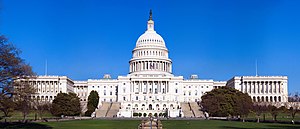
The western front of the United States Capitol...

Image via Wikipedia

One of the complaints of the voters in the last election was that Washington operates behind closed doors. There has been a lot a legislation passed by Congress in recent years that was not easily understood by the American people or that the American people were not given a chance to voice their opinion on. As Nancy Pelosi famously stated about the healthcare bill, “We have to pass the bill so you can find out what’s in it.” I wonder if even Congress had any idea what they were voting on.

Now we are faced with the same sort of situation with the super committee. Yesterday’s Washington Examiner posted an editorial suggesting that the negotiations be made public and the final product could be amended in the House and Senate rather than just voted on. Obviously these conditions are not in accordance with the original agreement, which I believe was the result of a lack of courage on the part of Congress. The editorial points out that Speaker of the House Boehner agreed to the secrecy despite having promised “the days of quickly ramming massive bills through Congress — such as the ‘stimulus’ that didn’t work and the job-killing national energy tax — are over. Under the new rules, the House will post all bills online at least three calendar days before a vote, giving lawmakers, the public and the media a chance to read each proposal and understand its impact.” 

The editorial concludes:

As the Sunlight Foundation said in a recent memo on the issue, “it doesn’t have to be this way. Super Committee members still have the opportunity to redeem some measure of integrity by letting the public in on their legislation by posting their final recommendations online 72 hours before their vote. There is even a bill — the Deficit Committee Transparency Act (HR 2860) — that would require that. But, as of yet, members of Congress have shown little appetite for mandating Super Committee transparency.”

There is always the temptation to appoint a select group of “experts,” give them extraordinary powers, and shield them from public pressure in the hope they will objectively produce a reasonable solution to a vexing problem. That temptation should always be resisted, particularly in a democratic republic. There is still time for Congress to do the right thing on the supercommittee’s transparency.

I am not sure that the super committee will actually produce a bill. Generally speaking, the members of the committee are not acting independently–they are under the control of their respective political parties. It is Washington–politics is king–party politics is more important than the well being of America. There is also the issue of the philosophical divide between the two parties–the Democrats believe that the deficit is the result of taxes that are too low and the Republicans believe that the deficit is the result of spending that is too high. Until that issue is resolved, we will have gridlock.

Enhanced by Zemanta

Government Regulation And Jobs

John Boehner

Image via Wikipedia

On Tuesday, Fox News posted an article detailing some of the current discussions on government regulations and their impact on jobs.

Representative John Boehner has asked the Obama Administration for a list of all pending and planned regulations with a projected impact on our economy in excess of $1 billion. This request comes at the same time President Obama is claiming that he is planning to save the government money by cutting regulations.

The article reports:

President Obama replied Tuesday with a list of seven proposed rules with an estimated economic impact of over $1 billion. The various proposed regulations apply to the Environmental Protection Agency and Department of Transportation, ranging in rough costs from $1 billion for DOT hours of service regulations, to as much as $90 billion for ozone air standards.

Boehner’s office answered Obama’s letter with a statement Tuesday afternoon bashing the seven regulations.

“The combined cost of these seven new regulatory actions alone could be more than $100 billion,” the statement read. “These costs will be felt by the American people in the form of fewer jobs and slower economic growth.”

The amount of savings President Obama has called for in the reduction of federal regulations is $10 billion over 5 years. Seems a little unbalanced to me.

When the House of Representatives reconvenes this month, it is expected to examine the impact of regulations on employment and propose legislation to free small businesses from excessive regulation, allowing the businesses to grow and to hire new employees.

Read more: http://politics.blogs.foxnews.com/2011/08/30/obama-and-boehner-square-government-regulation#ixzz1Wonnmfm0

Enhanced by Zemanta